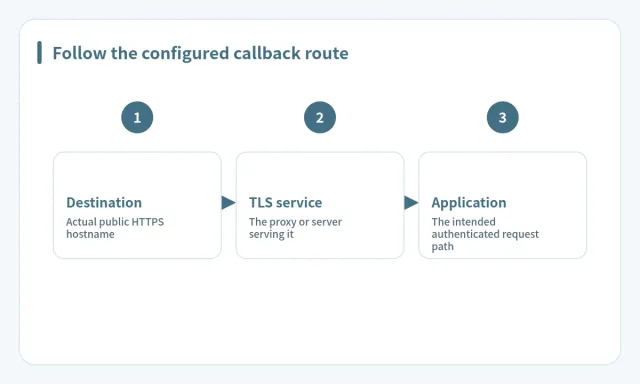
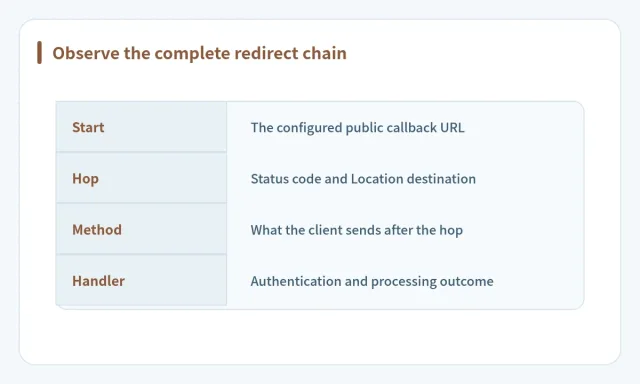
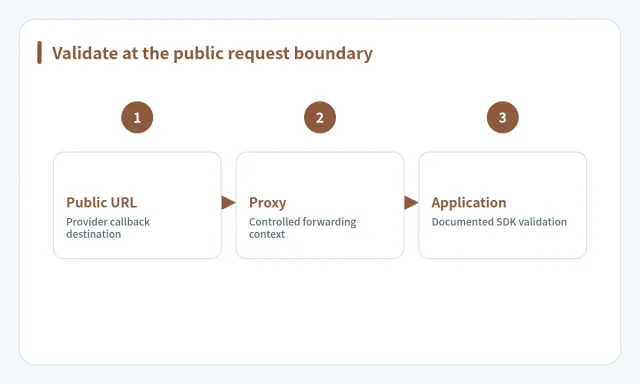
Locate the layer rejecting a callback, then check the exact sending service’s official source-address policy. One address observed in a packet capture is not a complete long-term allowlist.
Locate the rejection before widening access
An edge security service, cloud firewall, reverse proxy and application can each reject a request. Compare the provider’s request time and response record with your rule-hit and access logs. An application parser is not the first suspect when the request never reached it. Conversely, a signature failure after connection is a different problem from a network deny.
Collect the timestamp, target host, path, rule identifier and outcome. Avoid putting live codes, credentials or full private payloads into ordinary tickets. Use an authorised harmless test and make one identifiable rule change at a time, so a changed outcome can be tied to a changed condition.
Match the address policy to the product
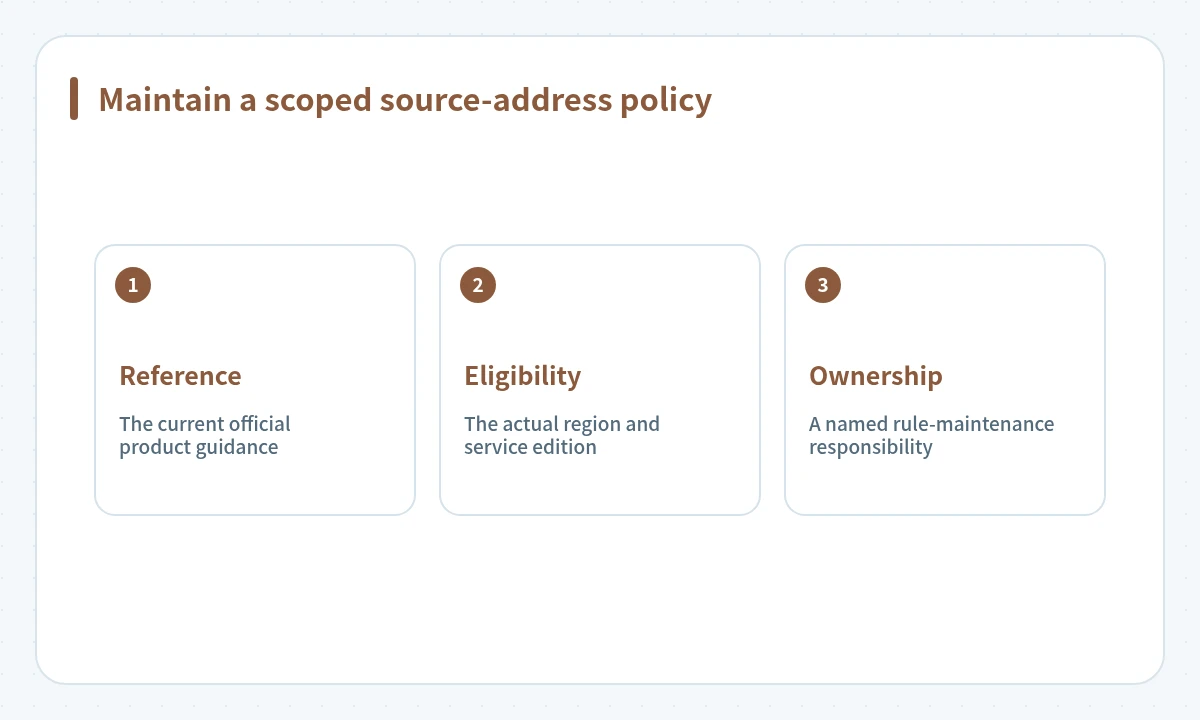
Official ranges can differ by product, region or service edition. A fixed-egress feature may require a particular subscription. Twilio’s Static Proxy documentation is an example with explicit eligibility and scope; it should not be treated as an address list for every Twilio integration, much less for another provider.
| Allowlist record | Why retain it? |
|---|---|
| Official reference | Find current scope and updates |
| Product and region | Avoid using a different traffic path’s policy |
| Review date | Recheck during documented changes |
| Responsible owner | Ensure updates have someone to act on them |
Do not freeze a copied address list indefinitely. Use the provider’s maintained reference and change process. A successful connection from one allowed address is evidence about that request, not proof that every legitimate future callback will use it.
Distinguish an outbound allow rule on your own server from an inbound rule admitting provider callbacks. The directions serve different connections, and changing the former will not necessarily affect the latter. Give rules descriptive names that identify direction and service so the next review does not depend on the original operator’s memory.
Network filtering and request verification have separate jobs
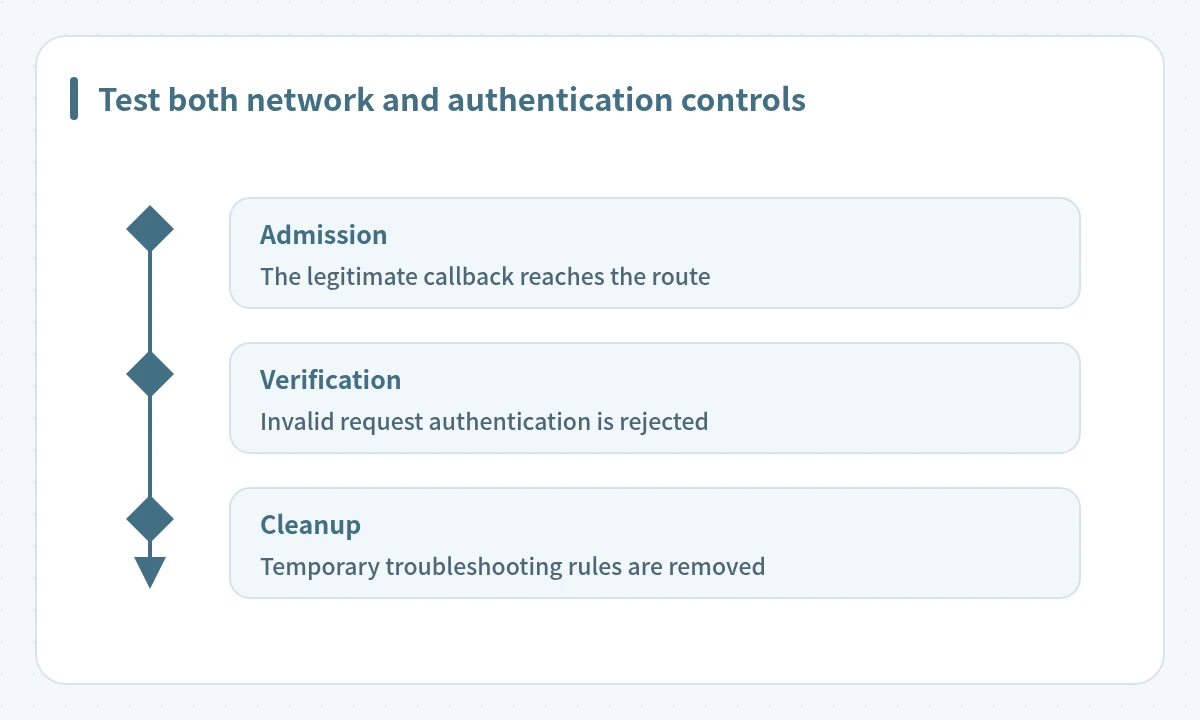
Allowlisting limits network admission; provider-defined request verification checks the request according to its authentication contract. Passing one control does not show that the other ran. Keep signature verification in place where required, and observe it independently when diagnosing the network rule.
Behind a proxy, the application’s direct peer can be your own infrastructure. Interpret forwarded address headers only through a correctly configured trusted-proxy arrangement. An arbitrary caller supplying a familiar-looking header must not acquire the authority of a trusted source.
Acceptance should exercise a legitimate callback, the intended rejection of an unexpected source and continued rejection of invalid authentication. Confirm that the accepted request produced the expected business outcome. Finally, remove temporary diagnostic exceptions and record the effective rules, rather than leaving a broad troubleshooting allowance as the unnoticed production policy.
References: Twilio: Static Proxy eligibility and maintained addresses; Twilio: request security.