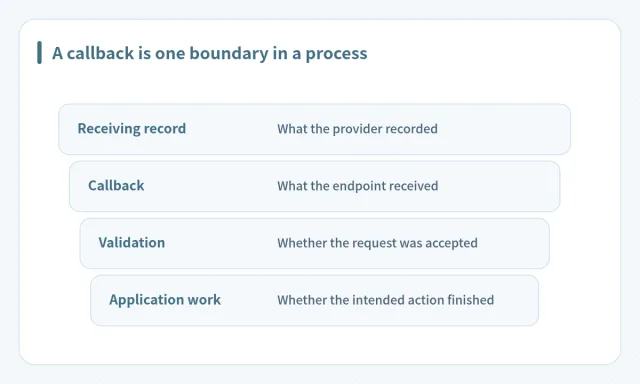
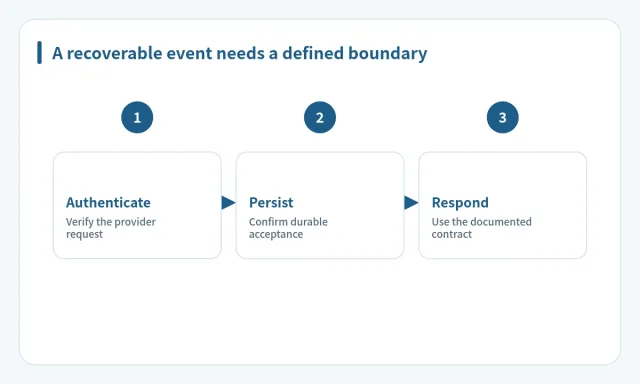
A primary callback timing out may already have stored the event or performed an action. Check the fallback trigger rules and make both paths recognise the same logical event.
Define what triggers the fallback
Providers can treat connection failures, response timeouts, error responses and instruction failures differently. Twilio’s reliability documentation describes a fallback-URL feature for incoming numbers. For the actual integration, check the applicable trigger, method and request parameters instead of treating that feature as a universal messaging standard.
During an incident, correlate the provider’s request record with both application logs. Establish which handler received which attempt and how far each progressed. An access-log entry does not prove a committed database operation, just as a missing response does not prove the operation never happened.
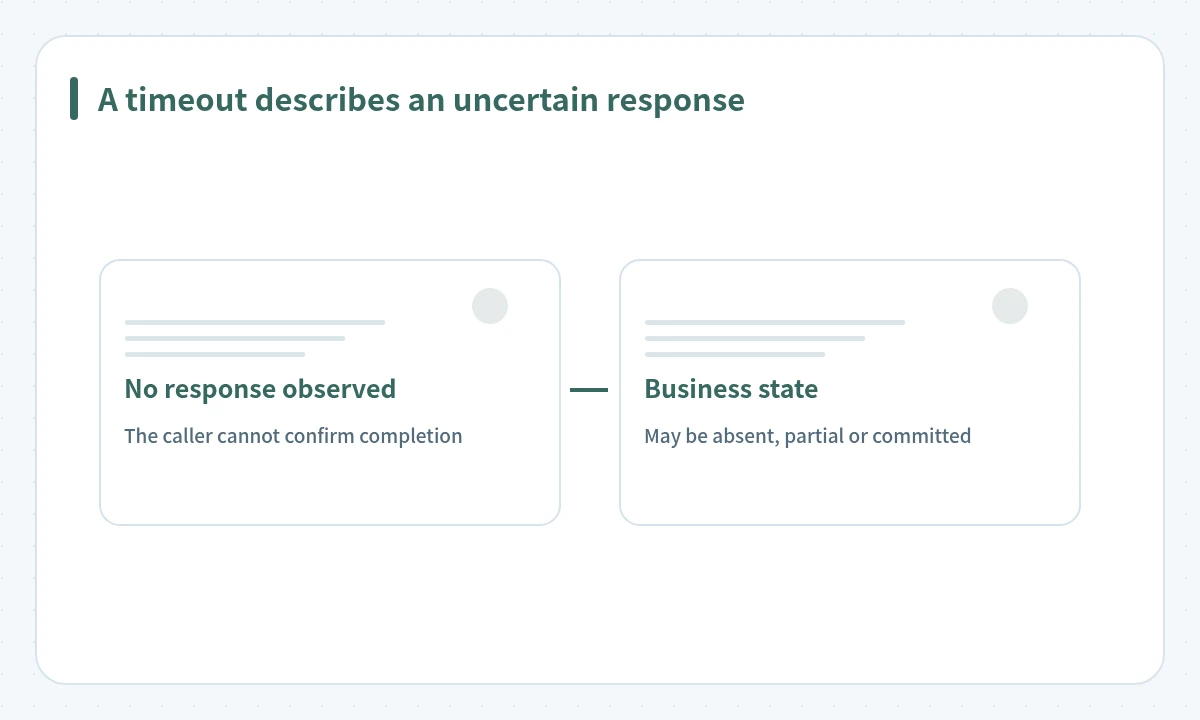
Coordinate the business state, not just server responses
| Primary progress | Fallback concern |
|---|---|
| Request never reached it | Authenticate and accept the event normally |
| Work still in progress | Coordinate concurrent attempts |
| Work committed, response lost | Recognise completion without repeating the effect |
| Only part of the work completed | Resume according to an explicit recovery rule |
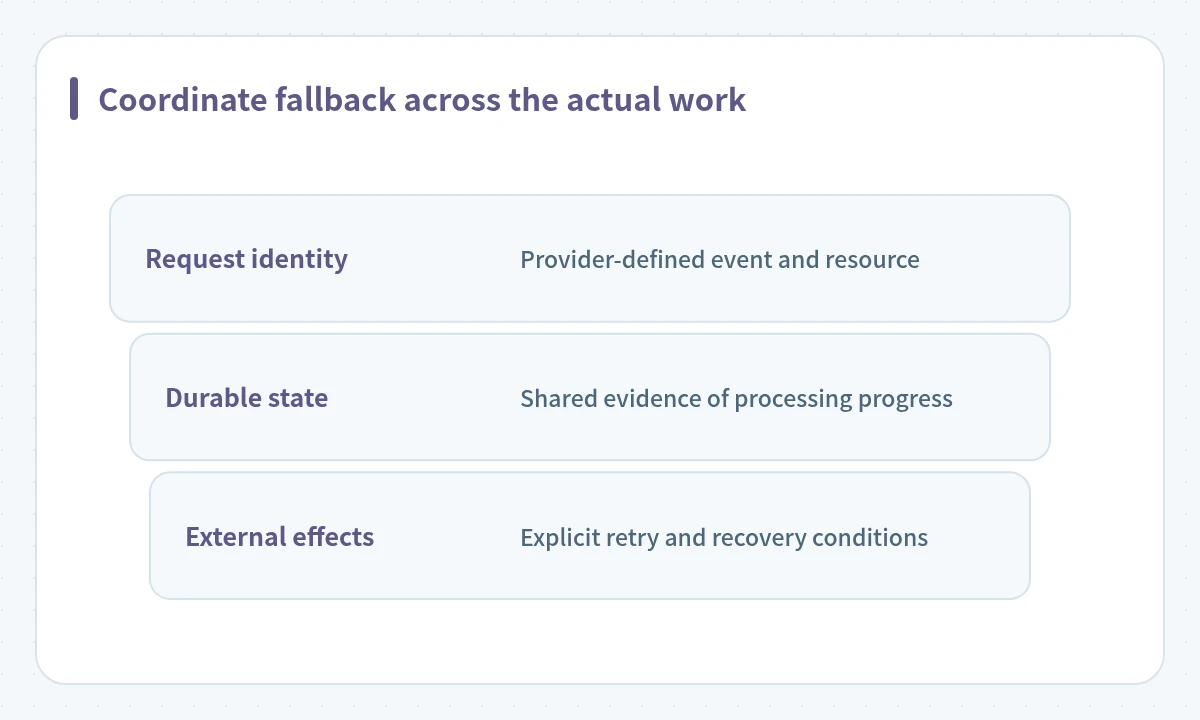
Use the documented event or message identity together with the required account and action scope. A different hostname does not make the same event a new task. Conversely, matching text is not enough to establish identity. If each server maintains an unrelated local completion flag, neither may know that the other already acted.
Separate durable acceptance from downstream effects. Saving a receiving marker should not automatically claim that every later external operation finished. Each consequential step needs its own supported idempotency or recovery arrangement so partial completion can be understood rather than blindly repeated.
A shared processing-state dependency has its own availability requirements. If both handlers lose access to it, the fallback should not simply ignore that uncertainty and execute anyway. Define the permitted acceptance or failure behaviour and make the unresolved state visible instead of trading a state-store outage for duplicate external actions.
Exercise the failure points deliberately
Use authorised harmless fixtures for failure before processing, interruption after storage and an unavailable fallback. Inspect the resulting records and action counts. Traffic appearing at the backup endpoint is useful evidence of routing, but it is not enough to establish correct business recovery.
If a test requires fault injection, isolate it from real customer traffic and specify the stop condition. Keep enough identifiers to reconcile the result without retaining private message bodies. Record which failures were actually exercised and which behaviours remain dependent on the provider’s documented guarantees.
The fallback environment needs maintained credentials, permissions and monitoring too. When the primary returns, define how normal routing resumes and who owns unresolved tasks. A second URL that nobody validates can leave the system with two unknown paths instead of one.
Keep the acceptance claim narrow: the tested failure cases produced the expected authorised outcomes. Do not turn the existence of fallback configuration into a promise that every possible outage will avoid lost or duplicate work.
Reference: Twilio: fallback URLs and reliability.