Where a provider supports inbound webhooks, trace the event through the receiving record, endpoint and application result. A successful callback boundary does not prove downstream work completed.
Identify the event before connecting a handler
Providers can use callbacks for different purposes. Twilio's messaging webhook documentation, for example, distinguishes an incoming-message webhook from an outbound-message status callback. A delivery status for a message your application sent is not evidence that a new inbound message arrived.
Read the chosen provider's own event definition, resource scope and payload fields. Establish which authorised number the configuration covers and whether it is intended for a test or production environment. Do not assume that a web inbox, a phone number rental or an API key automatically includes every integration capability.
Give each stage its own evidence
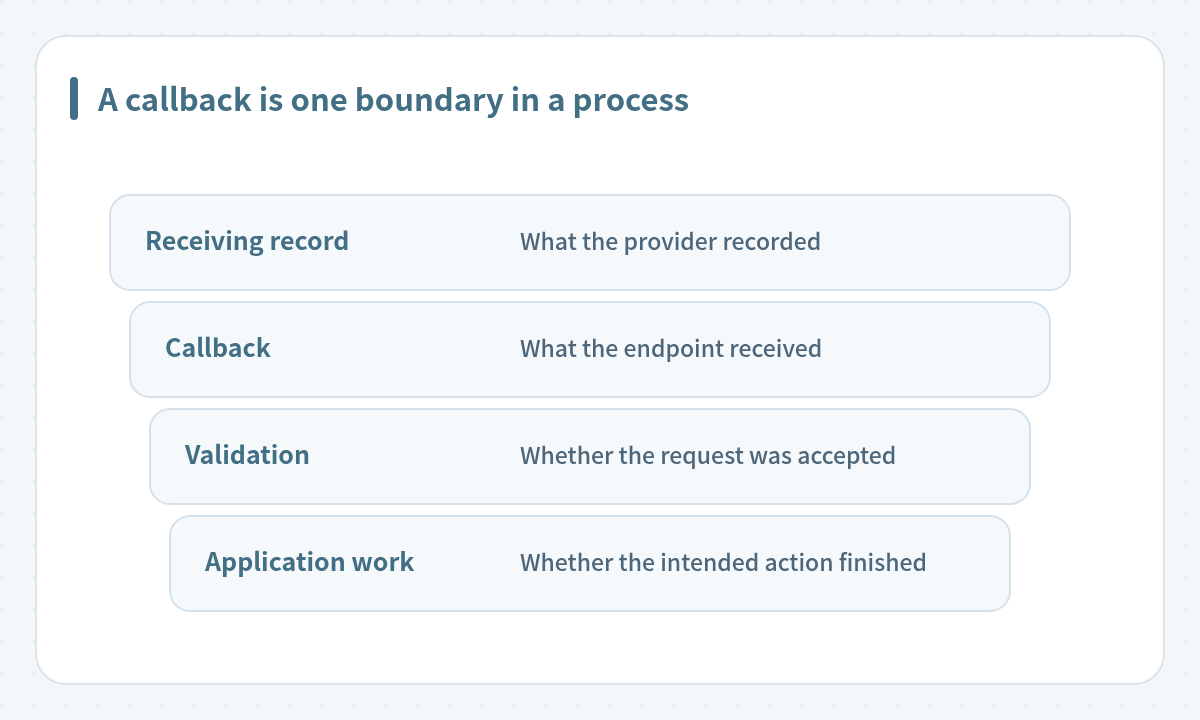
The receiving service may have a message record. Your endpoint may then receive a callback. The application needs to validate the request, interpret the documented fields and perform whatever authorised action is required. A success response from one boundary should describe that boundary; it should not be stretched into proof of all later steps.
For instance, an endpoint can acknowledge an accepted event for queued processing before a downstream task completes. If that is your design, record the accepted event and the later processing outcome separately. If processing fails, an earlier successful web response cannot be used as the business completion record.
Authenticate callbacks using the provider's documented mechanism. Twilio's webhook security guidance covers secure transport and request validation for its service. It is an example of provider-specific requirements, not a recipe to transplant unchanged into another product.
Protect message contents in logs. Technical traces usually need a stable reference, stage and outcome rather than a full verification code. Set access and retention for the diagnostic material deliberately; sending every body into general application logs creates another place to manage sensitive information.
Give repeated events a defined business outcome
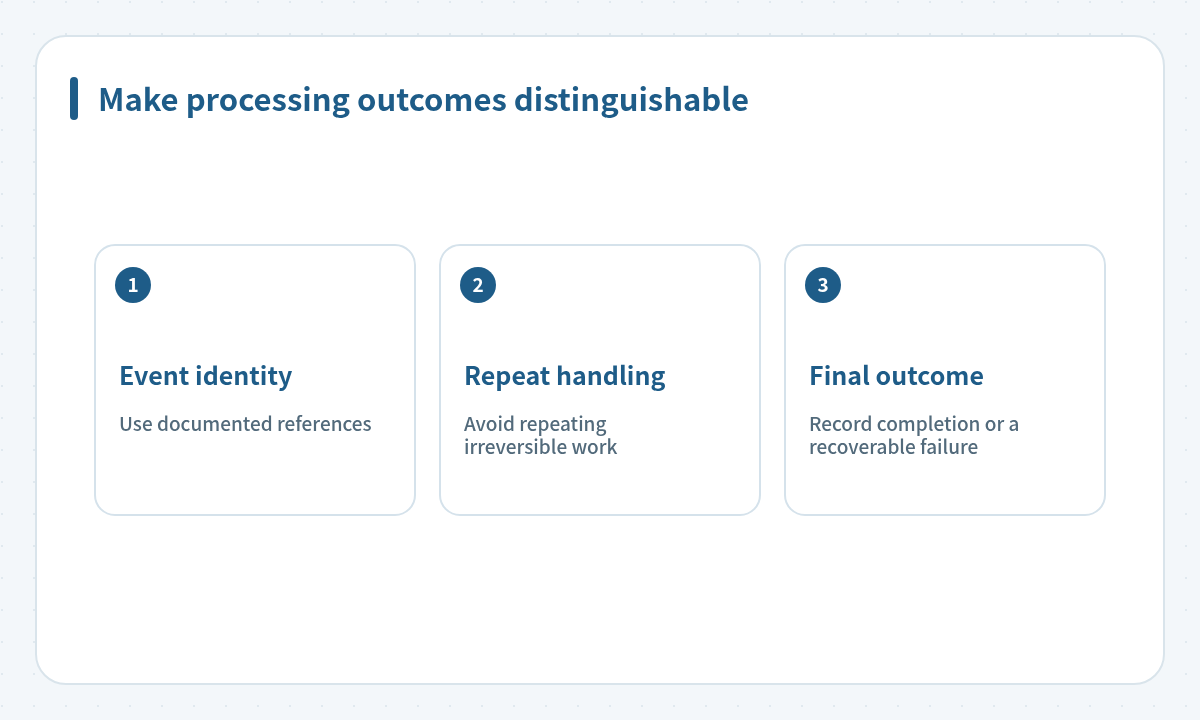
Use the provider’s documented event identity and a recorded processing state so a permitted repeat callback does not repeat an irreversible action. Equal message text alone is not a reliable event identity.
Test a controlled failure using harmless authorised data. Record transport, validation and processing outcomes separately, and return the response required by that callback contract rather than assuming every provider accepts the same acknowledgement.
Design retries around the documented event identity
Read the actual retry policy before relying on repeated delivery. Do not assume callbacks are always unique, ordered or retried forever. Where retries are possible, arrange processing so that a repeat notification does not repeat an irreversible action. Use the provider's documented event identity and your own recorded processing state, rather than treating equal message text as proof of duplication.
Return the response expected for the particular callback type. Some systems expect a specific response body or status behaviour; “any 200 response is enough” is not a universal rule. If you need to acknowledge before processing, confirm that this design fits the documented contract and gives failed work a clear recovery route.
Test with an authorised non-sensitive message and follow it through the receiving record, callback trace, validation result and application outcome. Include a controlled failure case so that the team can tell whether a problem belongs to transport, validation or later processing. A test event supplied by a console may verify part of the route without proving real inbound delivery.