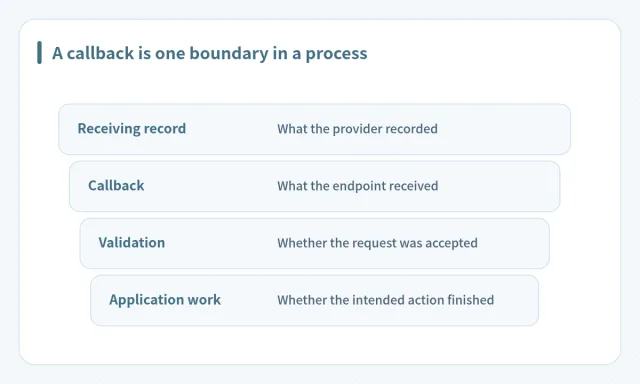
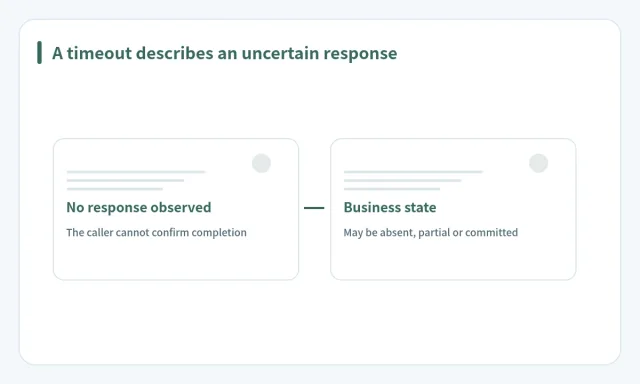
When an informational webhook contract treats success as acceptance, acknowledge after the authenticated event reaches recoverable storage. Starting an in-memory task alone does not establish that downstream work will survive a process failure.
This is an integration design question. Some webhooks also request instructions in a particular response format. Twilio’s webhook overview distinguishes informational notifications from instruction-seeking callbacks, including inbound messaging flows. Follow the endpoint’s actual response contract rather than replying with an arbitrary empty success to every event.
Define what accepted means in your system
A practical acceptance boundary is a confirmed durable record or a queue entry whose persistence guarantees match the task. Calling a background function is not the same thing. If the process exits immediately after the response, the work still needs a recoverable place from which to resume.
Validate the request before accepting its content as a trusted event. Then retain only the fields required for the authorised workflow, using the appropriate protection and retention policy. Do not solve reliability by copying entire private messages into every diagnostic log.
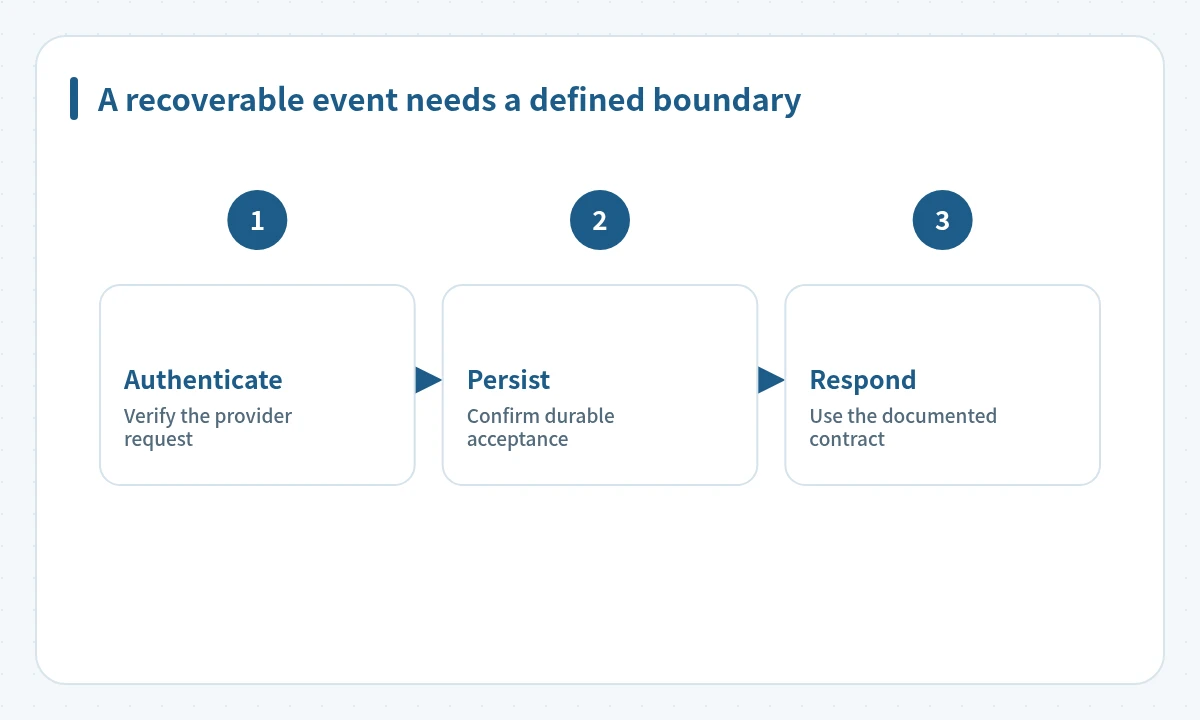
| Stage | What to establish |
|---|---|
| Authentication | The request passes the provider’s verification procedure |
| Durable acceptance | The required event data has a confirmed recoverable location |
| Acknowledgement | The required response is sent within the provider’s constraints |
| Processing | The application records completion or a recoverable failure |
Design for uncertain response delivery
The sender may retry if it does not observe the acknowledgement, even when your system stored the event. Store and compare the documented event identity at the appropriate boundary. An idempotent processing strategy should avoid repeating an irreversible action while still allowing recovery from unfinished work.
Do not equate duplicate receipt with duplicate completion. Several authenticated deliveries can refer to one logical event, while a single receipt can still fail during processing. Keep those observations separate in metrics and incident records.
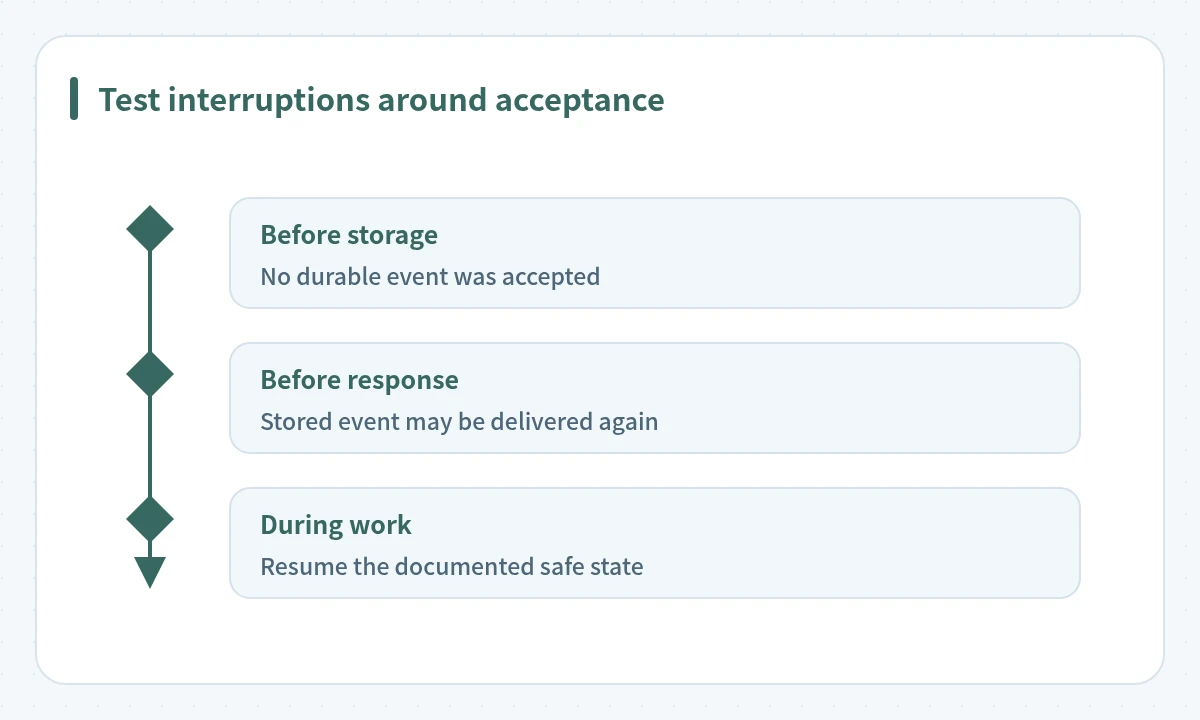
Test the uncomfortable interruption points
Use controlled fixtures to stop the process before persistence, after persistence but before response, and during downstream processing. Inspect the stored state and the supported replay behaviour at each point. These are deliberate resilience tests, not fabricated examples of a provider outage.
A queue becoming unavailable also needs an explicit outcome. If your chosen acceptance boundary was not reached, avoid claiming the event was safely accepted. The provider’s retry and fallback rules determine how a failure response is handled; verify them rather than assuming indefinite automatic redelivery.
For operations, make the stuck state visible. Someone should be able to identify an accepted event that has not completed, determine which safe recovery action is available and record the outcome. A silent queue backlog can otherwise sit behind a perfectly healthy-looking HTTP success rate.
The result is a clearer promise: acknowledged events have crossed a defined, recoverable boundary. Completion remains a separate application result, with its own evidence and recovery procedure.
Reference: Twilio: webhook types and response roles.