Repeated callback parameter names need an explicit parsing rule. Check whether a field permits multiple values and whether signature verification and business processing interpret the request consistently.
Multiple values are not always an error
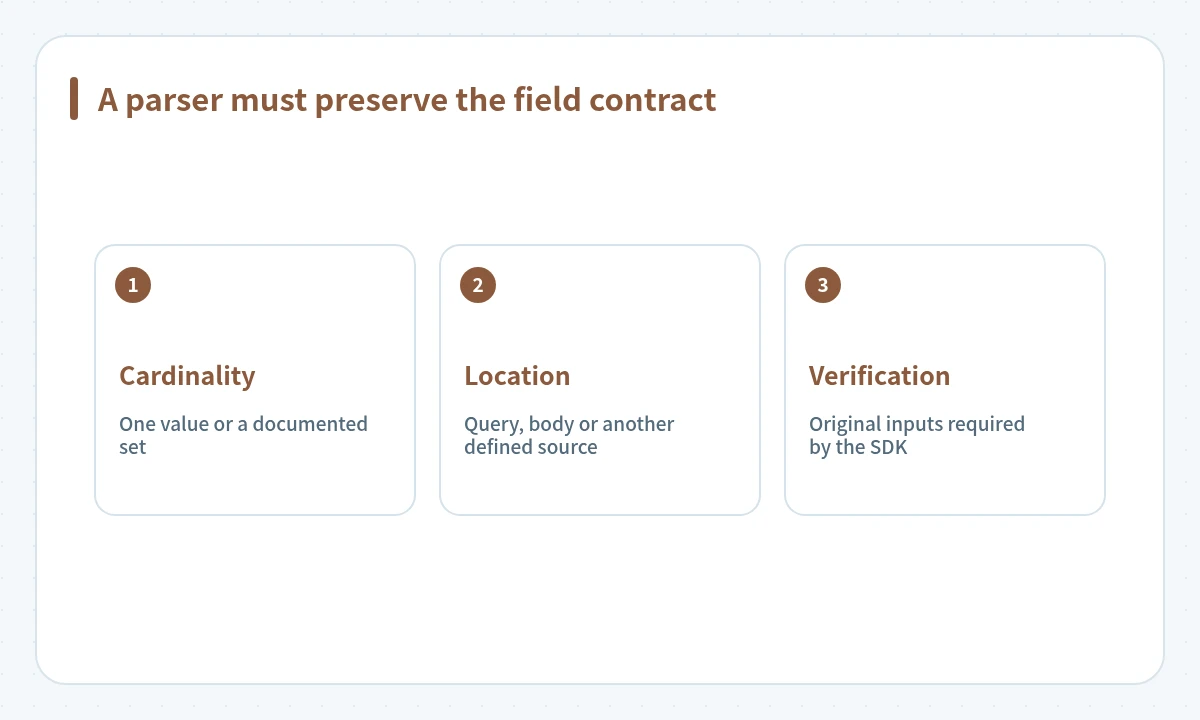
A query can intentionally allow several filter values. An event identifier or resource-identity field may instead have a documented single-value requirement. The contract determines that distinction; a convenient framework helper does not establish it.
MDN’s URLSearchParams documentation includes getAll for retrieving every value associated with a name. That illustrates why an interface exposing one value is not proof that the original input contained only one. A server framework can have different parsing behaviour and must be checked separately.
Make each accepted representation explicit
| Contract | Defined handling |
|---|---|
| Single value only | Reject or explicitly handle repetition according to the protocol |
| Multiple values permitted | Retain the full set and its documented interpretation |
| Same name in query and body | Use the documented source, not hidden precedence |
| Undocumented case | Clarify the contract before broadening acceptance |
Keep the provider verifier’s required original inputs. Deduplicating, sorting or rewriting parameters before verification can replace the actual request with a different representation. Follow the official SDK’s instructions rather than adapting the data until a hand-written check succeeds.
Verification does not replace business-schema validation. A request still needs the required account, resource and event fields interpreted under the agreed rules. Likewise, plausible-looking field values are no reason to skip authentication. Observe these outcomes separately so the operator can distinguish malformed input from a failed identity check.
Identical repeated values still need the documented policy. Silently accepting them because they happen to match can leave different behaviour for a later mismatch, or hide an upstream client defect. Make the chosen rule testable for both matching and conflicting repetitions rather than improvising a decision for each incident.
Test through the real request stack
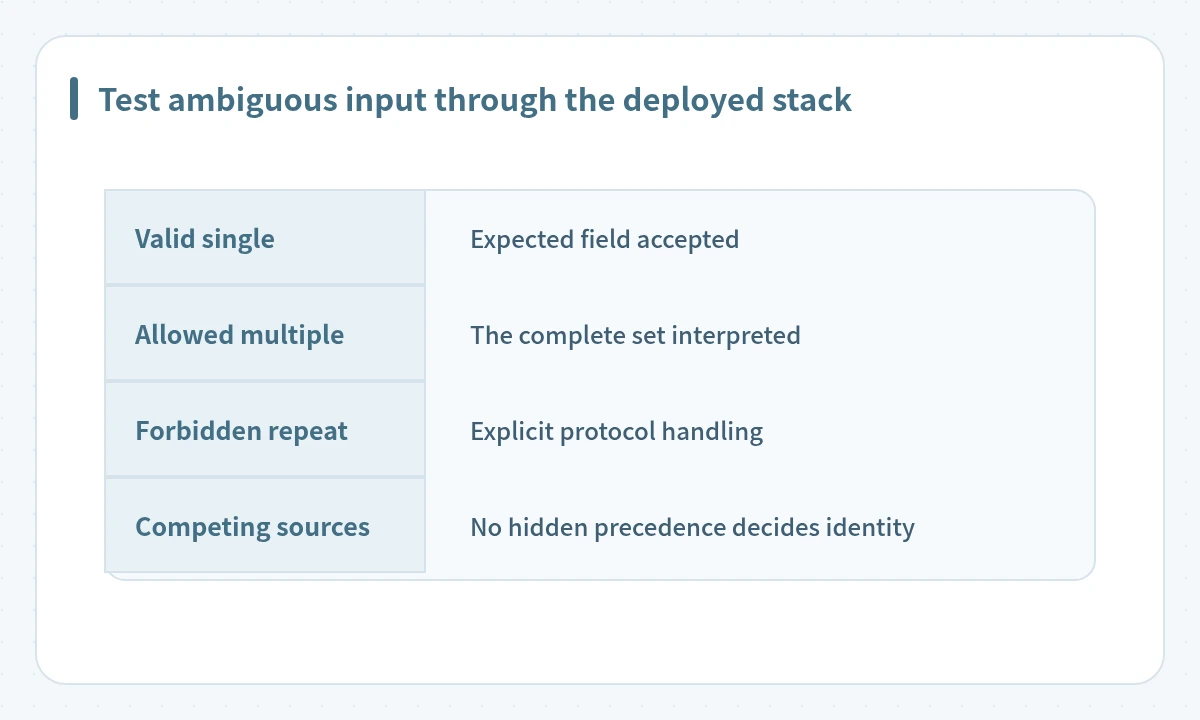
Build harmless fixtures for a valid single value, an allowed multi-value field, forbidden repetition, empty values and competing input locations. Send them through the controlled equivalent of the deployed proxy and framework path. A standalone string-parser demonstration cannot establish what the final route receives after middleware has run.
Log the structural issue, field name and correlation identifier without exposing a real message or active code. The useful diagnostic is which contract failed, not a full reproduction of private contents in every access log.
Include these fixtures when upgrading the SDK, proxy or request middleware. A library change can alter how repeated input is represented even if the application code is untouched. Keep the expected interpretation tied to the current event contract and version.
When the provider changes its structure, document the supported transition deliberately. Avoid leaving old and new handlers to depend on different implicit precedence rules. An explicit acceptance or rejection result makes the integration maintainable without teaching operators to guess which duplicate value happened to win.
Reference: MDN: reading all values for a query parameter.