
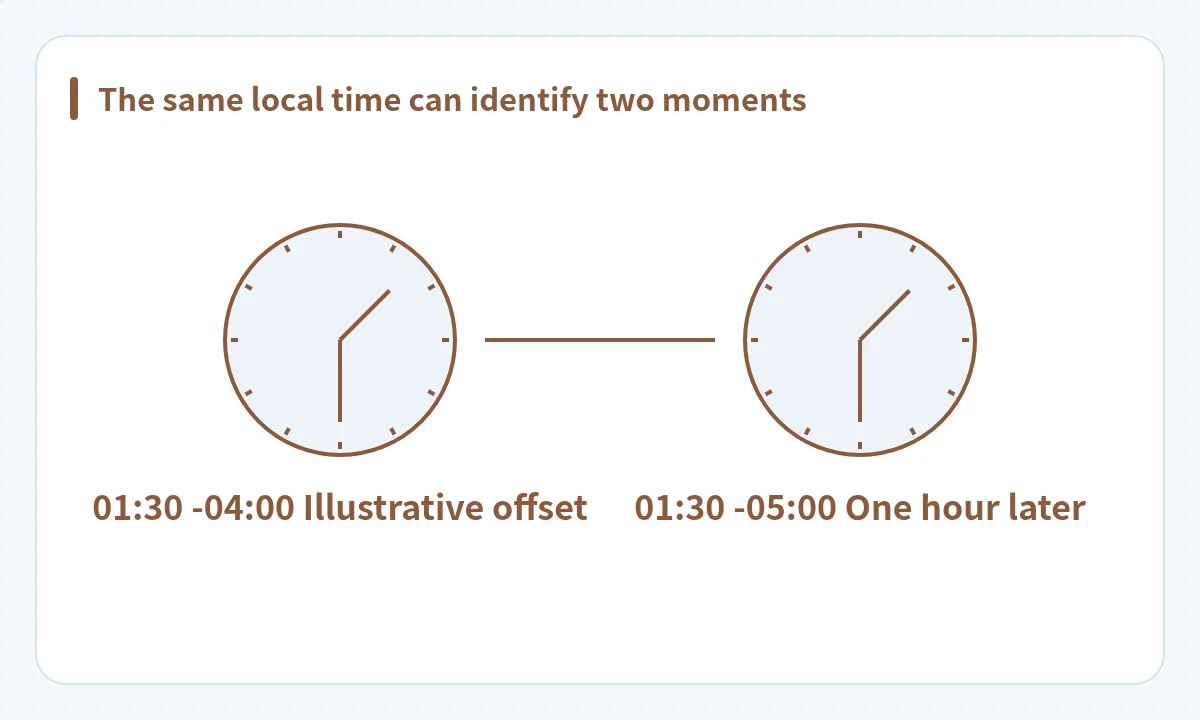
Two records can show the same local clock time while referring to different moments during a daylight-saving rollback. Compare the full date, offset and record identity before treating them as duplicates.
The displayed hour is not a complete timestamp
As an illustration, 01:30 with an offset of minus four hours and 01:30 with an offset of minus five hours identify moments one hour apart on the same date. The example demonstrates offset arithmetic; it does not specify a real provider’s display format or a particular region’s transition date.
A timestamp with a date, time and UTC offset provides more information than a bare clock value. RFC 3339 documents an internet timestamp format with offsets. An interface that omits the offset may be easier to scan, but it can hide the distinction needed to reconstruct an event sequence.
Find out which timestamp the field represents
A message can have an originating event time, a provider receipt time and a local display conversion. Do not combine them simply because they all look like dates. Read the API or export field definitions, then compare the same kind of timestamp across records.
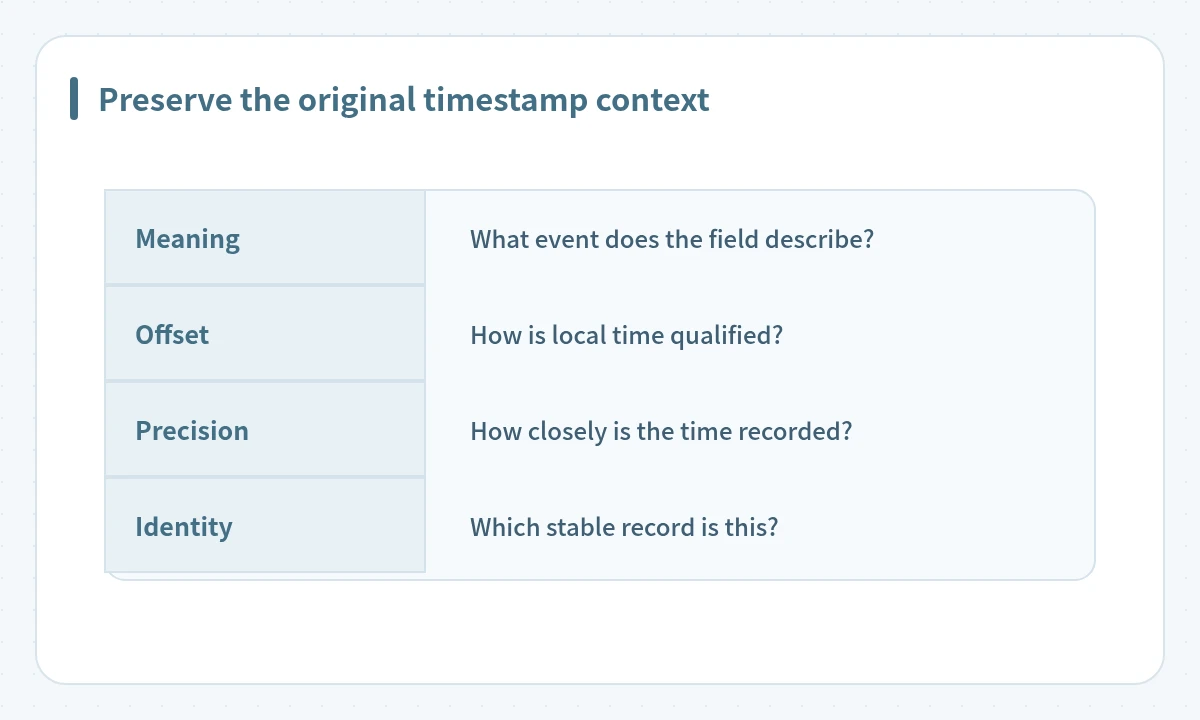
| Field property | Question to resolve |
|---|---|
| Meaning | Sending event, receipt or another operation? |
| Representation | UTC, an explicit offset or local display? |
| Precision | Seconds, milliseconds or rounded minutes? |
| Identity | Which stable identifier belongs to the record? |
Even full timestamps need not be unique. Two messages can share a recorded time at the field’s precision. Use stable record identifiers to determine identity, and retain the original values rather than inventing extra precision to make sorting look tidy.
Build the timeline without rewriting the evidence
For analysis, make a working copy with a clearly labelled UTC conversion while preserving the original timestamp and offset. Verify that the parser understands the format and treats the offset correctly. Avoid importing ambiguous local strings into a spreadsheet and accepting its automatic guess as the source truth.
If a field has no offset or documented time zone, ask the provider before making a precise conversion. The reader’s current laptop time zone is not a reliable substitute for the zone used when the record was created. A phone prefix is also insufficient evidence of the correct clock setting.
For software tests, use synthetic records on both sides of a documented transition and give them distinct identifiers. Check sorting, date filtering and export output. These fixtures should be labelled as test data and should contain no real codes or customer details.
IANA maintains time-zone data as rules change. Applications and operating systems may need updated data to perform conversions correctly. When a discrepancy appears, record the original values and software context so a maintainer can distinguish a display conversion issue from an actual message timing issue.
References: RFC 3339: internet timestamps; IANA: time-zone database.
