
A regional holiday message needs a reason to contact the recipient, not an assumption about their identity. A simple web phone number does not reveal religion, nationality or a family’s holiday plans. Verify the relevant language and dates before using a greeting as part of a business notification.
Start with the practical reason for contact
Ask what the reader needs to know or do. Revised support hours, delivery arrangements and appointment availability can be stated directly. If removing the holiday wording leaves no relevant information, reconsider whether the contact is needed at all.
A neutral operational note can be more appropriate than a culturally specific greeting when the context is unknown. Do not infer observance from a name or language preference. Someone choosing an interface language has not supplied a complete cultural profile.
Use the business’s actual contact preferences and authorised audience. A holiday is not a separate justification to send to everyone whose number is available. Keep the decision about contact scope with the responsible operation.
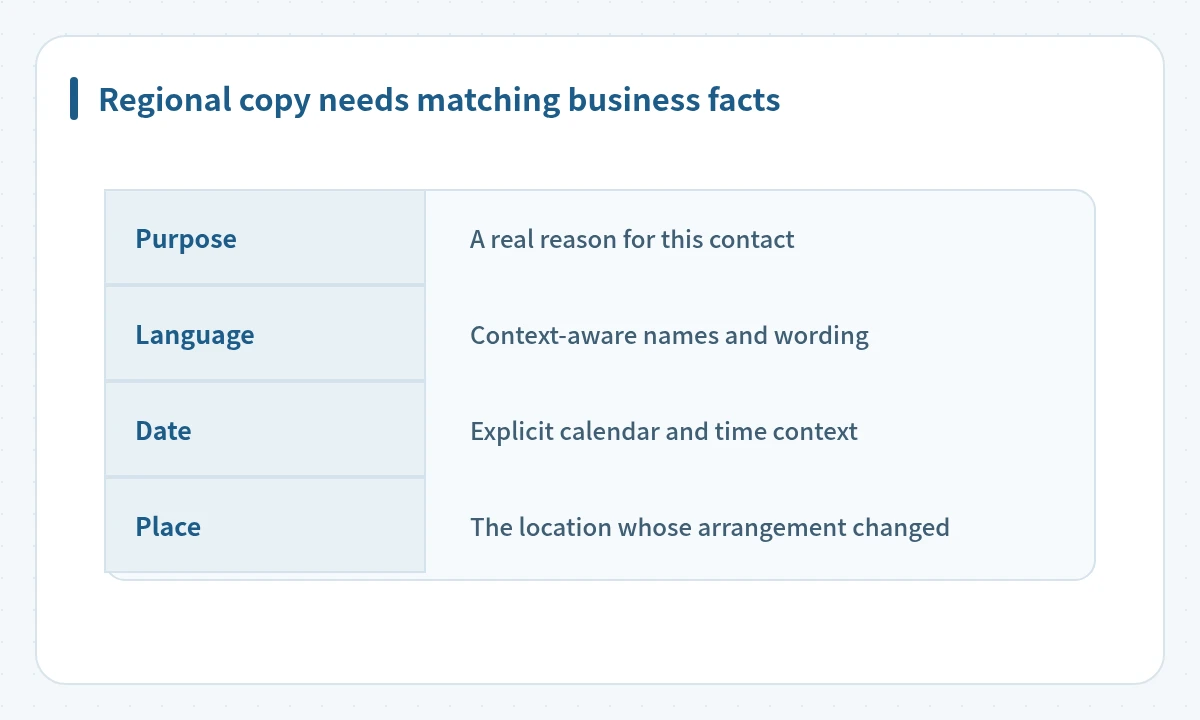
Check names, dates and language together
Have a reader familiar with the relevant context review the holiday name, form of address and wording. Translation need not be word-for-word, but it should preserve the actual business conditions. One version should not describe a single day while another implies an entire week.
Date formats can introduce a separate ambiguity. Use an explicit format appropriate to the audience and include a time zone where the operational arrangement needs it. Keep the original business dates with the approved versions so later edits can be checked.
Do not fill an unverified language slot with a generic global template merely to complete a calendar. Leaving that audience out of an optional campaign can be preferable to sending an inaccurate or irrelevant message.
Put the arrangement ahead of decoration
If opening hours change, make the affected service, dates and next step easy to find. A long greeting should not hide that a support queue or collection point is unavailable. Likewise, a delivery note should not imply that every order in a region is delayed unless operations confirms it.
Avoid adding unrelated offers at the end of an otherwise necessary notice. That changes its purpose and can make the reader unsure whether the operational information or promotion is the real reason for contact.
If several locations share a brand, identify which location’s hours the notice describes. A regional greeting should not obscure that one collection point is closed while another continues normally. Keep that location reference consistent in the message and destination.
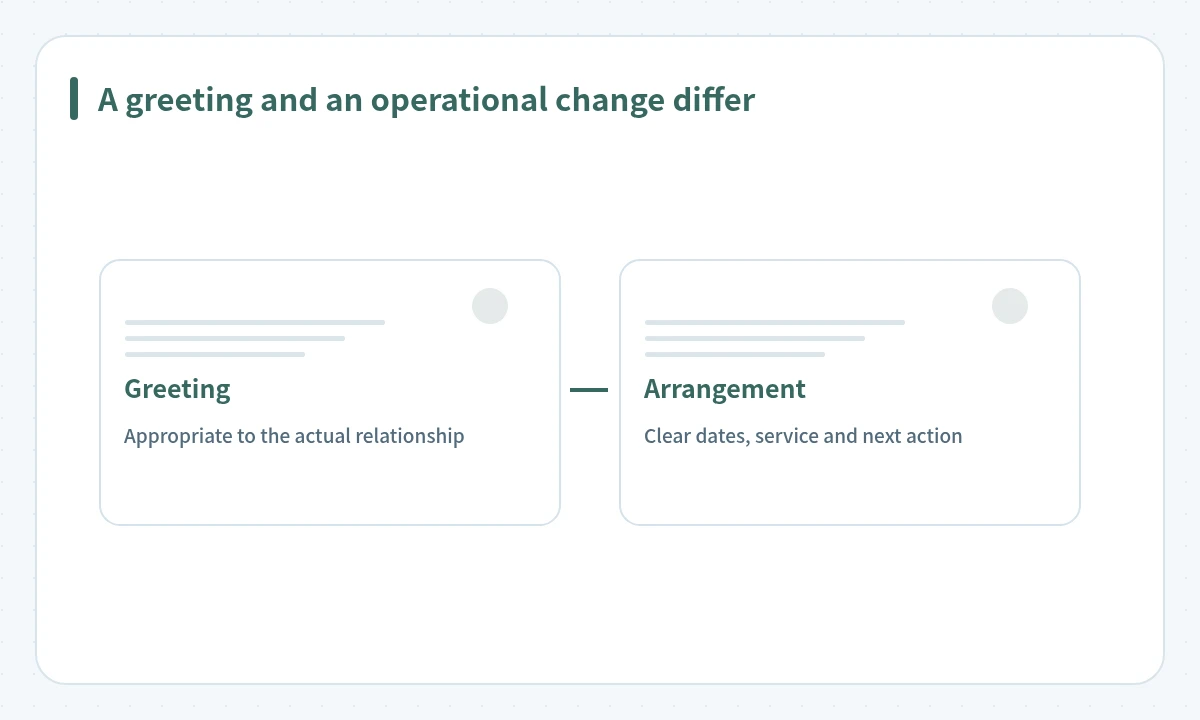
Review the message and destination as a pair
Check that the receiving text and target page agree on dates, service name and action. If a page continues to show ordinary hours after the text announces an exception, the contact has not solved the user’s problem.
Use fictional sample records for review. An authorised inbox can help inspect line breaks and the visible order of information, but a single display observation is not proof of universal rendering or delivery. Keep the tested conditions with the result.
Assign an owner to stop or update outdated messages after the relevant period. A greeting approved for a past calendar entry should not be rolled forward automatically. The closing check is whether this recipient has a clear, accurate and relevant arrangement to act on, in language that fits the actual relationship.
