
An international-looking number does not guarantee access to short-code messages from every country. A long term phone number to receive SMS verification codes still has to match the sending route and the target service’s eligibility rules. Ordinary long-code SMS and a country-specific short code are different receiving tests.
A short code has its own coverage boundary
Twilio’s international short-code guidance describes short codes as provisioned by country, with coverage tied to approved carrier networks. Its incoming short-code guidance adds product and account conditions. These are concrete examples of why the sender’s reach and receiving resource must both be checked.
Do not convert a short code into a supposed international number by adding a guessed country prefix. Nor should a number’s listing in a country directory be treated as proof that a specific short code can reach it. Assignment, routing and target-service acceptance are separate questions.
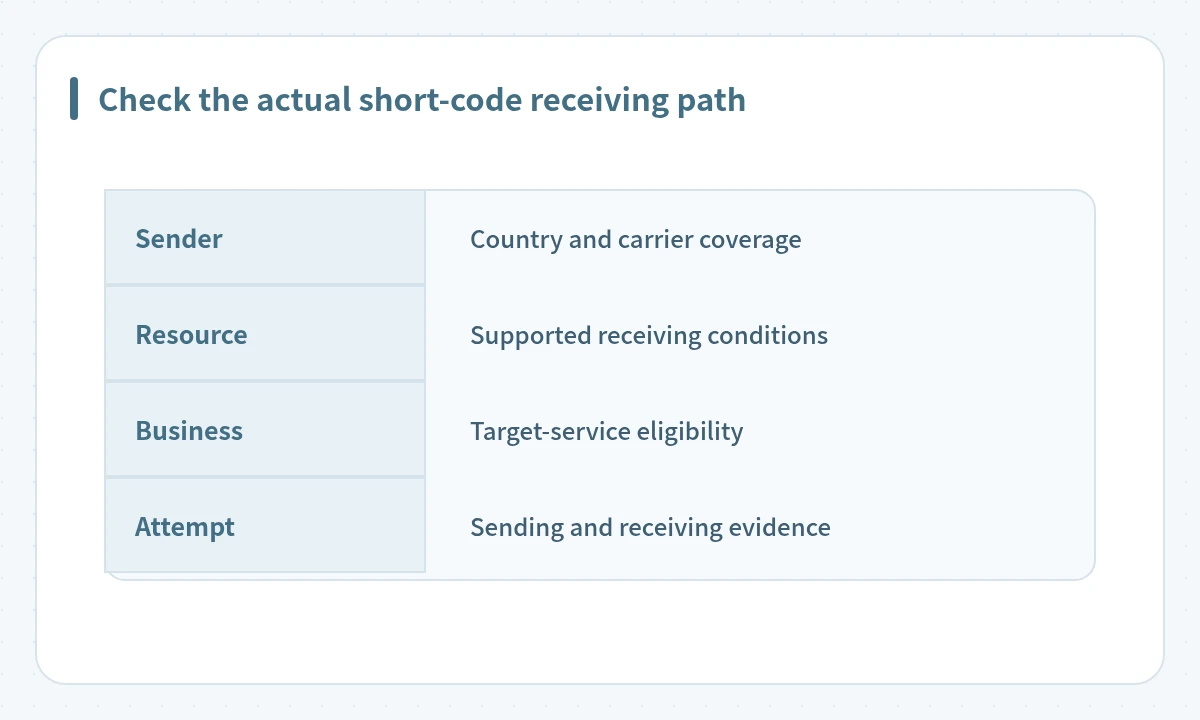
| Question | Evidence to obtain |
|---|---|
| Where is the short code provisioned? | The sender’s current official coverage information |
| Can this resource receive its traffic? | The receiving provider’s documented support conditions |
| Does the verification service accept the number? | The target service’s normal eligibility rules |
| What happened in this attempt? | The relevant sending and receiving records |
The same-country condition, where required, is not a universal success guarantee. Other route, account or number-type restrictions can remain. Keep uncertainty explicit when the responsible provider has not confirmed the relevant path.
Use a test that answers the actual question
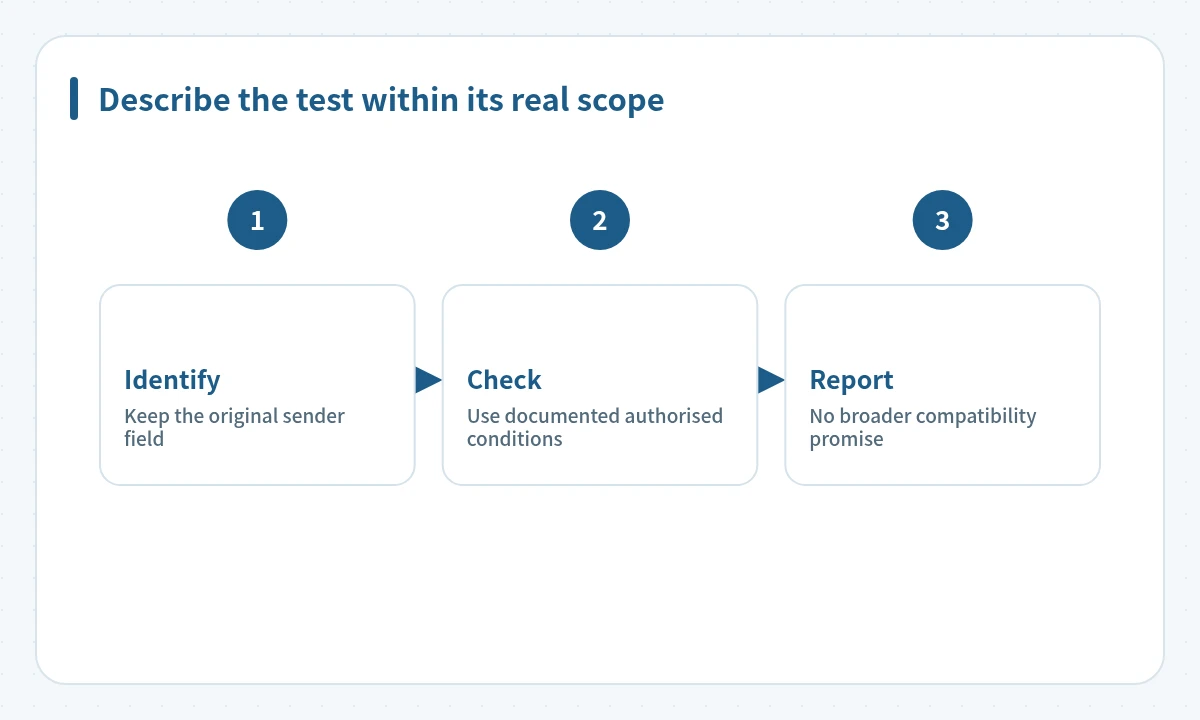
A harmless message from an authorised ordinary number can establish an observation about that ordinary route. It cannot replace a short-code test. If the target service rejects the resource type, use its permitted alternative rather than repeatedly cycling numbers to search for an exception.
Where a legitimate test is allowed, record the time, receiving resource and original sender identifier. Do not use someone else’s account or gather public verification messages as test evidence. A private message body is not needed just to report that the expected record was absent.
Reception does not automatically provide a reply path
A provider may support a particular inbound route without allowing outbound messages to that short code. Before trying a command such as a subscription reply, check the actual supported flow. Do not assume that a text box in an inbox sends an SMS to the original sender.
For support, keep the short code, recipient resource and target business in separate fields. A local contact label or a phone number printed inside the body is not necessarily the original sender. State which fields are unknown instead of filling them with a guess.
The practical result of this check may be that compatibility remains unconfirmed. That is more useful than promising that a long rental period or a broad international label solves a route limitation. Choose a resource only when the required receiving path and continuing account-access needs can be supported by reliable information.
References: Twilio: international short-code coverage; Twilio: incoming short-code conditions.
