
An SMS receiver that accepts XML needs an explicit parser configuration, not just code that extracts a number and body. Review external-resource and entity handling at the actual entry point before trusting the resulting fields.
Limit the accepted input contract
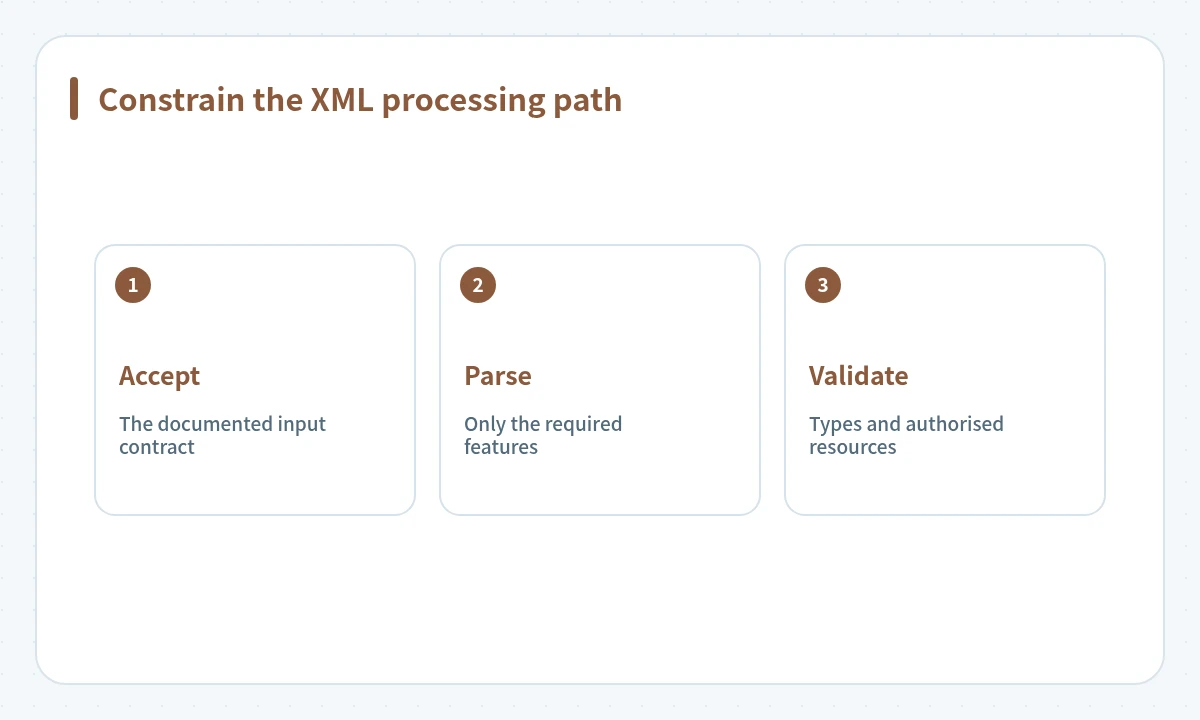
A flexible sms enabled number does not determine the callback format. Verify that the provider actually sends XML and identify the required document structure and size bounds. If the endpoint supports a different format only, automatically trying several parsers can expand its input surface without solving a documented need.
OWASP's XML guidance recommends disabling unneeded DTD and external-entity features using the controls appropriate to the parser. Treat that as a configuration task for the actual language and library version. A flag copied from an unrelated example cannot establish the behaviour of a different runtime.
Trace every parsing step
The framework may parse the request before the application handler, while a conversion library may create another parser later. Review both paths. A safe helper function does not protect data that has already been processed elsewhere with different settings. Include dependency changes in this review because defaults and supported controls can differ.
| Boundary | Expected review |
|---|---|
| External resources | No unneeded file or network access |
| Entity processing | Contract-appropriate restrictions |
| Resource use | Bounded size and processing behaviour |
| Business fields | Normal type and resource validation |
Authenticating the caller does not replace safe parsing. An authenticated request can still be malformed or outside the endpoint's supported structure. Keep both checks and follow the documented verification order without enabling broad parser features simply to accept a troublesome fixture.
Use harmless tests in an isolated environment
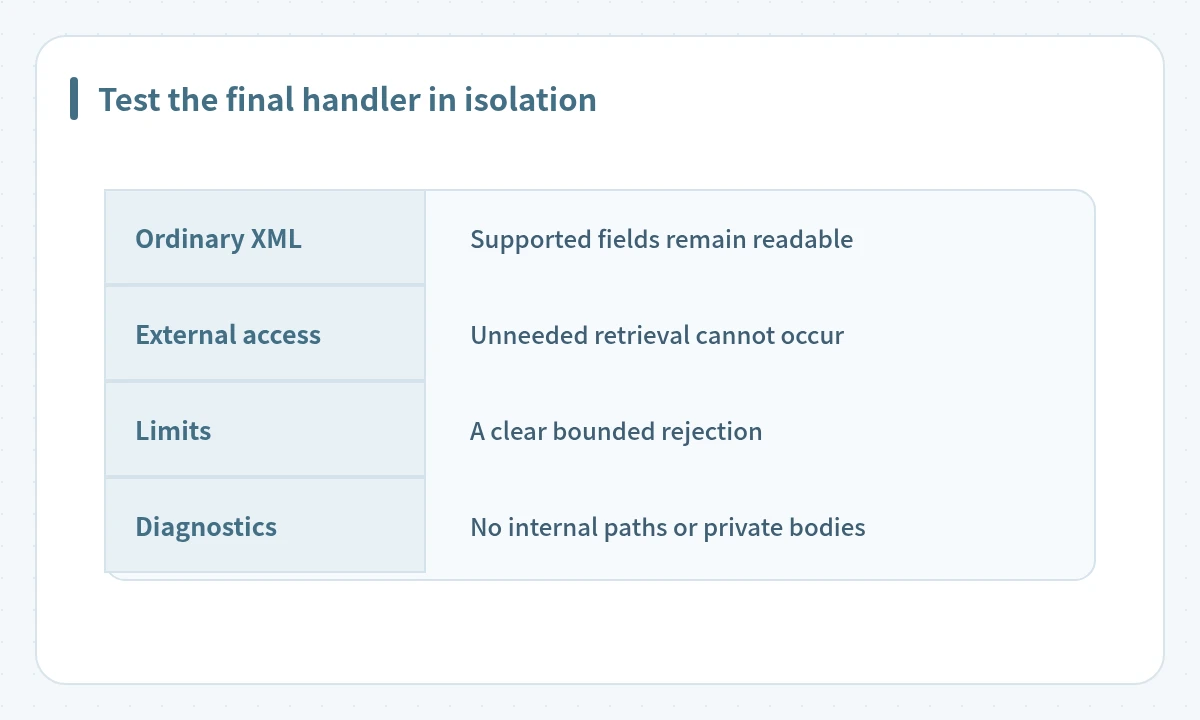
Verify that normal supported documents work and that unneeded external access cannot occur. Use controlled, non-sensitive resources and the organisation's authorised test environment. There is no need to inspect a real server's private files or probe another organisation's endpoint to confirm your own configuration.
Exercise oversized and structurally invalid documents as well as the ordinary path. Check the defined rejection result and resource limits. The useful evidence is the final handler's behaviour, including framework and library stages, rather than the presence of a reassuring option in a source file.
Review optional validation and transformation features as part of the same parsing path. A secure initial reader is insufficient if a later helper retrieves an external resource while processing the document. Confirm which components are enabled for the endpoint’s real needs and remove unsupported assumptions from the test. The review should describe the observed boundary without claiming that a parser setting alone secures every possible XML workflow.
Keep failure reporting limited
Record the request reference, parser version and failure category needed by operators. Do not return internal paths, unrestricted exception details or private message bodies to the caller. Monitoring can identify an unusual error rate without distributing the full payload to everyone receiving an alert.
If the business genuinely needs an advanced XML feature, review a narrowly constrained implementation and its isolation requirements. Do not quietly enable general external access to make a sample pass. Retest the accepted contract after deployment changes so that the receiver's safety depends on verified behaviour rather than an assumption about a library's historical defaults.
Reference
OWASP: XML External Entity Prevention
