
A worker whose lease expires may still be running. A task allocator needs to account for a paused old process resuming after a new process has obtained responsibility, not merely change the owner's name in a management table.
Define what the lease authorises
For an sms capable virtual number workflow, keep task identity, holder and validity conditions explicit. AWS's discussion of leader election explains why lease-based designs require care around failure and timing. The actual coordination mechanism determines the guarantees; a convenient fixed timeout is not a universal answer.
Losing the lease should stop new actions under the design. A check performed only at the start of a long task cannot cover a later pause, communication loss or operation that outlasts its assumptions. Identify which steps need current authority rather than treating the initial allocation as permanent permission.
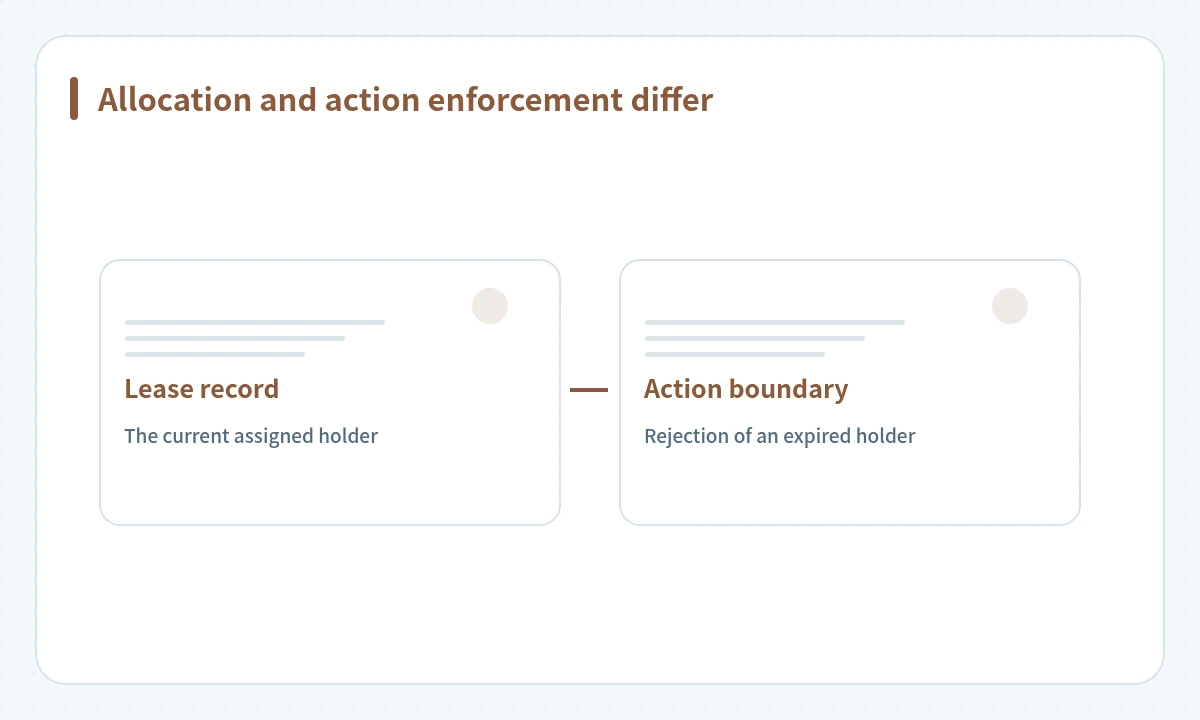
Enforce stale-holder rejection at the action boundary
Where the storage or downstream mechanism supports it, evaluate increasing generations with conditional acceptance so an older holder cannot overwrite the new holder's result. The decisive question is whether the system performing the action checks that condition. A generation printed in a log is only an observation if nothing enforces it.
| Layer | Question |
|---|---|
| Allocation | Who currently has the assignment? |
| Renewal | Does that authority remain valid? |
| Write | Can an expired holder change the result? |
| External effect | What separate duplicate controls apply? |
An external send cannot necessarily be undone with a local database rollback. Use the actual provider's supported operation identity and duplicate-handling contract where needed. Do not claim that a lease alone makes every side effect occur exactly once, particularly when the outcome of an external request is uncertain.
Preserve an understandable recovery state
Record the task, generation and confirmed steps without copying private content into routine diagnostics. If authority is unclear, follow the defined stop or reconciliation path. A replacement worker should examine existing results instead of interpreting uncertainty as proof that nothing happened.
Distinguish an expired holder's rejected write from a business failure in the task itself. Those observations may require different operational responses. Keeping the categories clear makes it easier to investigate a handover without repeatedly restarting an otherwise completed action.
Keep the allocation token’s authority distinct from an ordinary tracing identifier. A request reference can help find an action without proving that its sender still owns the lease. The enforcing component needs a trusted relationship to the current generation under the coordination design. Document where that relationship is checked, especially when work moves through another queue or service that could otherwise discard the ownership context.
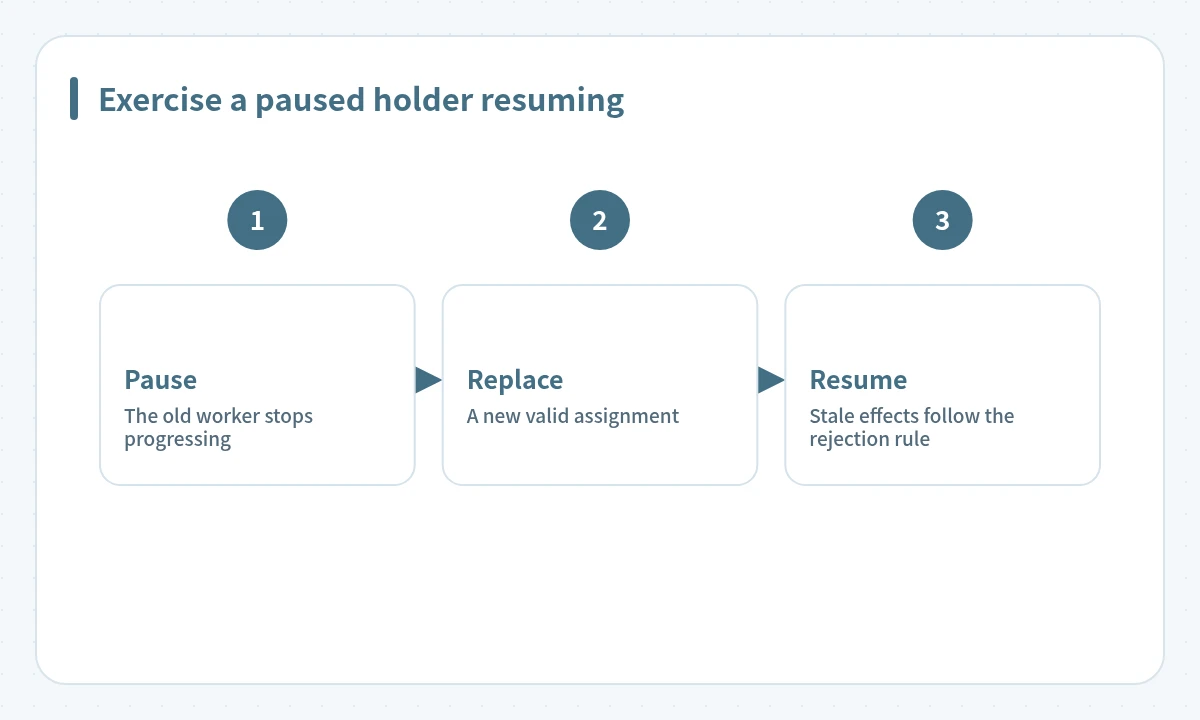
Rehearse pause and resume in isolation
In an authorised environment, pause the old worker, allow the replacement to obtain its assignment and then resume the old process. Inspect the final store and controlled downstream behaviour. A screen showing one current owner is insufficient evidence if both processes can still produce effects.
Use harmless tasks and retain the relevant ownership changes and rejection results. Report performance or correctness only from the records actually observed. A normal completion demonstrates its own path; it should not be presented as verification of every possible pause, partition and recovery sequence in a distributed deployment.
Reference
AWS: Leader election in distributed systems
