
A URL fragment is not a query parameter delivered to an SMS webhook server. If a callback address uses a hash to append an account reference, inspect the URL structure before debugging the handler's field-reading code.
Separate browser state from the HTTP request
An instant web phone number may be configured through a browser interface, but the provider's callback is a separate server request. MDN explains that URI fragments are handled by the client and are not sent to the server in the HTTP request. A complete-looking browser address therefore does not prove that the handler receives every visible component.
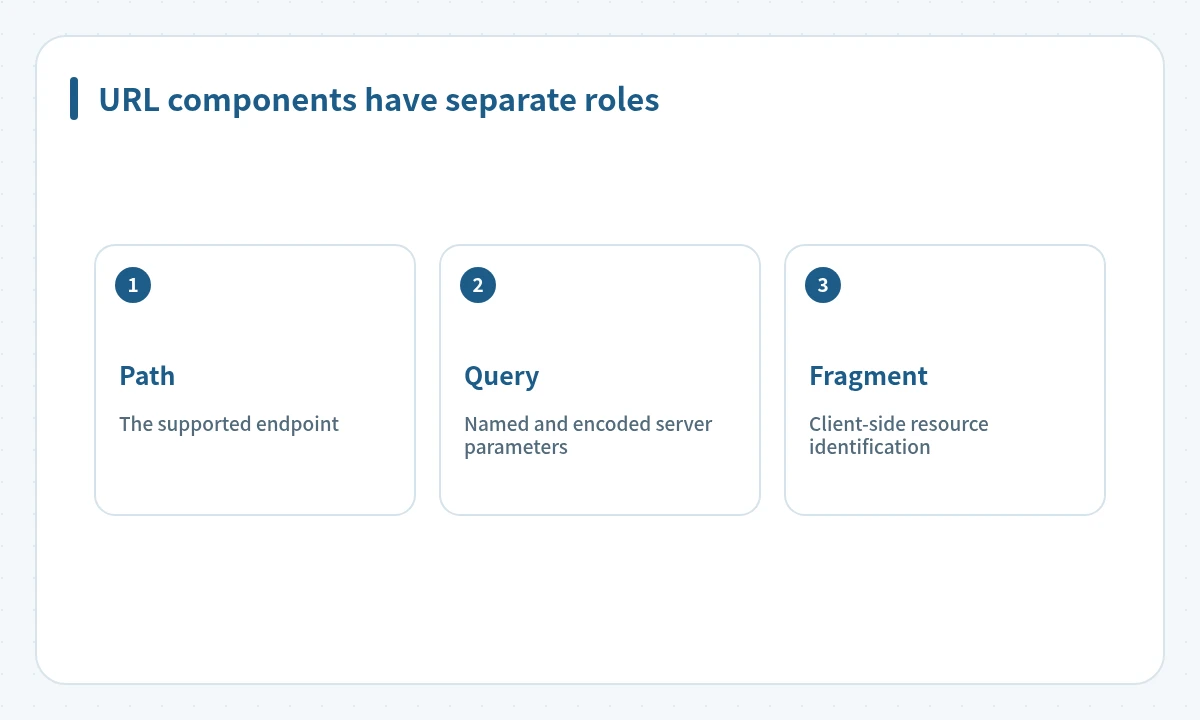
Identify the path, query and fragment explicitly. A front-end application may use a fragment to select a screen, while the receiving endpoint needs a documented path or request field. Those mechanisms should not be treated as interchangeable merely because they appear in a URL.
Follow the receiving contract
Where a configuration reference is required, use the supported location and encoding for that value. Check both the sender's configuration rules and the handler's expected input. Do not repeatedly encode the entire address until one test appears to work; that can change separators and produce a different request from the one you intended.
| Component | Review |
|---|---|
| Path | The actual supported endpoint |
| Query | Documented names and value encoding |
| Fragment | Client-side identification rather than server query data |
| Authentication | The callback protocol's separate source check |
A readable account reference is still only a locator. Validate the request and resource relationship under the callback's authentication design. An arbitrary caller must not be able to choose the destination account merely by changing a visible identifier in a URL.
Recheck signature input after a URL change
Some signature schemes include the receiving URL or parameters. Use the provider's actual specification to determine the input. Correcting the URL structure can make a missing parameter visible while also changing the data that the verifier expects. Review both changes together rather than weakening signature validation to finish the test.
If a reverse proxy presents a different external address, use the application's supported configuration for that relationship. Avoid trusting unrestricted forwarding headers supplied by a caller. The diagnostic goal is to reconstruct the documented input accurately, not to make any supplied address acceptable.
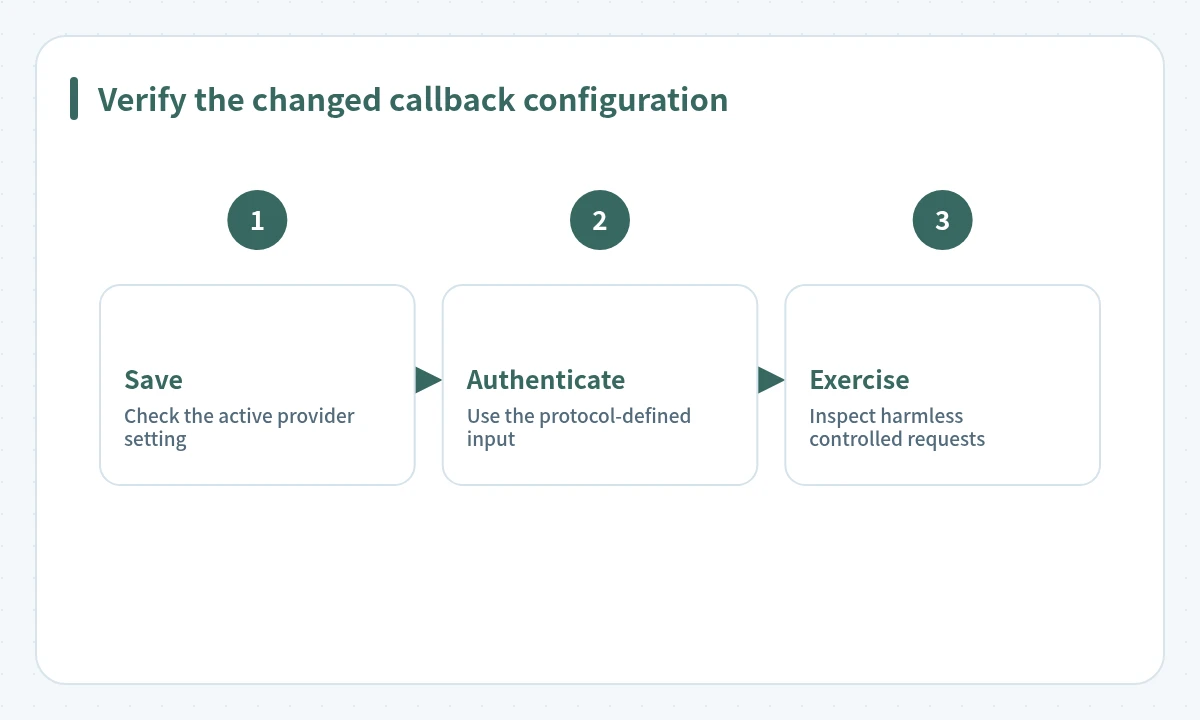
Check the configuration saved by the provider after editing, not only the value still visible in an unsaved form. Some interfaces display an example alongside the actual active endpoint. Use a limited test event and its receiving reference to verify the active configuration. This prevents a correct local URL analysis from being mistaken for proof that the remote service has already started sending to the revised address.
Verify a small controlled set of requests
Test the correct address, a missing reference, an unauthorised reference and an unsupported parameter form in an authorised environment. Use harmless data and capture only the request details needed for diagnosis. Real verification codes and account secrets are unnecessary for testing URL component handling.
Retire the obsolete configuration through the provider's supported process and observe whether requests still reach the previous endpoint. Keep the change tied to its configuration reference. Two active addresses with different meanings should not silently feed the same business record while leaving operators unable to explain which path produced an event.
