
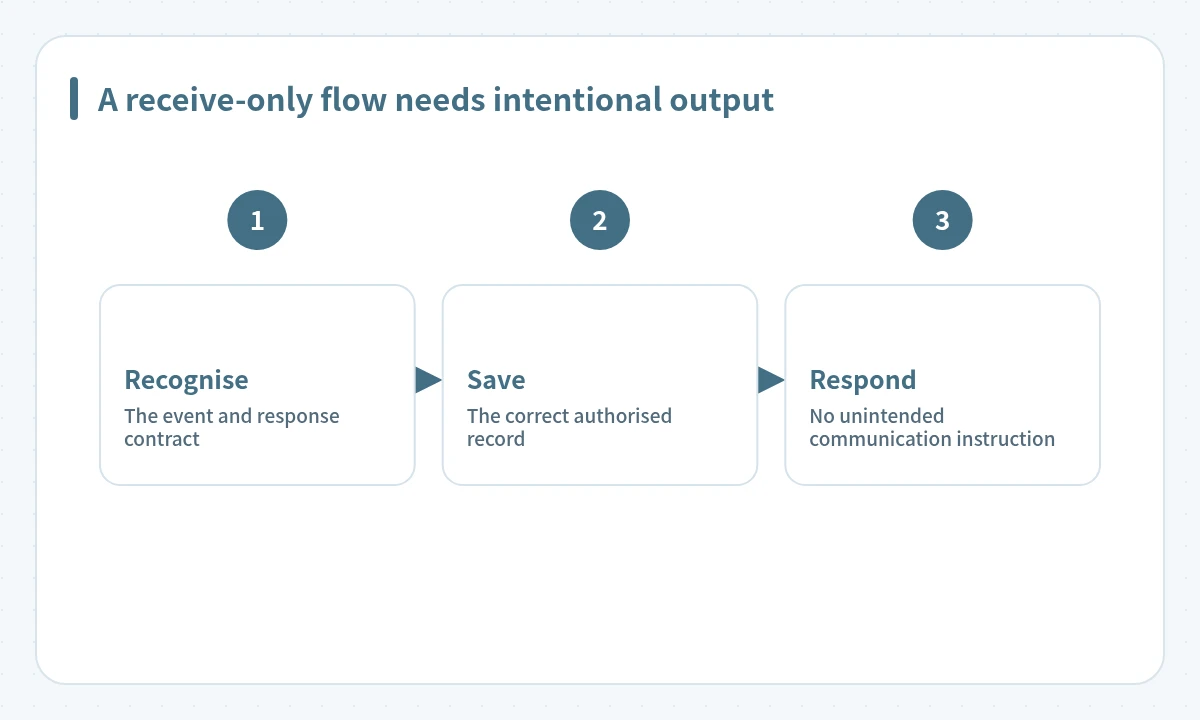
An inbound handler that only needs to save a message should not copy an automatic-reply example unchanged. Confirm whether the provider treats the callback response as acknowledgement or as instructions for further communication.
Name the event and intended outcome
Receiving a message, replying to it and observing an outbound status are different tasks. They can all arrive as HTTP requests without sharing the same response rules. Identify the event, required format, media type and error handling for the product you actually use.
Twilio’s incoming-message documentation, for example, describes an empty TwiML Response element when no reply is wanted. A response containing a Message instruction has a different purpose. That product-specific arrangement is not a rule that every SMS callback should return the same XML, and it should not be copied into unrelated status handlers.
Remove unintended echo behaviour
An example that inserts the received body into a reply can transmit that body again. For a verification message, that can spread sensitive content rather than merely demonstrate that a request arrived. Use harmless fixtures and specify whether the test should save a record, return a control instruction or deliberately send a reply.
If there is no reply requirement, do not retain a tutorial’s greeting or debug echo in the deployed flow. A helpful-looking sample response can still become a real action. Inspect configuration-based flows and bound services as well as the application function you just edited.
Give the receive-only fixture an explicit expected outcome: one harmless message is stored against the intended resource and no outbound task is created. Add invalid-input and failed-authentication fixtures that must not enter the reply branch. If a deliberate reply is required, test it separately with its authorised recipient, content and actual send result. Status events need their own state-update and acknowledgement checks.
Check the final response bytes as well as the object created by the SDK. A shared page template, debug banner or warning printed after a valid instruction document can change what the provider receives. Generate the required response through a controlled route and keep diagnostic output in the approved logging path.
Inspect both incoming and outgoing records
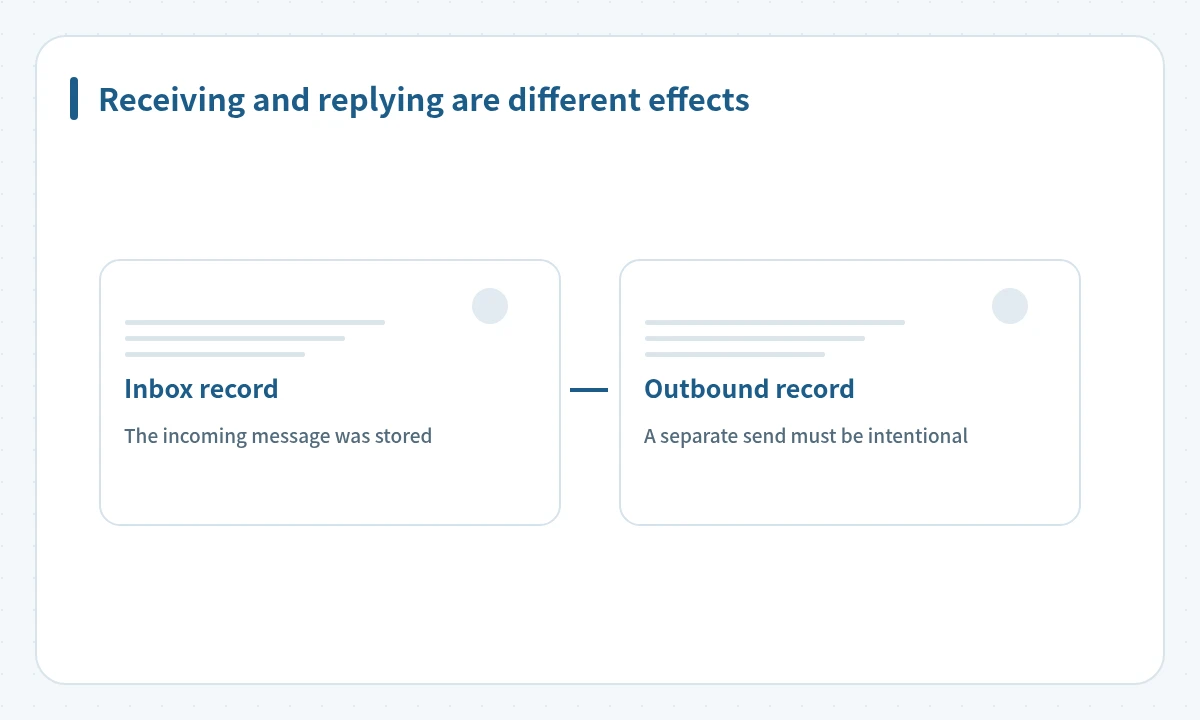
One new inbox entry does not establish that the integration only received. Check for an unintended outbound task, secondary flow or delayed action. Where requests can be retried, validate that the same event does not repeatedly execute the reply path.
Use the production binding’s actual configuration for acceptance, even if the initial example ran safely in a sandbox. A test resource can point to a different handler. Record which resource and flow were checked so the result cannot be mistaken for a universal property of the account.
After deployment, retain suitable identifiers and outcomes without logging live authentication codes. If an unexpected send is discovered, disable the offending reply path and investigate the real outbound records. The interface saying “received” is not the end of that investigation.
A receive-only implementation also needs an intentional response when storage or validation fails. Do not let a generic success page mask the failure, and do not substitute a chatty error reply to the sender. Follow the provider’s retry and error contract while making the application failure observable to the authorised operator.
References: Twilio: incoming webhooks and no-reply responses; Twilio: messaging instructions.
