
A correctly signed webhook can still be delivered more than once. A simple private SMS inbox integration needs an event identity and replay policy alongside request authentication. Passing the signature check should not automatically turn each received request into a new business action.
Read what the protocol actually authenticates
Establish which raw body and request properties participate in verification, and whether the provider includes an authenticated timestamp. An arbitrary unprotected time field cannot simply be treated as trusted freshness evidence.
Stripe’s webhook documentation provides one concrete design with signed timestamps and a tolerance check. It illustrates that freshness can be part of the protocol. It does not establish an algorithm, window or retry rule for every SMS provider.
Use the chosen provider’s current verification method. Do not invent a general timestamp requirement for an endpoint that does not define one, or remove documented checks because a sample request is inconvenient to reproduce.
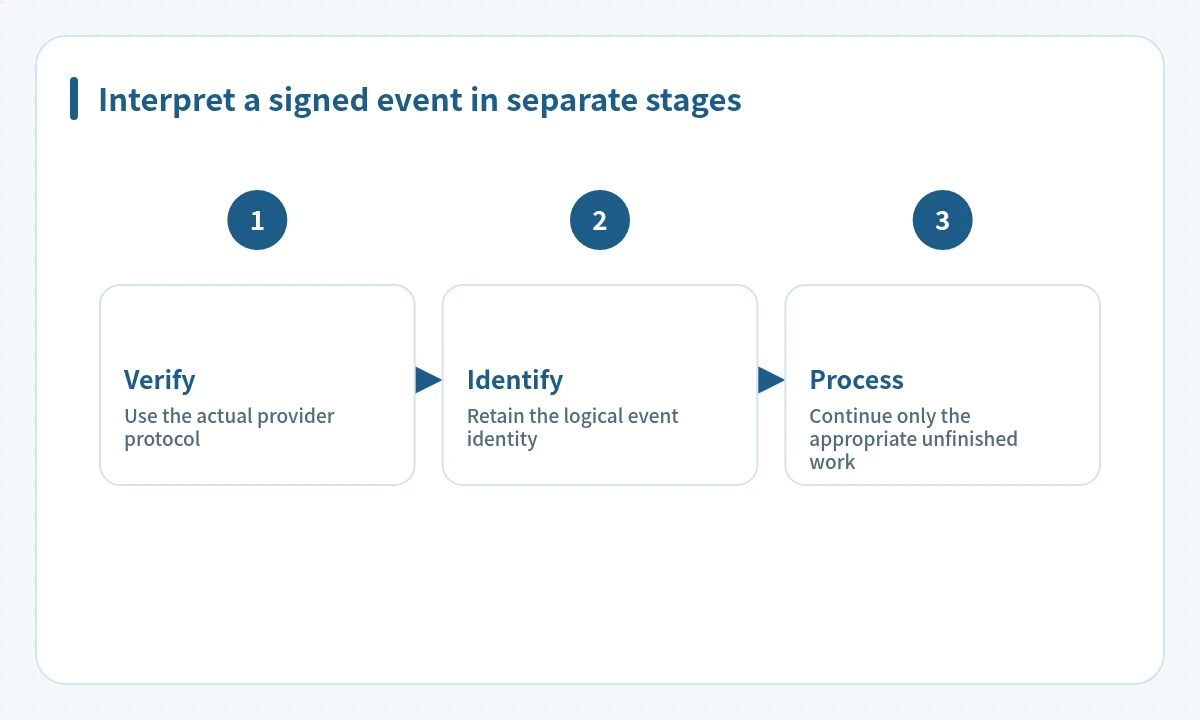
Keep event identity distinct from request freshness
Several legitimate deliveries can refer to one logical event. Save the documented event reference with accepted and processed states. A later request timestamp does not necessarily mean another incoming message or another authorised business action exists.
Conversely, an unprocessed event does not justify executing any old request without checking its applicable conditions. Use the provider’s or application’s supported recovery path and inspect current task relevance and authority.
Distinguish accepting a repeated delivery from repeating its side effects. An application can recognise the event while resuming only unfinished work. Creating a fresh logical identifier to bypass duplicate detection removes the very relationship needed for that decision.
Maintain the clock and tolerance deliberately
Where timestamp verification is part of the protocol, inspect actual system time and supported synchronisation. Understand what the tolerance describes. Do not keep widening it until errors disappear, or substitute the time displayed on an SMS page for the authenticated request value.
Use limited error categories and non-sensitive event references for diagnosis. Secrets and reusable authentication material do not belong in ordinary logs. Check environment, credential changes and supported retries separately when investigating failures.
Document which response the provider expects for a recognised duplicate. That response must follow the endpoint contract while the application avoids repeating completed effects. Returning an arbitrary error for every repeat can provoke further retries without improving the business result.
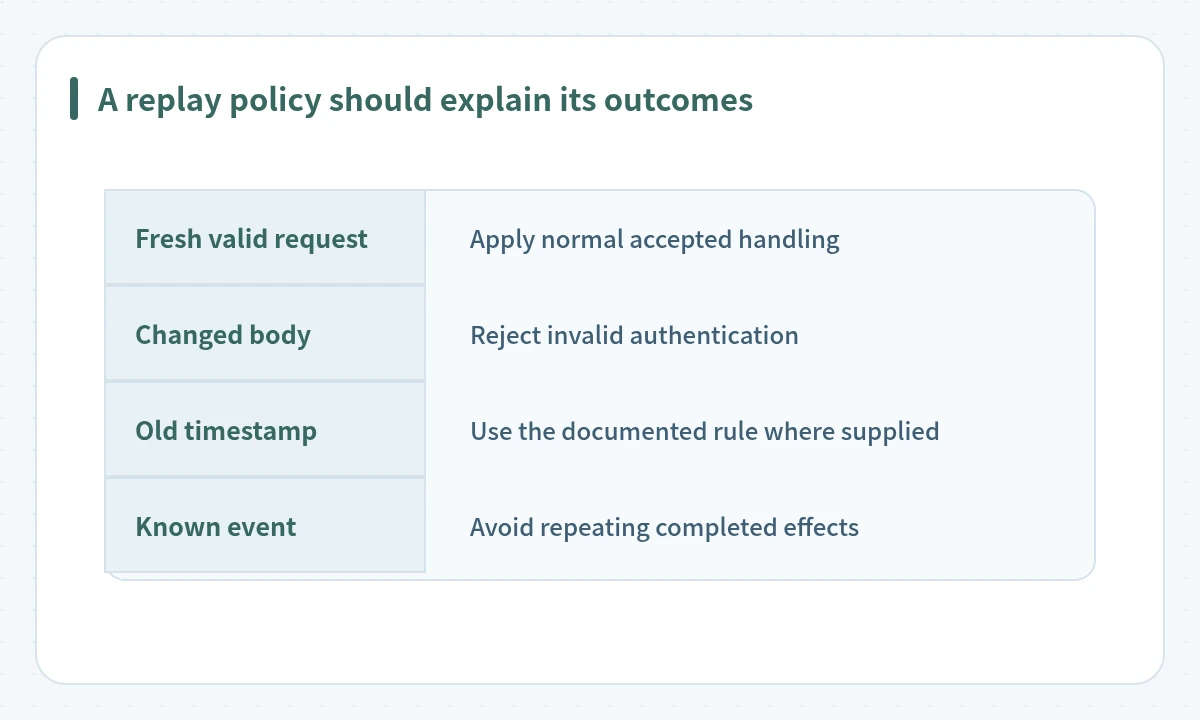
Exercise the boundary with controlled requests
In an isolated environment, include a normal request, changed body, stale timestamp where applicable and another delivery of the same event. Define separate expected outcomes rather than measuring only the number of HTTP successes.
Use harmless fixtures and your own test receiver. Do not replay requests against another party’s live service or collect real account codes to make the test realistic. The task is to inspect the receiving application’s documented behaviour.
Also test a correctly authenticated event whose business task has already ended. Request validity cannot make an obsolete action appropriate again. Record that decision through the normal task state rather than weakening authentication.
The closing evidence should keep signature validation, freshness, logical identity and business completion distinct. Each answers a different question. Together they can support a controlled recovery path without treating a single valid signature as proof that every later action should run again.
Reference: Stripe: webhook verification and replay protection.
