
HTTP 413 concerns accepted HTTP request size, rather than directly describing SMS text length. Find the rejecting server or proxy and inspect the payload boundary before changing message content or server limits.
Measure the object that was rejected
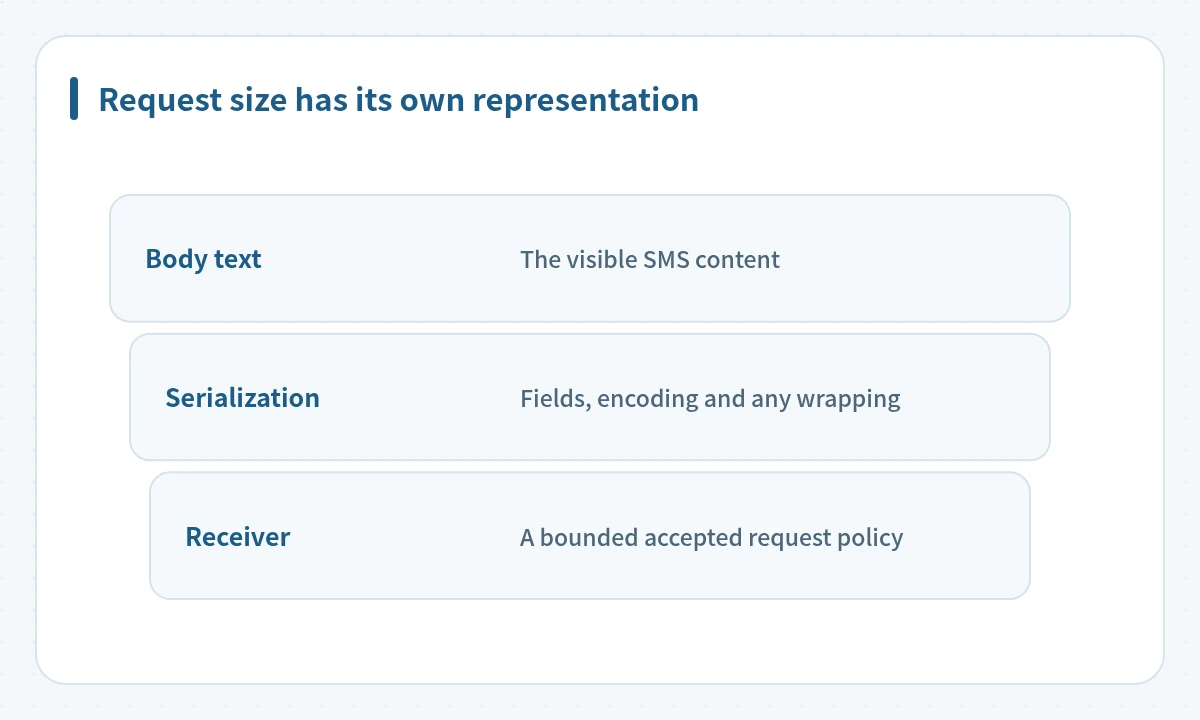
The callback body can contain addresses, identifiers, status and text serialized as form data or JSON. Encoding and field overhead affect its byte size. A visible character count cannot substitute for the size of the actual request representation.
RFC 9110 defines 413 as a request-content-size rejection. It does not describe SMS segment counting or determine a messaging provider’s text limit. If a reverse proxy rejects the body, the application may never have received it, so an absent application log is not proof no request was sent.
| Question | Appropriate observation |
|---|---|
| Which layer rejected it? | Corresponding proxy and application request evidence |
| How large was it? | The actual serialized payload’s byte length |
| Was it expected? | The documented event schema and media type |
| What was accepted? | The receiver’s explicit bounded input policy |
Explain the excess before increasing a limit
Check whether the sender targeted the wrong route, an intermediary wrapped the body again or an unexpected field dominates the payload. Do not remove size limits from every endpoint to make one test pass. Nor should the receiver truncate a body and acknowledge it as a complete event.
Truncation can corrupt content and interfere with request authentication. The supported signature procedure may depend on the original representation or specified parameters. Follow the provider’s actual contract instead of modifying an incoming request until the parser accepts it.
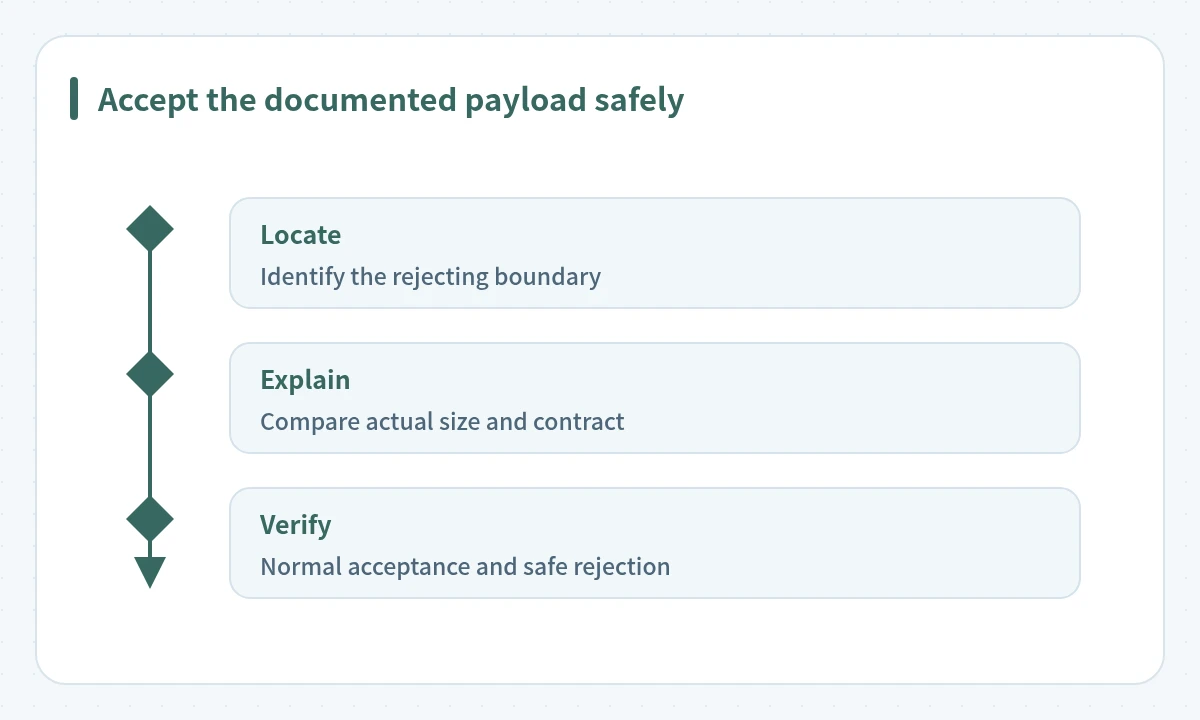
Keep the measurement method clear. A declared request length is not a substitute for bounded handling of the content actually read. If the stack supports compressed requests, its policy should also explain the accepted decoded size. Different processing layers may enforce different limits, so record which representation each observation describes.
Test the approved boundary with harmless data
Use an isolated environment and synthetic payloads encoded in the real supported format. Observe the intended valid range and the controlled rejection above the approved boundary. This is a bounded configuration test, not a reason to send oversized traffic continuously to a live provider or production inbox.
After a change, verify both outcomes. Documented normal requests should reach the correct processing path, while out-of-policy requests should still fail safely. Authentication and parsing must remain intact. A permissive proxy does not help if the application’s documented input policy still rejects the same event for a valid reason.
If a provider-generated payload appears outside its documented contract, use verified support with the event type, request reference, time and non-sensitive size observations. Avoid attaching credentials or an entire private body. Establish whether retry or replay is supported, because the provider may not retain the event indefinitely.
Record the approved limit, affected endpoint, expected encoding and observed acceptance and rejection results. Keep that record with the deployment configuration. During a later proxy or framework change, the maintainer can then compare the effective boundary with the agreed policy and identify which layer changed it.
Technical reference: RFC 9110: 413 Content Too Large.
