
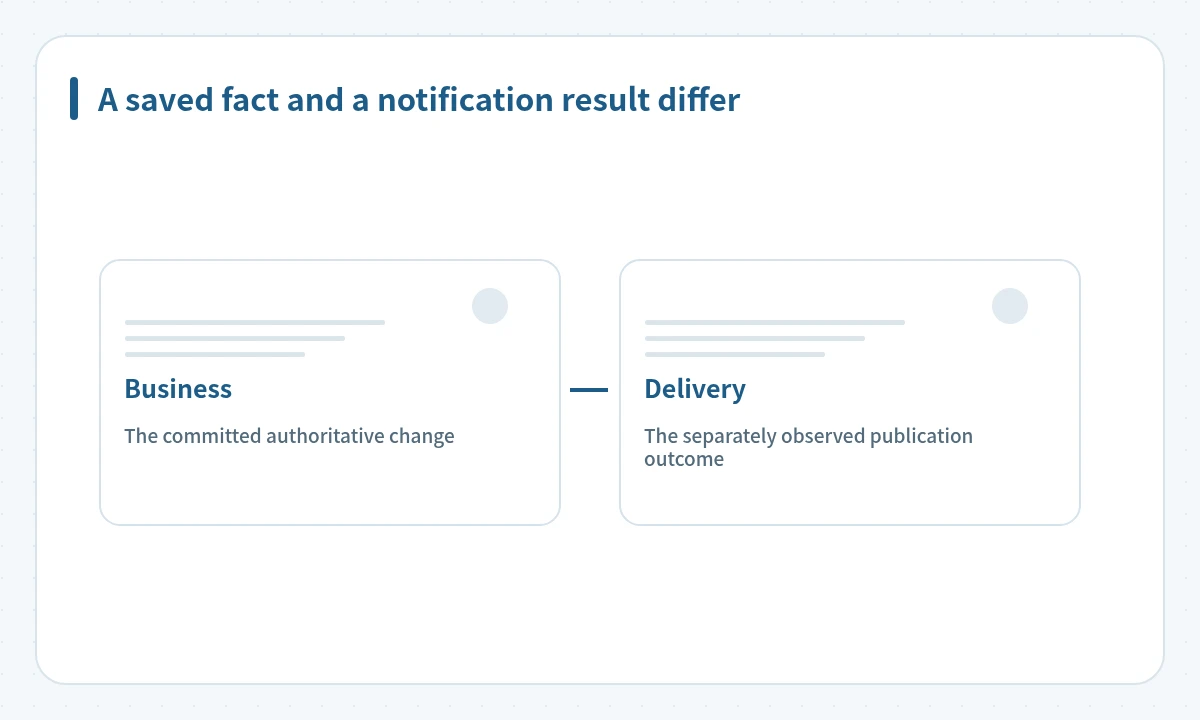
A saved business change and a missing notification task can result from a failure between two writes. A simple spare phone number in the receiving path cannot resolve that inconsistency. The sending application needs a reliable association between the business fact and its intention to notify.
Define the decision before publishing it
Identify the state change, stable business reference and notification intent. Do not announce a final result before the business commit succeeds. Likewise, recording an intended notification does not prove that a text was delivered or read.
The transactional outbox is one design for this problem: store the business change and the publication intent in the same database transaction, then publish through another process. AWS describes the pattern in terms of avoiding inconsistent dual writes across systems.
Choose an architecture suitable for the actual storage and interfaces. The presence of a queue or table name alone does not establish the required transaction boundary. Review what can fail between the operations and what evidence remains.
Do not promise exactly-once effects from the table
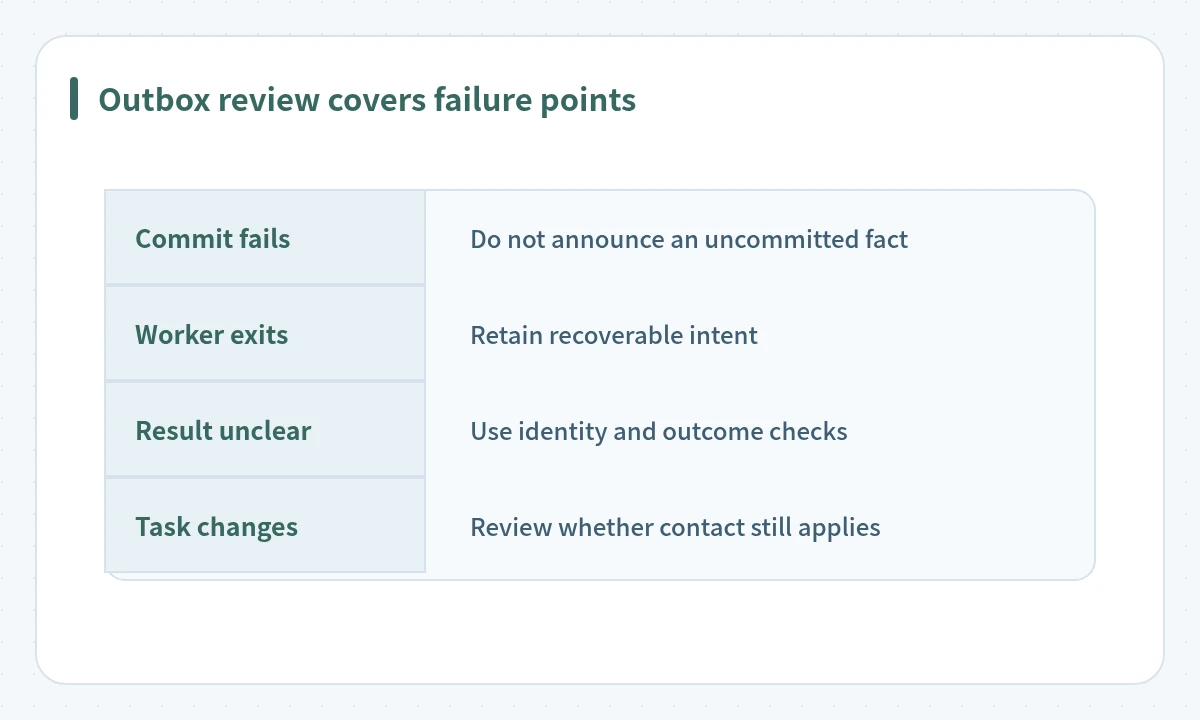
A publishing worker can send successfully and fail before saving its completion marker. Recovery still needs stable event identity, supported duplicate controls and a way to inspect uncertain outcomes. An outbox does not remove those downstream questions.
Keep task records limited to required data or protected references. Private message bodies, active credentials and unrelated account information should not be copied into every queue and diagnostic record merely to support tracing.
A logical event and a particular delivery attempt can have separate references. Preserve their relationship rather than generating a new business identity whenever the worker retries. That makes completed and unfinished work distinguishable.
Recheck relevance before a delayed release
An appointment can change again, an order can be cancelled and a contact choice can be updated while a task waits. Define how pending work uses the appropriate current conditions. The earlier intent explains what was decided then, not automatically what should be sent now.
Keep stalled work visible with a responsible owner and next step. A growing count of queued events is not evidence that business notifications completed. Distinguish accepted work, attempted publication and confirmed outcomes in monitoring.
The publishing backlog also needs a bounded operational response. Record how old the pending intent is and whether the underlying task is still relevant. A worker that keeps retrying obsolete work can create noise while valid work waits. Use explicit failure and review states under the design instead of treating every uncompleted row as something to send immediately.
Exercise the failure points with controlled data
Test a failed business commit, a worker exit after commit, an uncertain sending result and recovery retries. Uncommitted facts should not produce ordinary notifications, while committed intents should remain recoverable under the design.
Use fictional records and a controlled downstream service. There is no need to create real orders or send customers repeated messages for the exercise. Verify the business state, outbox entry and downstream result separately.
Also inspect operational restart procedures. A recovery should not bypass the current task checks or release an obsolete backlog without review. The closing result is an understandable relationship between the saved fact, recoverable intent and permitted publication, with uncertain cases explicit instead of hidden behind one successful HTTP response.
Reference: AWS: transactional outbox pattern.
