
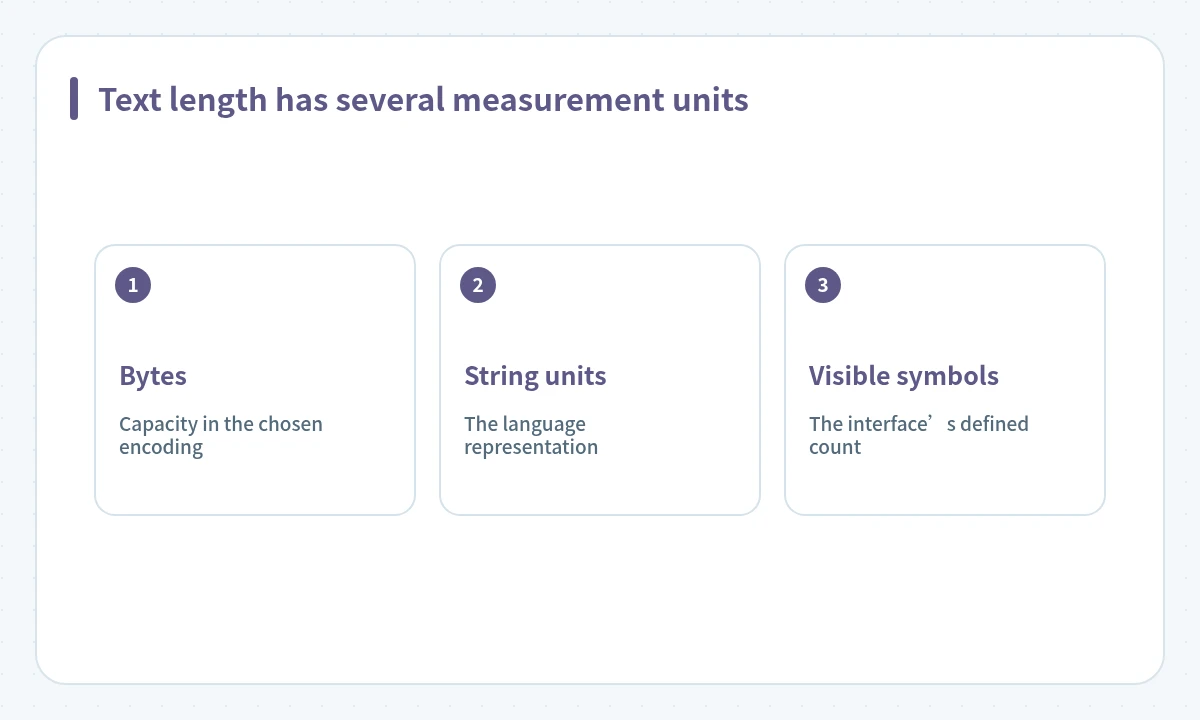
A text-length number is meaningful only when its unit is clear. UTF-8 bytes, Unicode code points, a language's internal string units and user-perceived symbols can produce different counts for the same notification.
Define the limit before choosing a counter
For an instant one time sms number workflow, storage, API validation and the editor can each have a different stated limit. Read those contracts separately. A convenient built-in string length is not automatically a message-segment count or a billing measure, and a receiving-number description cannot settle the encoding rules.
MDN documents TextEncoder as a way to encode a JavaScript string in UTF-8. Unicode's text-segmentation specification addresses boundaries such as grapheme clusters. These tools answer different questions. Choose the measure required by the interface rather than selecting whichever produces the most reassuring number.
Keep visible symbols intact
Some symbols that look like one unit to a reader consist of several code points. A cut at an arbitrary storage offset can split an encoded character or a visible combination. Use processing appropriate to the defined unit, and keep the complete source text where the product requires it.
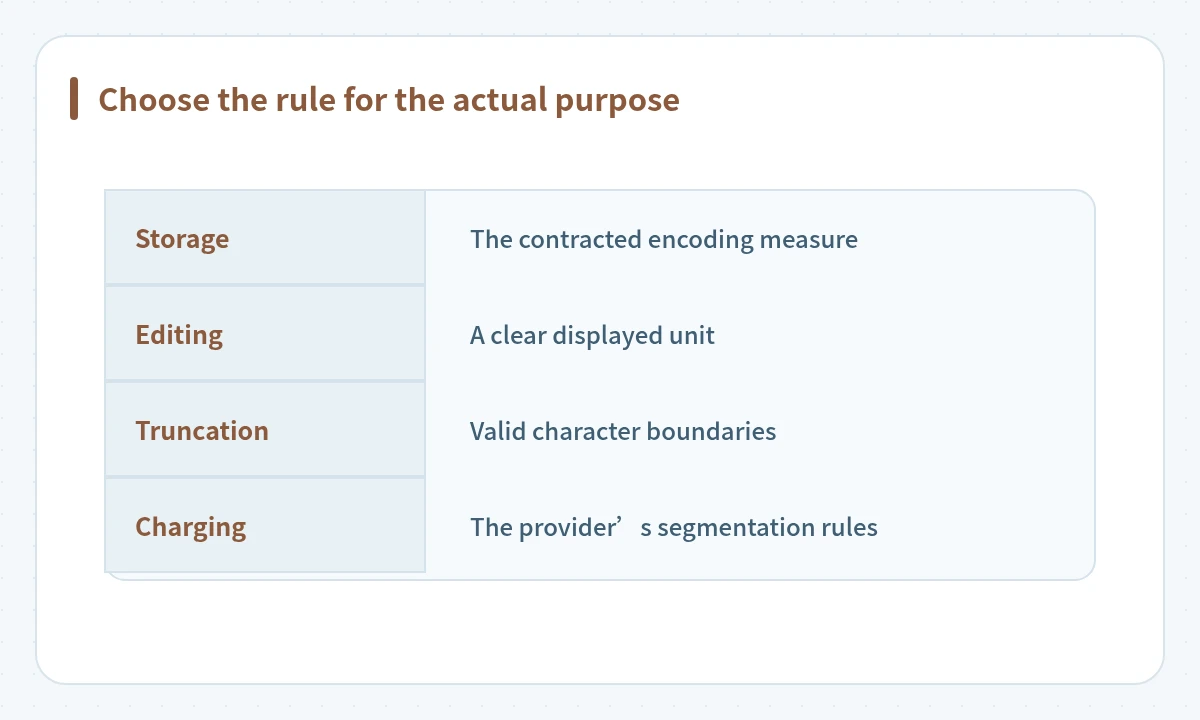
| Purpose | Unit to establish |
|---|---|
| Storage or transport capacity | Bytes in the specified encoding |
| Program operations | The actual string representation |
| Editing experience | The product's defined visible count |
| SMS charging | The provider's encoding and segmentation rules |
A diagram showing these layers is not a tariff table. If an application estimates outgoing SMS segments, validate that separate calculation against the actual provider's rules. UTF-8 size alone should not be advertised as a reliable charging prediction for every service.
Compare one input across the whole path
Use harmless fixtures containing ordinary letters, Chinese text, combining sequences and emoji. Check the editor's counter, submission validation and stored result together. Include line breaks introduced by paste. A form that appears to accept a message but receives an unexplained server rejection has not provided a useful length contract.
Retain boundary fixtures when a library or algorithm changes. The relevant question is whether the same documented unit still controls the decision, including for older stored content. Do not alter the original text simply to make a new display counter equal a previous internal value.
Keep a byte limit separate from the field’s semantic validation. A short value can still be the wrong identifier, and a correctly encoded string can still exceed the business scope. Validate both properties without presenting the length counter as a general correctness check. For a field that must remain exact, reject unsupported content clearly rather than normalising or shortening it simply to meet the measured limit.
Prefer an explicit rejection to silent rewriting
If an input exceeds its limit, explain the affected field and supported correction. Quietly removing the end can damage an identifier, link or verification string. Where a summary is appropriate, identify it as a summary and preserve its relationship to the complete message rather than presenting shortened content as the original.
Keep diagnostic information limited to the rule version, measured unit and relevant request reference. A length investigation does not require routine copies of an entire private inbox. A clear measurement contract gives users and developers an understandable answer without turning several unrelated counts into one ambiguous label.
