
Expiry and scheduling tests are easier to reproduce when the application uses a controllable clock dependency. Changing the whole server's system time can affect unrelated tasks and is a poor substitute for a focused test boundary.
Make the time source explicit
A no sim temporary text number workflow can have an expiry decision even when the test sends no real message. Supply the current instant through an agreed interface and substitute a fixed value in the test environment. Avoid mixing browser time, server time and a script's local time within one expected result.
Document the unit, time zone and whether the cutoff includes the boundary itself. A formatted display rounded to minutes should not decide whether a fraction of a second remains. The comparison needs the business rule's actual definition, while the display needs wording that does not overstate its precision.
Exercise conditions instead of waiting for them
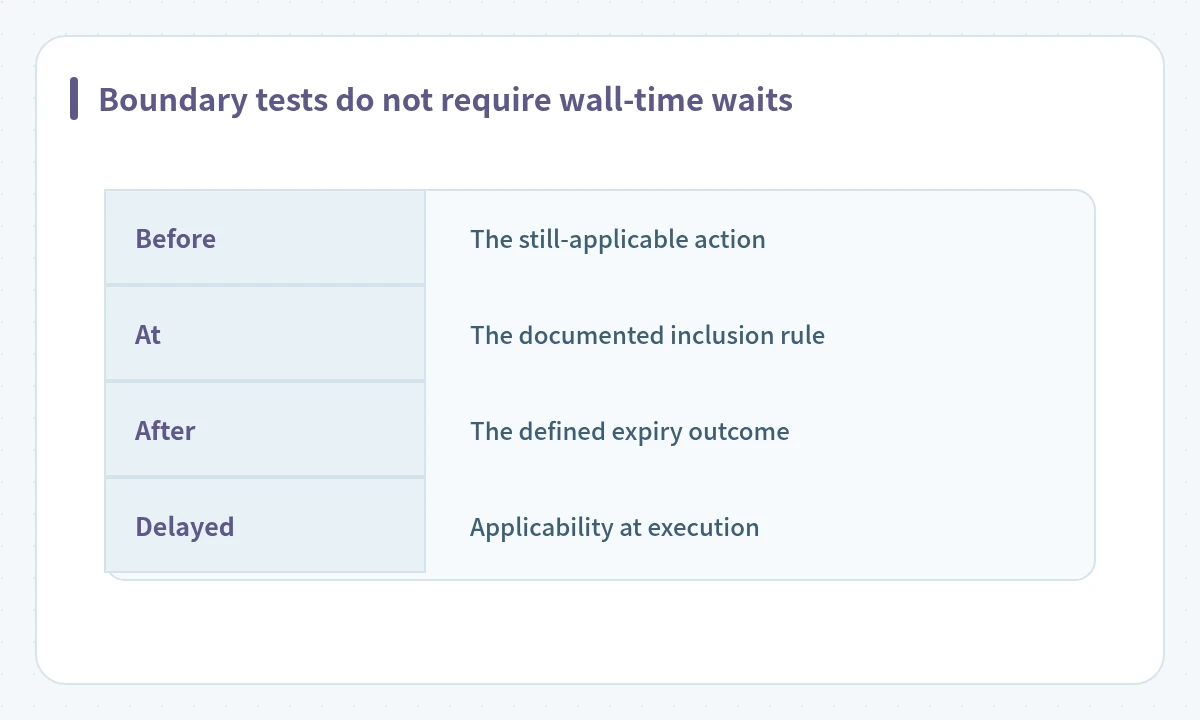
Create separate fixtures just before the cutoff, exactly at it and after it. For queued work, distinguish event time, scheduled time and actual execution time. A job that starts late needs its relevance checked under the intended rule rather than inheriting a permission to act from its earlier enqueue time.
| Case | Expected review |
|---|---|
| Before the boundary | The still-applicable action |
| At the boundary | The documented inclusion rule |
| Delayed execution | Current applicability |
| Repeated execution | No duplicate business effect |
Advancing a test clock does not complete an external provider's delivery. Use a controlled adapter for local tests or a separately authorised integration exercise for an external path. Record which boundaries were actually exercised instead of describing simulated completion as a measured live delivery.
Keep the replacement out of production input
An arbitrary request parameter must not choose the application's clock. Restrict substitution to the dependency and environment design, and make startup checks able to identify an unintended fixed-clock configuration. Otherwise a useful test feature can become an unrecognised operational defect.
The fixed clock also needs to reach every relevant component in the test. A helper that still reads wall time directly can make the result depend on when the test happens to run. Trace the failing decision before adding another delay to the test harness.
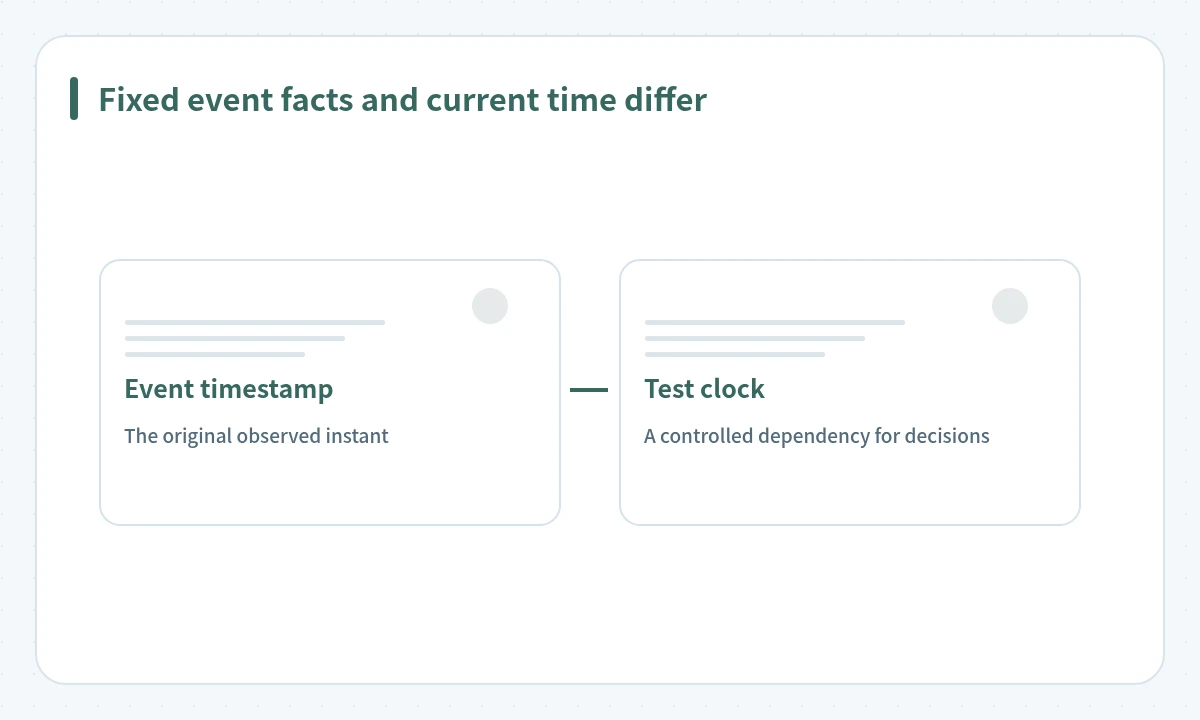
If a test advances time while work is running, define which decisions should observe the later instant. A queued task may legitimately recheck a cutoff at execution, whereas an event timestamp should remain the original observed fact. Do not rewrite both merely because they are represented as dates. Separating fixed facts from current-time decisions makes the test useful for delayed work rather than only for a synchronous happy path.
Keep a reproducible report
Record the chosen instant, input condition and expected outcome with harmless sample content. Another developer should be able to run the same case without waiting for midnight or modifying a shared machine. If the case fails, compare the rule and time source before masking the symptom with a longer sleep.
Retain representative cross-date and time-zone cases where the workflow requires them. Clock control provides repeatable observation; it does not establish that the chosen business zone or task state is correct. Verify those inputs separately so the test explains the actual scheduling decision rather than only demonstrating that time can be moved.
