
A notification with a missing reference or appointment time can leave its recipient unable to act. Treat missing template data as a defined rendering outcome, rather than deleting the placeholder and sending whatever sentence remains.
Give each variable a business meaning
An instant virtual sms number can receive a notice only under the sender's supported contact arrangement. Before the notice reaches that channel, its template should identify exactly which task it describes. An order reference, shipment reference and notification reference are different inputs, even when their values have similar shapes.
For each variable, document its type, source, required status and applicable condition. Distinguish an absent field from an empty string and a valid zero. A truthiness check can replace a legitimate zero balance or zero remaining items with an incorrect default. Use the business definition to decide which inputs are usable.
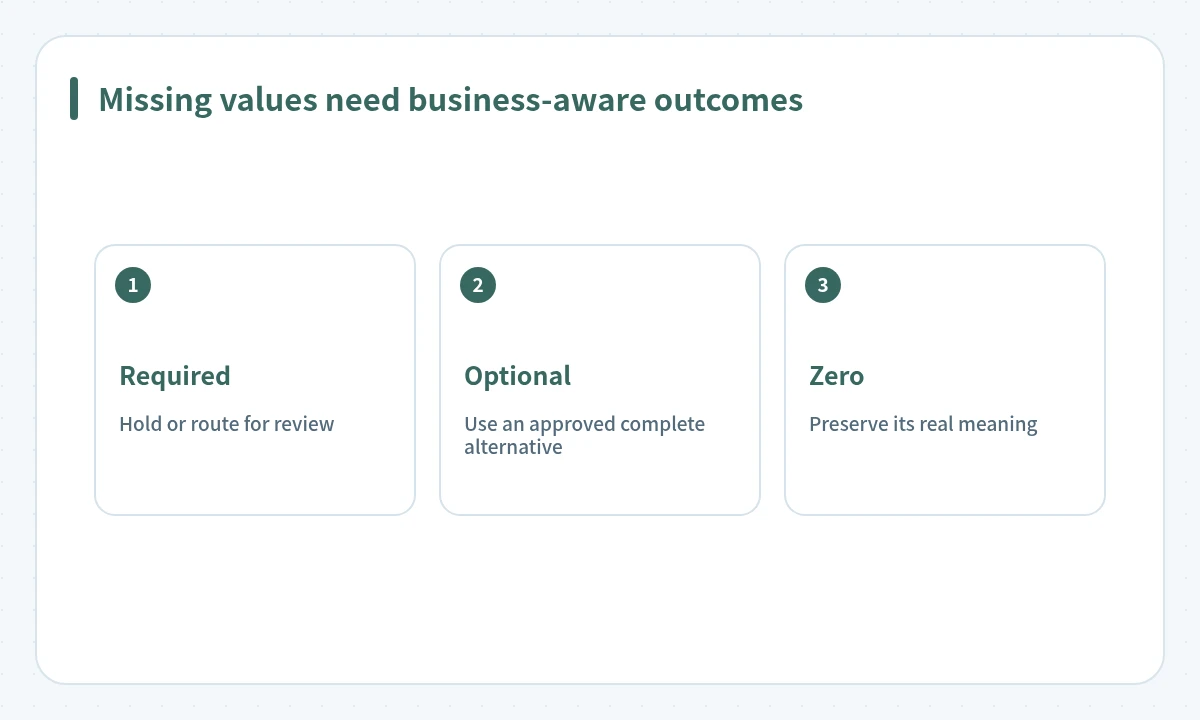
Define the missing-data result
If the missing field determines the next action, stop the notification or route it to the approved review process. An optional greeting may have an approved greeting-free alternative. That alternative should be a complete natural sentence, without an empty label or punctuation left behind by a removed name.
| Input | Review question |
|---|---|
| Absent field | Does the source match the expected contract? |
| Valid zero | Is its business meaning preserved? |
| Empty optional value | Is there an approved complete alternative? |
| Missing required value | Is sending blocked with a traceable result? |
Do not borrow an apparently suitable value from an older task. A beautifully rendered notice pointing to someone else's purchase is harder to detect than an explicit rendering failure. Keep defaults restricted to cases where their meaning has actually been agreed, rather than using them to make every preview look complete.
Inspect the final output with awkward inputs
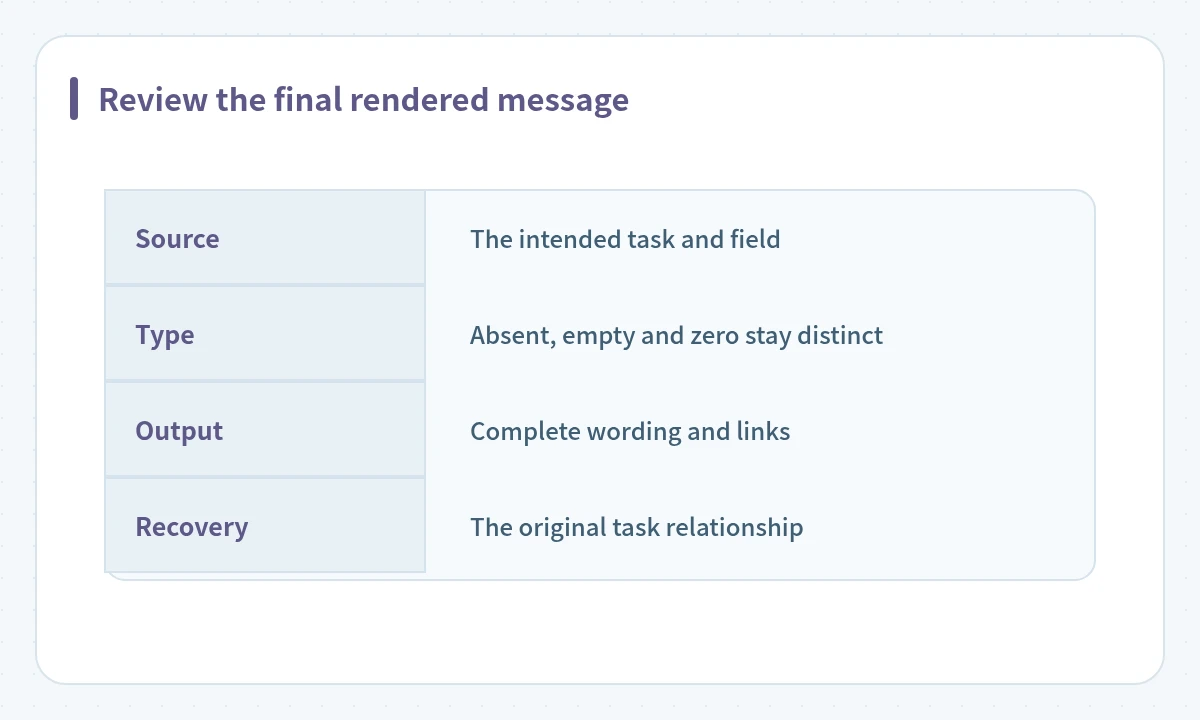
Prepare harmless fixtures for absent fields, empty values, zero, unexpected types and long content. Review the final message, including links and line breaks. A web preview and a plain-text notification have different output contexts; validate each context instead of assuming that one escaping rule makes both correct.
Keep the current template version with the task's rendering result. If the data changes while work is queued, the send path still needs its required-field checks. A validation step that exists only in the editor will not protect a scheduled job or a second integration that uses the same template.
Review the template release together with its consuming jobs. A producer may have renamed a field while a queued task still carries the previous structure. Use an explicit supported version relationship instead of guessing which field to substitute. When the relationship is unsupported, keep that task held with a clear reason. This turns a deployment mismatch into an actionable diagnostic instead of an incomplete message that the recipient has to decipher.
Make failed rendering recoverable
Record the task reference, template version and missing variable name without copying private input into the error log. Give the failure a clear owner and a supported correction route. A retry after a source-data fix should preserve the original task relationship and follow the system's duplicate-handling rules.
Review the failure report for patterns: an occasional incomplete record differs from an entire feed using the wrong field name. Correct the responsible source or mapping, then rerun the relevant fixtures. The useful outcome is a message whose meaning remains intact, with incomplete tasks visibly held for the right reason.
