
User text inserted into a notification should remain data. Do not compile a new server-side template from a contact name, note or incoming message merely because the first rendering step produced a complete-looking string.
Separate template authority from variable input
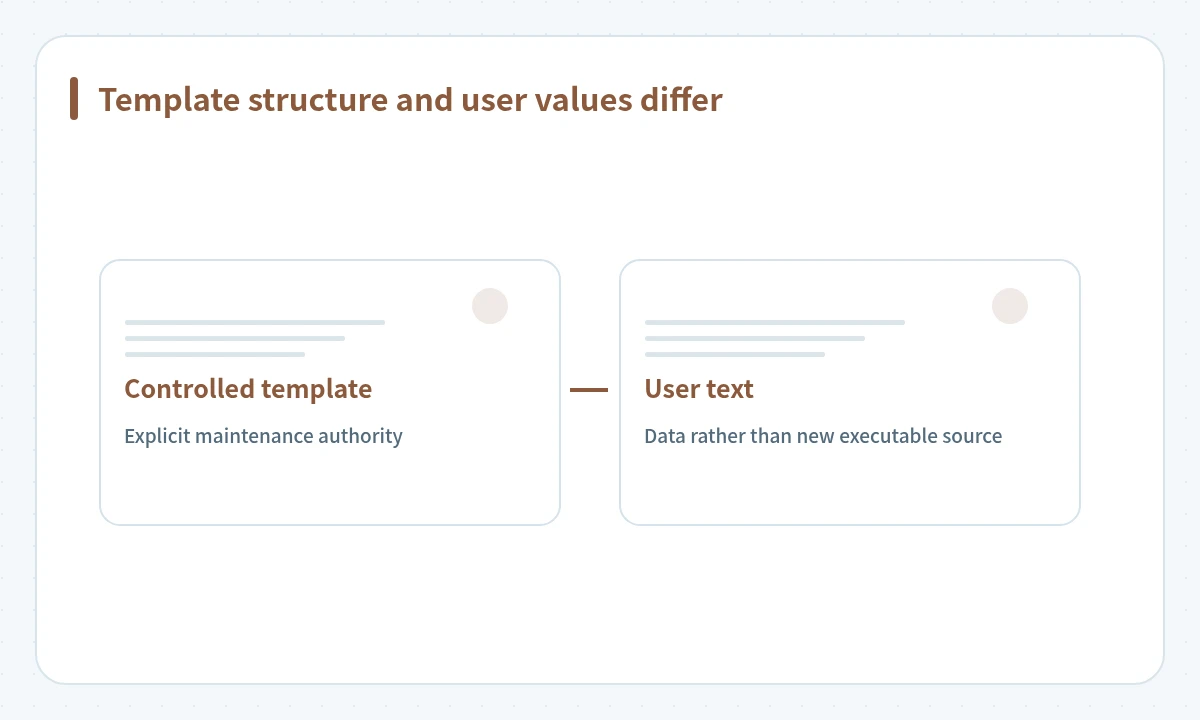
A no sim short term sms number workflow may handle descriptions and message bodies supplied by several parties. The controlled template structure and those external values need different handling. Pass values through the template engine's supported variable interface instead of concatenating them into executable template source.
OWASP describes server-side template injection as a risk when user input is embedded unsafely in template processing. The practical design question is where interpretation occurs. HTML escaping for a web preview addresses another boundary and cannot establish that server-side evaluation was safe.
Look for a second rendering step
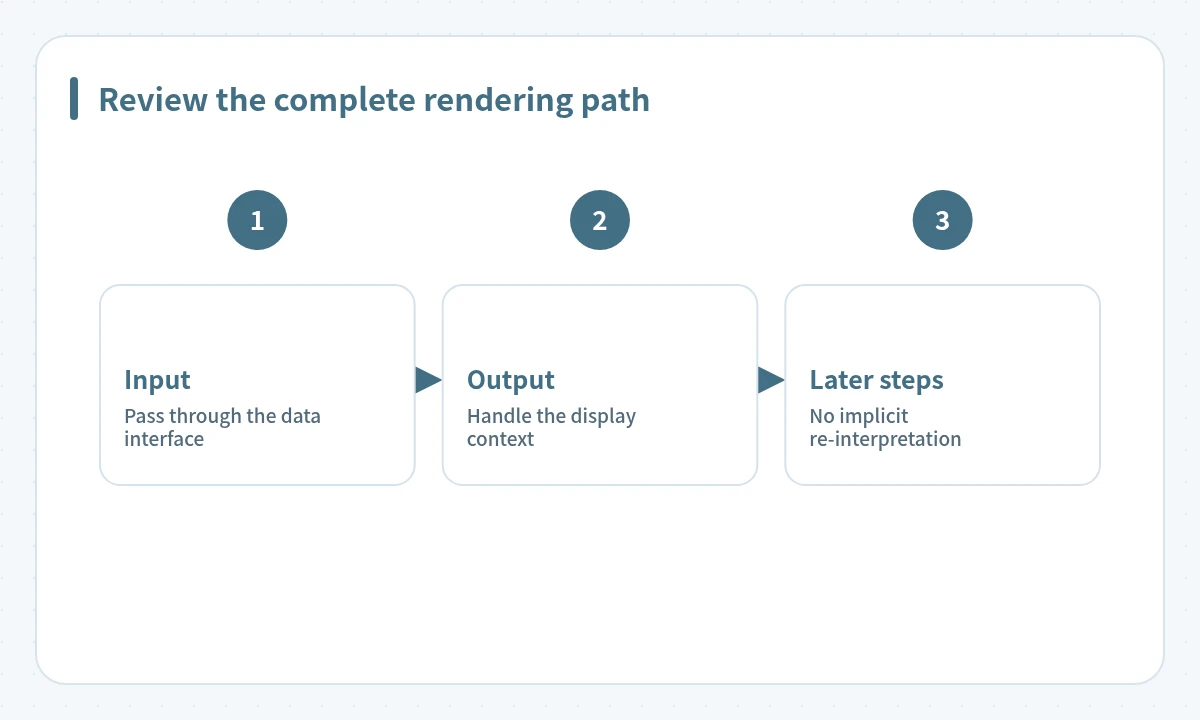
Trace preview, email forwarding and background jobs as well as the main notification path. A safe first render can be followed by a helper that treats the result as a new template. That extra interpretation step can turn ordinary user punctuation into something the engine attempts to evaluate.
| Material | Handling boundary |
|---|---|
| Controlled template | Explicit editing authority |
| User text | Values passed as data |
| Web preview | Context-appropriate output escaping |
| Final notification | No implicit additional template execution |
Deleting a short list of symbols is not a general solution. A legitimate note can contain brackets, mathematical notation or code. Restrict how the application interprets the input instead of damaging all text that resembles a syntax fragment. Keep the original values usable for their intended business purpose.
Define the template editor's actual privileges
If staff can edit templates, decide what functions and objects those templates may access under the chosen engine and deployment. A backend location does not justify giving every operator arbitrary server capabilities. Review the intended editing role and the runtime's supported restrictions together.
Keep template-maintenance permission separate from permission to view individual message records. The person who adjusts wording may not need unrestricted access to private live content. Harmless fixtures can support much of the editing workflow without making real account material a default preview dataset.
Review any feature that intentionally allows limited formatting as a separate contract. An approved set of presentation options is different from accepting arbitrary template source. Document the permitted behaviour and test it through the chosen engine and final output context. Do not quietly expand the interpreter’s accessible objects just because an operator asks for a more flexible greeting. A small wording feature should not accidentally change the application’s execution authority.
Test the complete path with harmless text
In an authorised isolated environment, use ordinary sample text containing common template punctuation and confirm that it remains literal data through the final output. Use a bounded test appropriate to the engine. There is no need to read private server files, use live secrets or probe another organisation's application to verify your own rendering boundary.
Record the template version, task reference and failure category if a result is unexpected. Retest after dependency changes and after adding a new rendering entry point. The useful outcome is an explainable interpretation chain with only the intended template execution, rather than reliance on an old library default that no one has checked recently.
Reference
OWASP: Server-side Template Injection
