
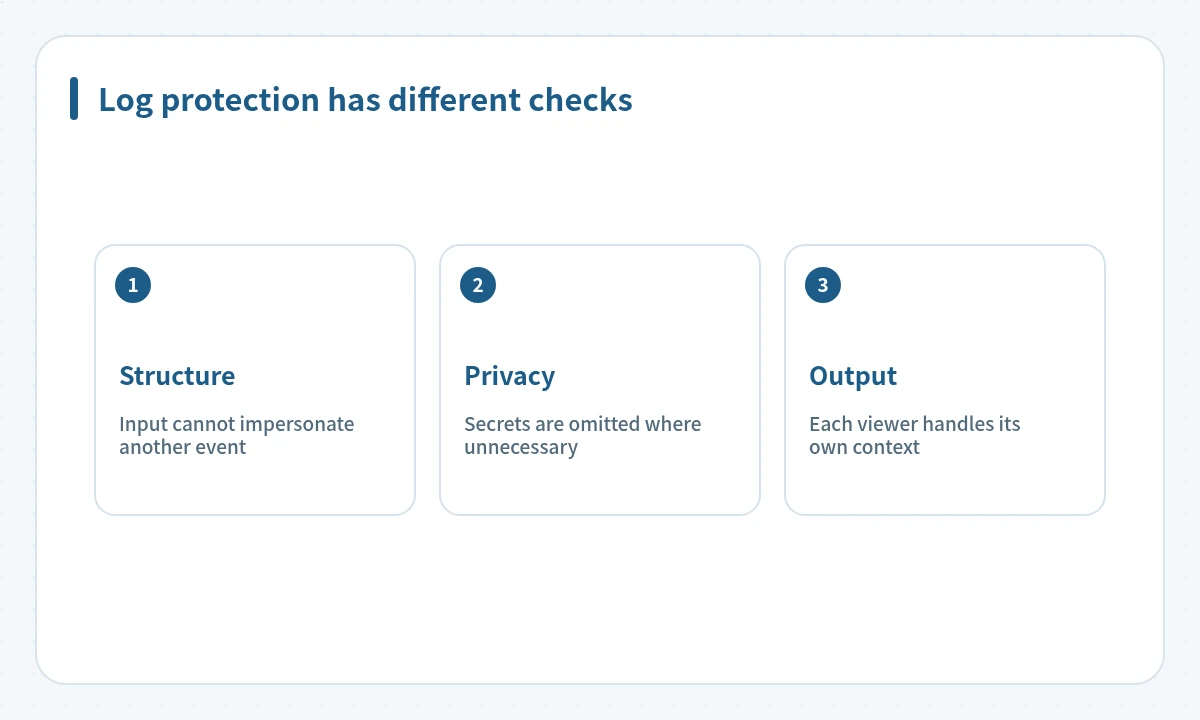
Putting a received SMS body directly into a log line can let its line breaks imitate separate application events. Preserve the event structure with the logging tool’s supported fields and serialization. Incoming content must not supply a new timestamp, severity or operator.
Separate event fields from external text
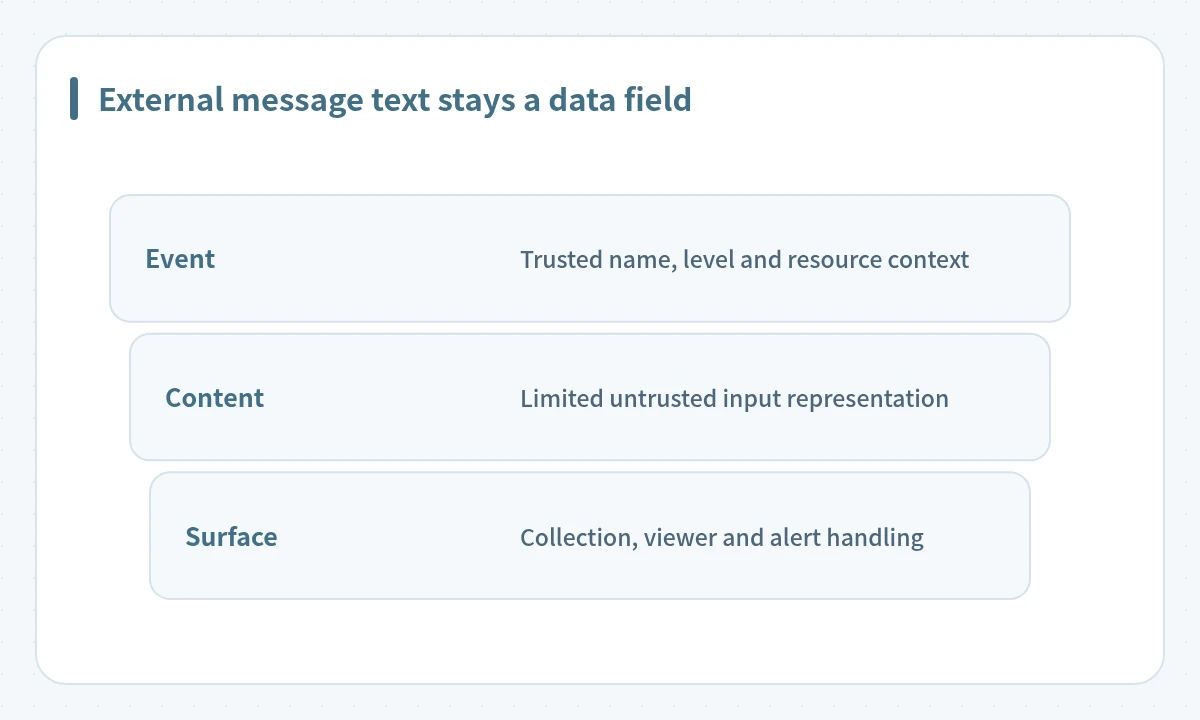
Use the logging system’s supported structured representation for the event name, request reference and resource context. If a limited content excerpt is genuinely needed, keep it in an identified data field. A fixed prefix followed by arbitrary text is not a complete structural boundary.
Handle delimiters, control characters and length according to the output format. Structured logging also needs correct serialization; manually concatenated JSON can reintroduce ambiguity. Check how the record is interpreted by the actual collection and search tools.
Do not alter the source message to solve a logging problem. A receiving record and a diagnostic summary have different purposes. If a summary is truncated or transformed, keep that meaning clear instead of presenting it as the complete original.
Decide what should be omitted entirely
A request reference, processing stage and error category are often a better starting point than a complete message. Active codes, credentials and unrelated personal content should not be recorded broadly for convenience.
If additional content is necessary, define its purpose, authorised access and retention. Avoid copying it into every worker log or alert. Reliability of diagnosis does not require distributing the same private data across all operational tools.
OWASP’s logging guidance addresses both untrusted log data and sensitive information. Those are related but distinct checks: a correctly structured secret remains a secret, while an innocuous-looking string can still disrupt a poorly constructed record.
Review every output surface
A web log viewer should render fields as text rather than HTML. A spreadsheet export and a chat alert create other output contexts with their own handling needs. A well-formed stored event does not certify every downstream presentation.
For alerts, provide a limited reference leading an authorised operator to the controlled record where appropriate. Do not automatically paste a private message into a broadly shared channel merely because a processing stage failed.
Review the log level and routing too. An incoming message should not choose its own severity or destination through text that a downstream parser mistakes for metadata. Keep those fields derived from trusted application state, and test the final routing result with ordinary fixtures.
Verify the assembled logging path
Create harmless samples with ordinary line breaks, quotation marks, delimiters and long text. Confirm that the expected event remains distinguishable and external content does not become an additional system entry. No live customer message is required.
Follow the sample through collection, storage, search and actual alert presentation. Include truncation and omitted-field cases so diagnostic state remains understandable even when content is restricted.
A useful test result records the fixture and the structure observed at each relevant surface. It should not claim that passing one string proves protection against every input. Maintain the same boundary when new viewers or exports are introduced. The aim is a traceable application event whose data cannot impersonate the surrounding operational record.
Reference: OWASP: application logging guidance.
