
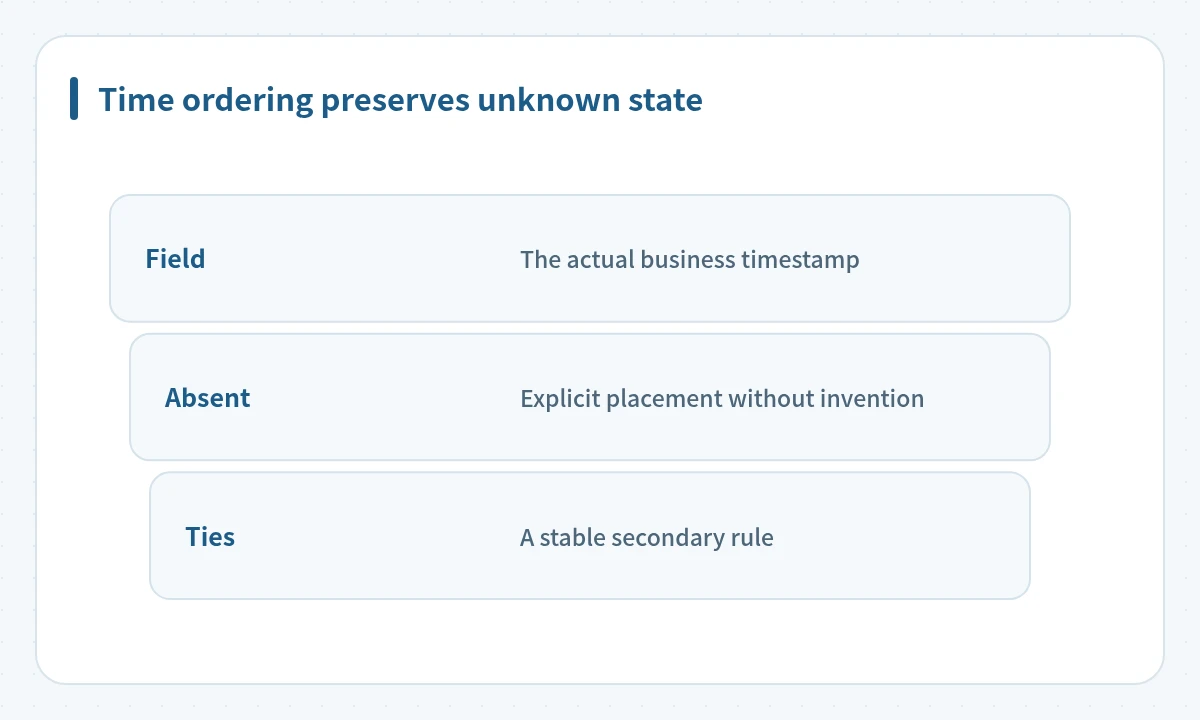
An inbox sorted by time needs an explicit place for records without a date. Unknown time is not the earliest time, and it should not silently become today merely to make the table appear complete.
Preserve the meaning of absence
A disposable online text inbox can lack a date because the source omitted it, processing has not supplied it or parsing failed. Keep those reasons distinguishable where the product needs them. Do not manufacture an event instant just to obtain a sortable value.
PostgreSQL documents controls such as NULLS FIRST and NULLS LAST. Database defaults can differ, so establish the actual query contract instead of depending on a test database's incidental arrangement. The display should let a reader understand why unknown items are placed where they are.
Include ties and pagination in the ordering rule
Specify the chosen time field, direction, unknown-value position and secondary ordering for ties. Keep that rule across pages. A later page using another default can make an operator see duplicates or miss items while believing the whole collection was reviewed.
| Dimension | Decision |
|---|---|
| Known time | The business field being ordered |
| Unknown time | Explicit placement and explanation |
| Equal values | A stable supported secondary order |
| Later update | How a confirmed date changes position |
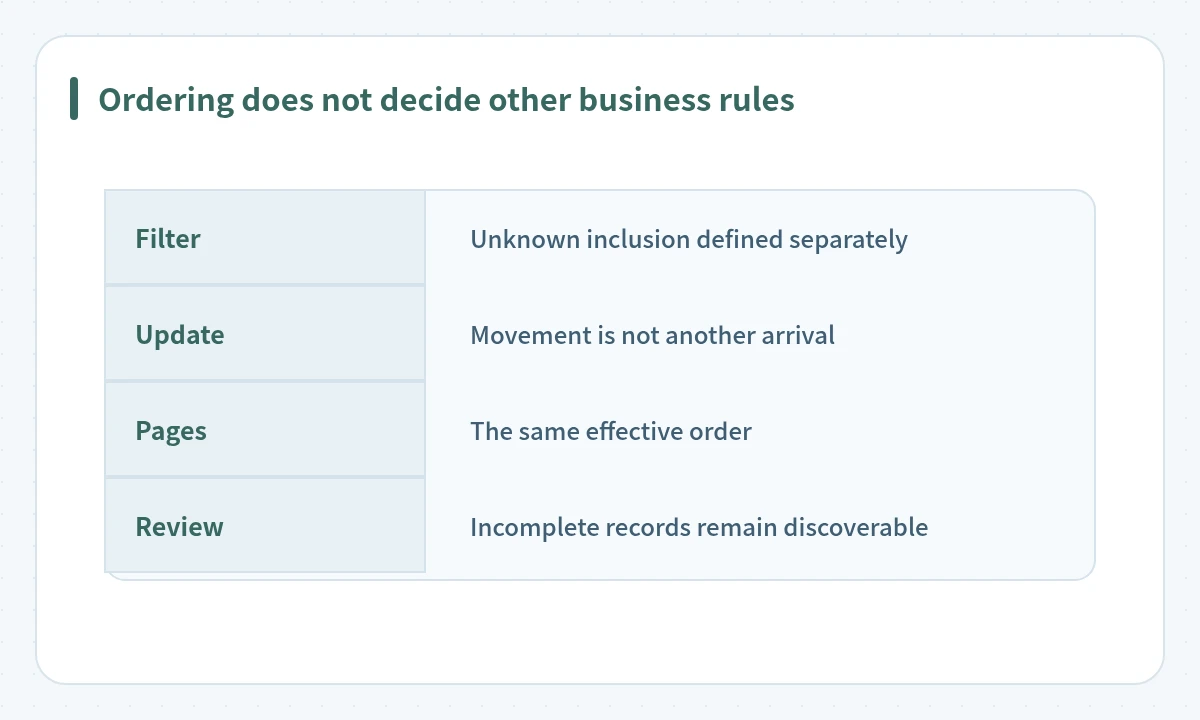
A date-range filter also needs a separate inclusion rule for unknown records. Sorting alone cannot decide whether an item with no date belongs inside a selected interval. Document that query behaviour rather than allowing the interface to imply a relationship it has not established.
Explain movement after a record changes
A newly confirmed date can reposition a record. Keep the original event and actual update relationship, and do not describe list movement as another message arrival. Task tracking should use stable identity instead of the item's current row number.
If the product displays a count alongside the list, use the same effective scope where it promises a direct comparison. Unknown items should not disappear from one side because a helper supplied a fabricated date for the other.
Consider whether the operator needs a dedicated unknown-time filter or a separate review state. That can make incomplete records discoverable without forcing them into a fabricated place on the timeline. Keep its count and result scope explicit, and preserve the original reference if a date is later supplied. Where a task depends on a time interval, decide how unknown records are handled under that task’s own rules. A presentation choice placing them last should not silently mean they are outside every interval or safe to discard. This keeps the data-quality question visible rather than allowing sort order to become an undocumented business decision.
Verify mixed data without rewriting history
Use harmless fixtures with normal dates, tied values, missing input and parse failures. Inspect the list, later pages and export under the defined rules. Record the actual observation rather than claiming a behaviour from an isolated query example.
For a discrepancy, check field meaning and query conditions before bulk-editing historical timestamps. The repair should preserve real information and make unknown state understandable. A precise-looking invented date may simplify a display while leaving a much harder problem for anyone who later needs to explain when the message actually occurred.
