
A webhook signature failure can arise from interpreting its text representation incorrectly. Hexadecimal, Base64 and URL-safe variants are not arbitrary interchangeable strings; follow the provider's actual protocol before comparing results.
Separate the algorithm from its representation
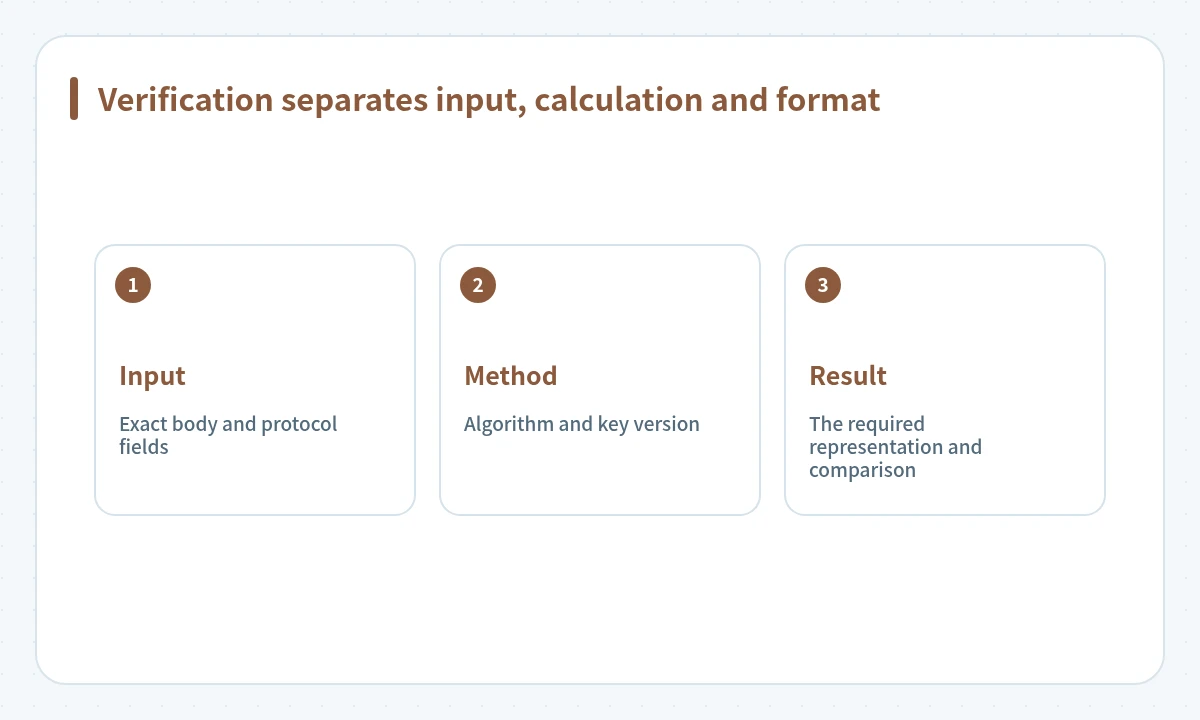
A digital text message number integration needs a defined signed input, algorithm, key version and output format. RFC 4648 describes common Base encodings, but it does not choose which one a particular SMS provider uses. Obtain that choice from the integration contract and approved fixtures.
Do not infer Base64 from a string merely containing letters and digits. Similar text lengths do not establish equivalent results. Check the specified prefix, padding and allowed-character rules, and keep that interpretation separate from reconstructing the data that was signed.
Decoding is not authentication
Recovering bytes shows only that the input meets the relevant representation rules. The verifier still needs to calculate and compare the expected result under the protocol and perform the required freshness and resource checks. A successful decoder cannot establish a trusted sender.
| Layer | Review |
|---|---|
| Input | The exact body and protocol fields |
| Algorithm | The documented method and key |
| Representation | Hex or the specified encoded form |
| Comparison | The protocol and library's safe method |
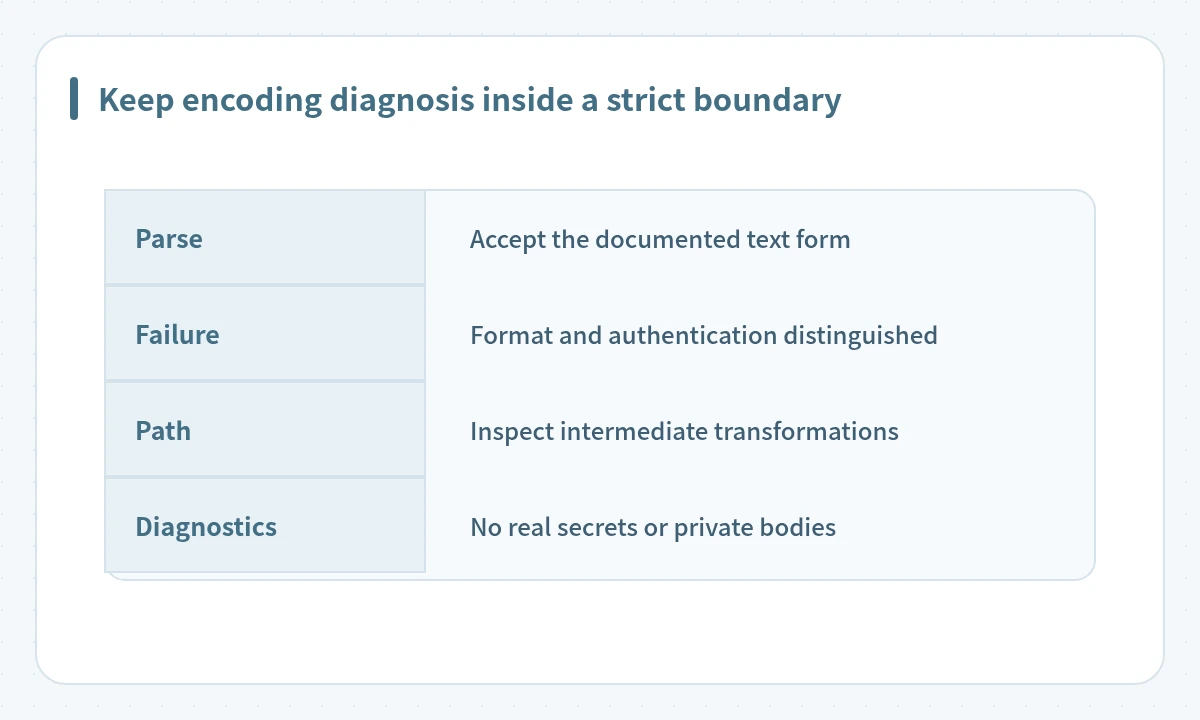
Avoid trying several permissive decoders and accepting whichever produces a convenient match. Compatibility needs an explicit basis. Invalid representations should reach a clear rejection path rather than silently becoming another accepted value.
Check transformations between the sender and verifier
Header handling, form decoding and proxies can change text. Trace the actual field through those boundaries and distinguish representation damage from changes to the signed body. Repairing the final signature string alone can miss a separate reserialisation problem in the input.
Keep key selection tied to the provider's supported versioning arrangement. A format investigation is not a reason to log production secrets or try unrelated keys without a defined selection rule. Retain only the information needed to identify the relevant protocol configuration.
Check the documented treatment of padding and alphabets at the boundary that receives the signature. A tool may display an encoded value in a shortened or transformed form, while the request requires the original representation. Use an approved fixture that passes through the actual header or parameter reader. Keep format rejection distinguishable from a correctly parsed signature that fails verification, so operators investigate the appropriate layer instead of changing the cryptographic configuration to compensate for an input-format defect.
Exercise invalid inputs as well as the expected fixture
Use the provider's supported test material in an authorised environment. Check the correct format, a wrong key, changed content and invalid characters. Inspect the actual verification result, not merely whether a parser returned a byte array without throwing an exception.
Record algorithm identifiers, handling categories and limited request references. Do not upload full private payloads to a public signature-checking tool. After the fix, keep strict verification in place and classify remaining failures accurately; an encoding repair should not become a broad bypass or a reason to label every authentication failure as a harmless formatting issue.
