
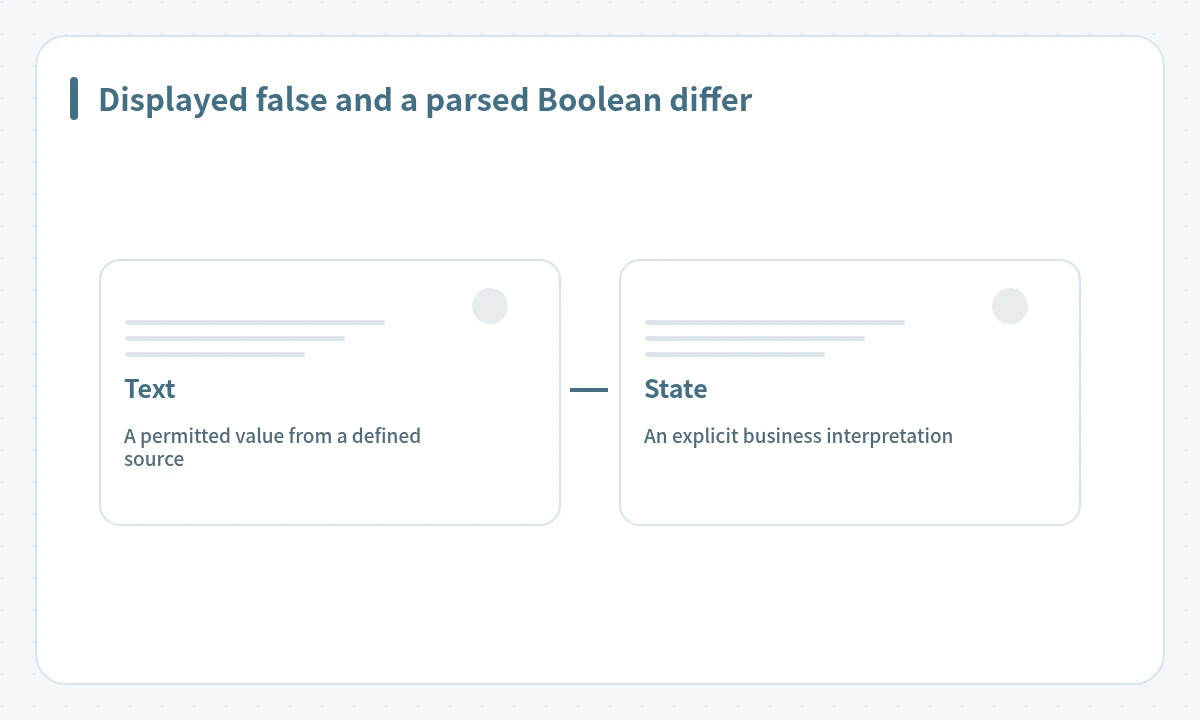
A setting displaying false can still be treated as enabled when code converts a non-empty string directly to a Boolean. Parse the agreed type and permitted values explicitly instead of letting a readable label stand for the actual runtime state.
Inspect the value's real type
A short term digital sms inbox configuration can pass through forms, files, storage and APIs. MDN's Boolean documentation explains JavaScript conversion behaviour: a non-empty string does not become false merely because its letters express a negative word. Check the actual rules of any other language in the path.
Find where the value became text. Changing the visible button or label alone can leave the underlying stored input interpreted differently by a worker. The investigation should include the actual consuming process, not only the settings editor.
State the accepted contract
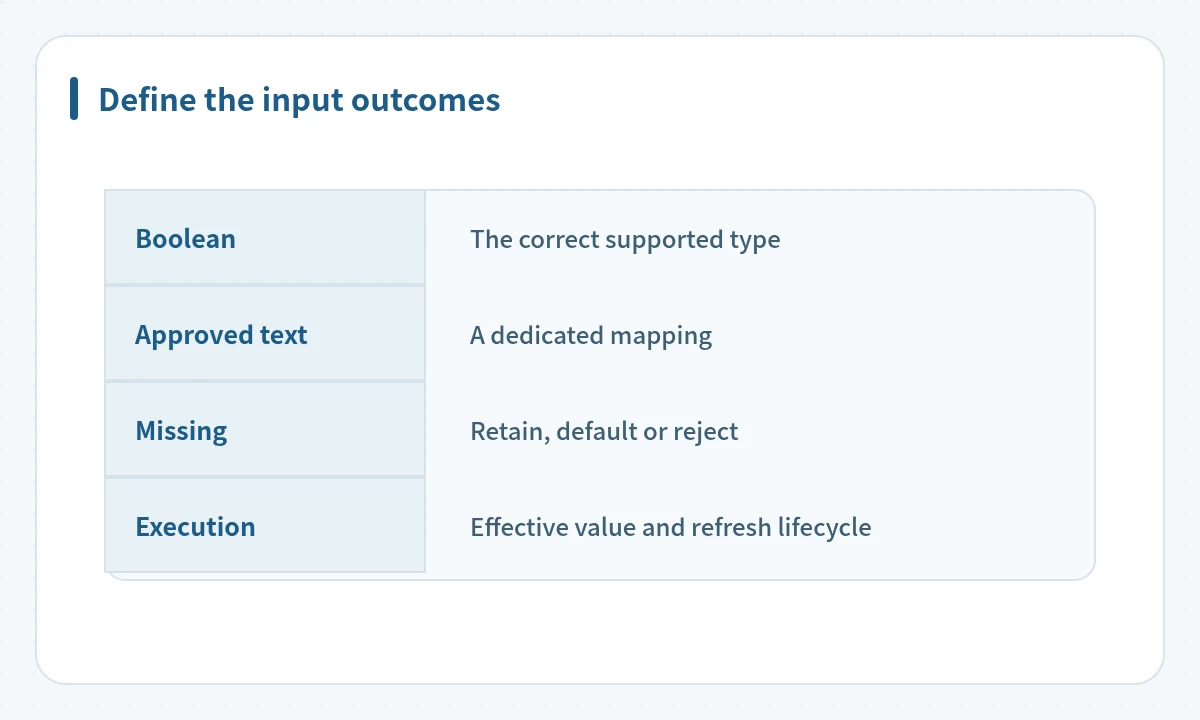
If an API requires a Boolean, reject unsupported string input clearly. If a configuration uses text, define its permitted values, case rules and missing-value behaviour, then map them through a dedicated parser. Avoid relying on a permissive generic conversion to infer the operator's intention.
| Input | Required decision |
|---|---|
| Boolean | Use the explicit supported type |
| Approved text | Apply the documented mapping |
| Missing field | Distinguish retain, default and required error |
| Other value | A clear invalid-configuration result |
The default must follow the real business design. A parsing failure should not silently become enabled or disabled in every context. For settings that can trigger external contact, an unexplained fallback can conceal the original configuration fault while creating a different effect.
Verify execution after saving
Inspect the effective configuration and a harmless controlled task. Form submission, backend storage and worker reading need the same definition. A grey button is not sufficient evidence that the execution path has stopped interpreting an old string as active.
Check how cached settings are refreshed under the product's design. A correct newly saved value can coexist temporarily with a worker still using an earlier configuration. Keep that lifecycle distinct from a parsing defect so the repair addresses the actual cause.
Keep deployment configuration and per-account settings distinct when locating the source. One may be read only when a worker starts, while another may follow a supported refresh path. The system’s actual lifecycle determines which observation proves the new value is effective. Record the tested configuration source and execution reference so a later operator can reproduce the result. Do not replace an explicit invalid-value error with a silent default merely to keep the page usable; that can conceal whether the operator’s intended setting was ever accepted. A clear rejection is more informative than a control whose label and effect have drifted apart.
Cover the full set of supported inputs
Exercise explicit types, documented text, empty, missing and invalid values through the relevant paths. Use fictitious tasks rather than repeatedly contacting real recipients to discover whether a switch works. Verify both the accepted outcome and rejection message.
Record the field, source and error category without copying credentials or the whole configuration. Update affected readers and the supported treatment of older values after the fix. The result should be a traceable state, rather than an apparently uniform display built on implicit conversions that different components interpret differently.
