
A number-validation request can stall because of matching cost, not only network delay or input length. Inspect the actual regex engine, pattern, input bounds and execution boundary rather than adding an indefinite waiting indicator.
Validity and computational cost are separate
A sim free digital sms inbox integration may use a regular expression for a limited format check. OWASP's ReDoS explanation describes how certain patterns can consume substantial time on particular inputs. Normal examples completing quickly do not establish the cost of every input the endpoint permits.
Keep the business purpose narrow. A progressively more complex pattern should not be expected to infer country context, line type and receiving capability at once. A format check cannot replace the provider's actual capability information.
Bound the real input path
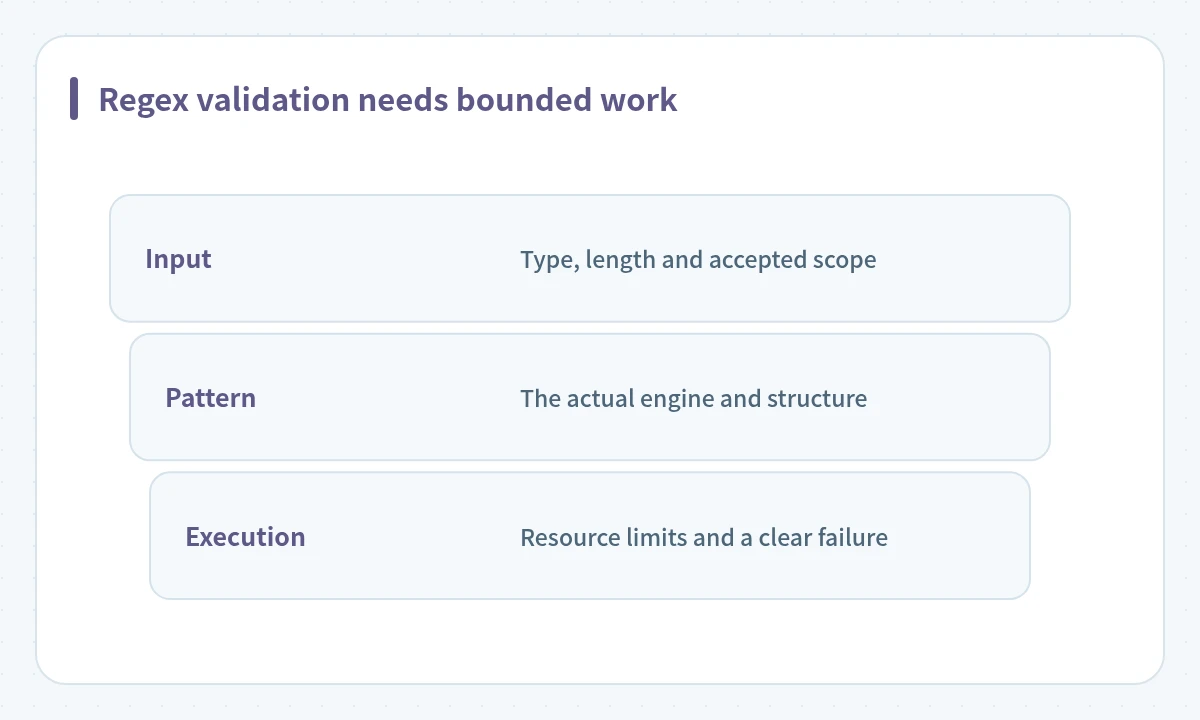
Define allowed type, length and characters from the contract, then evaluate whether a regex or a more direct parser is appropriate. Backend handling still needs its own boundary; the caller is not required to use the visible form that performs client-side checks.
| Layer | Review |
|---|---|
| Input | The supported type and maximum scope |
| Pattern | Potentially expensive matching structure |
| Engine | The actual supported limits and behaviour |
| Execution | A bounded failure or timeout result |
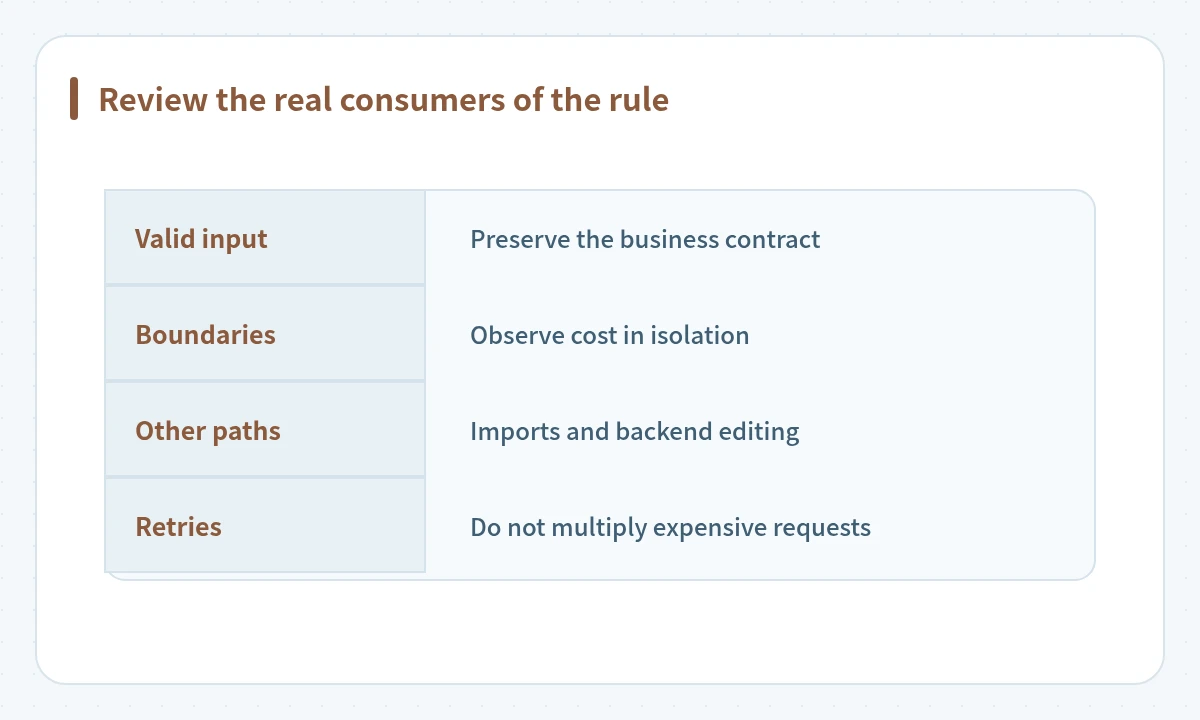
A replacement should preserve the intended valid inputs. Making a rule faster by accepting everything is not equivalent validation. A timeout should not be silently interpreted as either a valid format or proof that the destination can receive a message.
Exercise boundaries only within authorisation
Use synthetic non-sensitive inputs in an isolated environment with defined resource limits. Cover normal, invalid and boundary cases through the actual handler. There is no need to send expensive requests to another organisation's endpoint or test limits on production traffic.
Record observed timings only from the authorised exercise and keep their scope explicit. A diagnostic demonstration is not a universal performance claim for every engine version or deployment. Avoid fabricating throughput figures to make the recommendation sound more precise.
Review the response to a validation timeout separately from a retry decision. Repeating the same expensive input immediately can multiply resource use while leaving the original question unresolved. The endpoint should return the designed bounded result and give operators enough information to locate the rule version. If execution limits differ across workers, test the deployed path rather than relying on a development tool’s successful run. Record input size and classification using synthetic fixtures, without publishing a reusable stress payload or exposing customer numbers. That creates useful performance evidence while keeping the validation contract and test authority clear.
Replace the rule across its real consumers
Inspect registration, import, backend editing and API paths for continued use of the old rule. A page-only change can leave the same expensive operation reachable elsewhere. Retest relevant fixtures when the dependency or engine changes.
Keep the rule version, input length and failure category in diagnostics rather than full numbers or message bodies. The desired result is explainable bounded validation. Uncontrolled retries can increase work while concealing the pattern and lifecycle issue that actually needs repair.
