
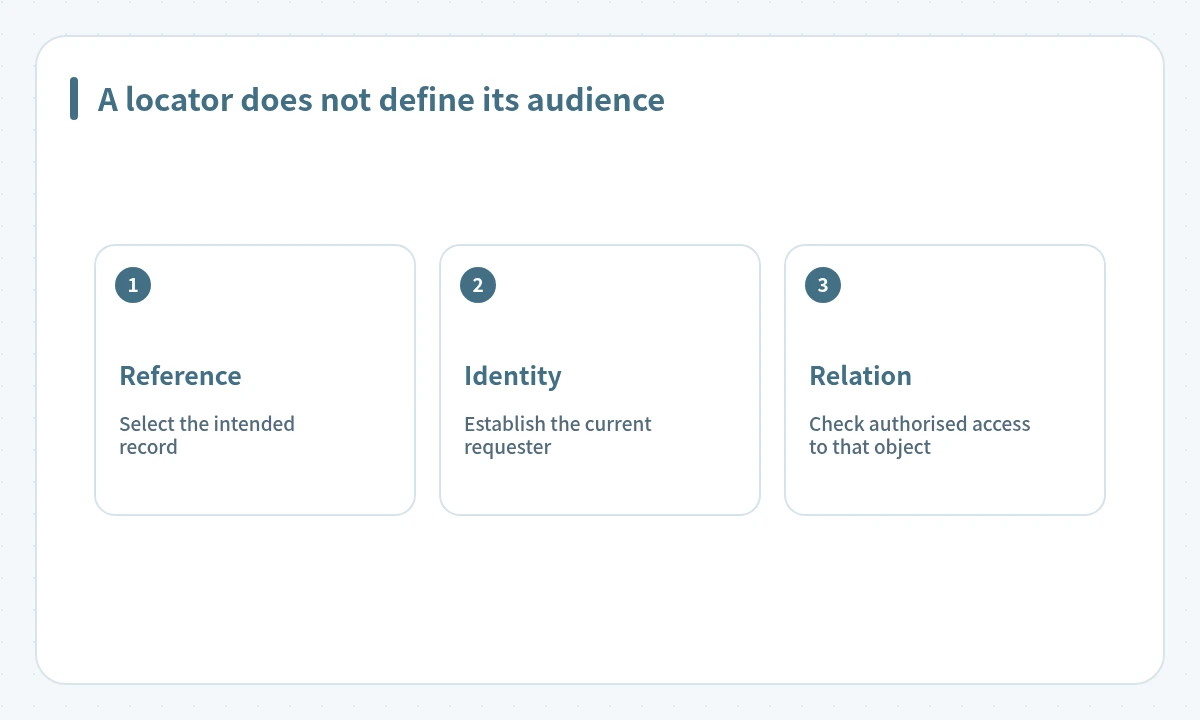
A long, hard-to-guess message identifier is not permission to read the message. Personal SMS inbox access should validate the current user’s relationship to each requested record. Identifier complexity can reduce guessing opportunities while leaving the actual authorisation problem unresolved.
Query inside a trusted resource context
Establish the user and tenant through the real authentication process, then constrain access to the appropriate records. Do not accept a client-supplied owner or role as proof of authority. A global object lookup needs the relevant relationship check before content is returned.
The relationship may depend on personal ownership, membership or a workspace role according to the actual product. When it changes, later requests should use the current rule. Having opened a detail page earlier does not create permanent access to its content.
Keep administrative inspection distinct from ordinary user access. A privileged maintenance path can legitimately have a different role, but it should not silently become the path used by normal detail requests.
Treat a reference as a locator
A screenshot, bookmark or log can reveal a record identifier. Someone obtaining that value has acquired a locator, not necessarily authority over its body. The same distinction applies to adjacent identifiers with a familiar format.
Choose appropriate feedback for missing and unauthorised resources under the application’s policy. Avoid disclosing another tenant’s content or unnecessary object details in an error response. Provide legitimate users a recognisable support route for unresolved access issues.
Do not merge a public listing feature with private message permissions. If a product intentionally shares selected content, define that mechanism’s scope and lifecycle separately from normal authenticated record access.
Cover every route to the object
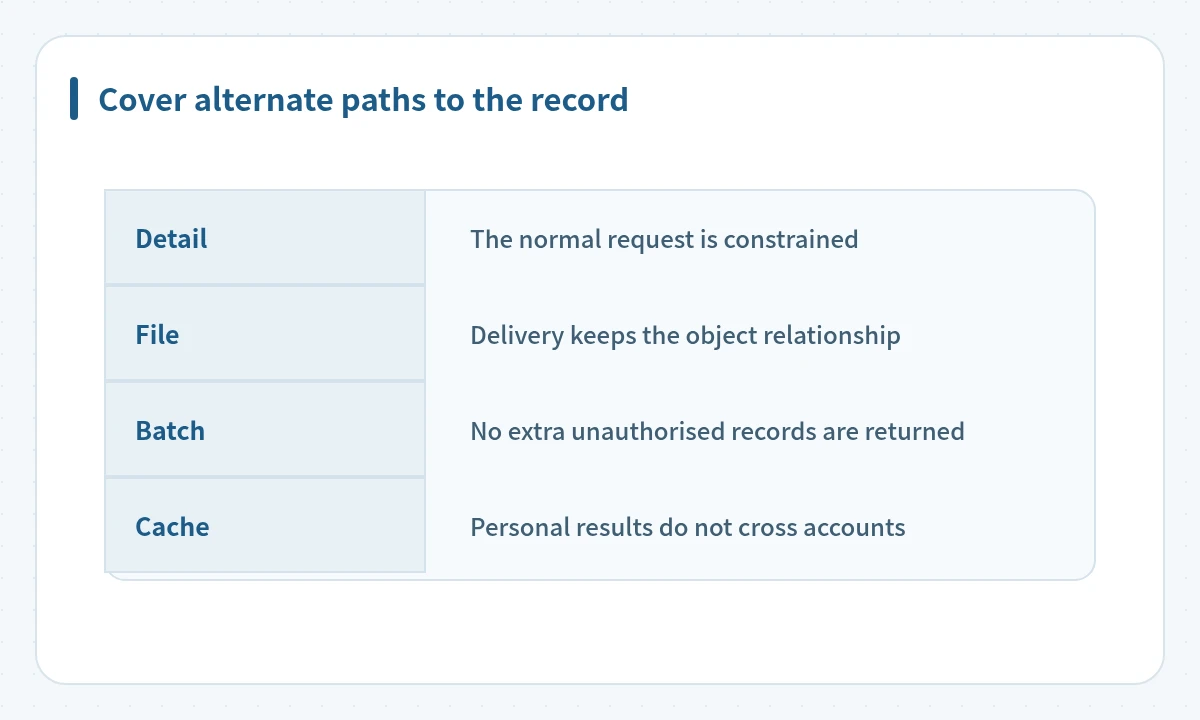
A protected detail view can be undermined by an attachment endpoint that retrieves files using only the message reference. Search previews, export controls, background status views and older links need the relevant object boundary as well.
Caching is another path to inspect. Personalised data should not be reused across accounts merely because the URL matches. A storage service or proxy involved in delivery must preserve the actual intended authority, not only the application page that generated a link.
Batch requests need the same object treatment. A caller permitted to read one requested identifier should not receive an entire unfiltered set because part of the batch is valid. Define the supported all-or-part outcome and test it with separate controlled records, keeping unauthorised content out of both success and error output.
Use two controlled identities for verification
Create harmless records for accounts A and B. Under their normal sessions, confirm intended access to their own resources and rejection of the other account’s reference. Include signed-out access and a removed-role case where the design supports it.
Test the deployed route, including file serving and relevant proxies. Do not use another customer’s real messages to demonstrate a boundary failure. Retain the intended role, requested object and decision without collecting private bodies.
If an access defect is found, constrain the affected route and follow the responsible incident process. Replacing identifiers with longer random strings is not the complete repair. The useful evidence is that the server consistently validates the actual user-object relationship at each relevant path while the permitted task remains usable.
Reference: OWASP: direct object reference protection.
