
Sending-queue validity and the lifetime of a verification code are separate timers. Define both boundaries instead of treating a queue setting as an end-to-end delivery or verification deadline.
Place each clock on the actual path
A business creates a verification request. Its messaging provider accepts an outbound message and may queue it. The message then progresses through further network stages before the receiving service and browser can display it. The business verifier determines whether the code is still valid when submitted.
Twilio’s Messaging Services documentation says its validity-period control applies while the message is in Twilio’s platform. A carrier can still queue a message afterwards. This provider example shows why the parameter is not an overall delivery guarantee and does not reset a business code’s expiry.
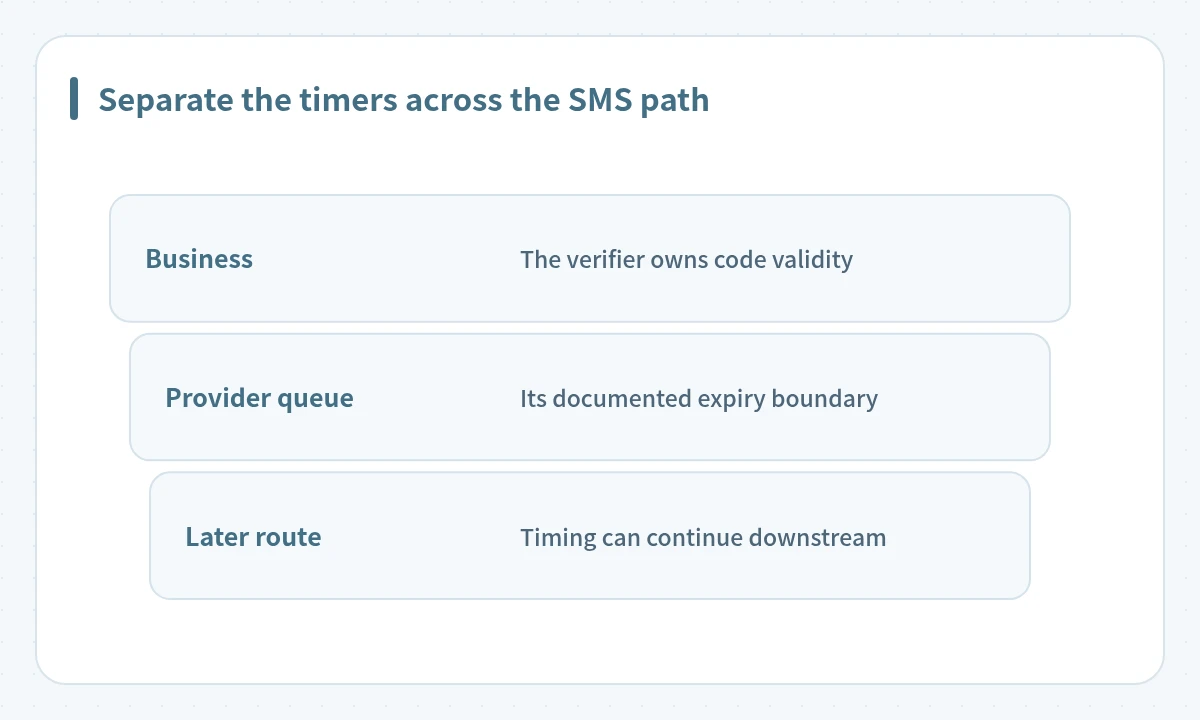
| Condition | Owner of its meaning |
|---|---|
| Business verification window | The service issuing and validating the code |
| Provider queue validity | The documented outbound messaging parameter |
| Later network timing | The relevant downstream route and records |
| Browser visibility | The supported receiving and display process |
Expiry needs a business outcome
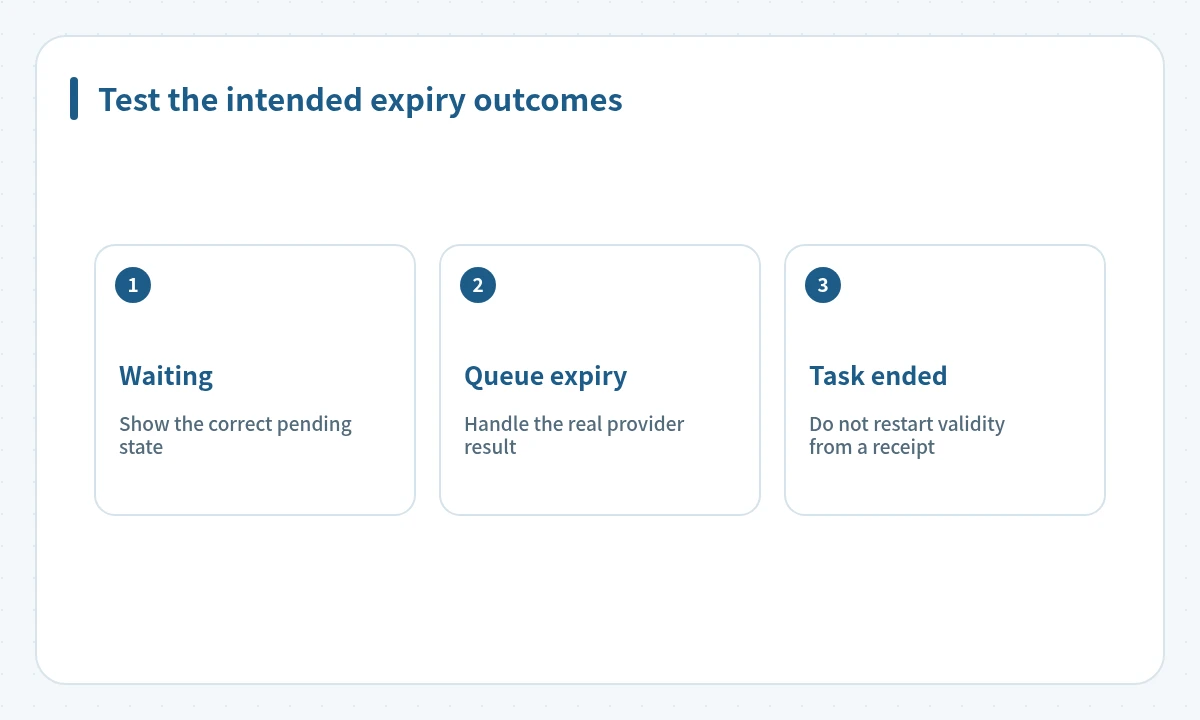
If an outbound message expires in the provider queue, the application should handle that recorded result rather than indefinitely telling the user to enter a code that has not been sent. Where restarting is permitted, maintain the association between the old task, the new request and any new secret.
Do not extend verification indefinitely merely to accommodate a backlog. The queue policy and authentication policy serve different purposes and should be set by the responsible application owner using the current service requirements. A receiving page’s refresh interval is not an appropriate source for either value.
Verify parameter units during configuration as well. A documented value in seconds should not be populated from an internal millisecond setting without an explicit conversion. Retain which level supplied the value when both service defaults and individual-message settings are supported, so the effective policy can be explained later.
Test the boundaries without manufacturing traffic
In an isolated test, model a waiting message, provider-queue expiry, departure from the provider and a business request that has already ended. Check the application’s handling and displayed status at each point. These fixtures describe expected behaviour; they are not measurements of a live provider’s delivery performance.
Keep creation, acceptance, relevant status changes and business completion as distinct recorded events. If everything is collapsed into a field called sent time, an operator cannot determine which expiry rule applied when a delayed code eventually appeared.
Also consider a stale screen. A user may see a fresh inbox refresh even though the underlying business request is no longer active. The interface should use the target service’s current request state rather than suggesting the displayed receipt time restarts validity.
For a real authorised investigation, provide task and message references with the relevant timestamps, excluding the live code itself. The aim is to establish where waiting occurred and how the business handled the result. It is not to prove compatibility with every verification site or to promise that changing one queue parameter will make delivery immediate.
Reference: Twilio: Messaging Services validity period.
