
A shared SMS work queue can keep showing healthy total throughput while one busy account leaves others waiting. Review how work is admitted and scheduled before treating more global worker threads as the complete answer.
Define the fairness boundary
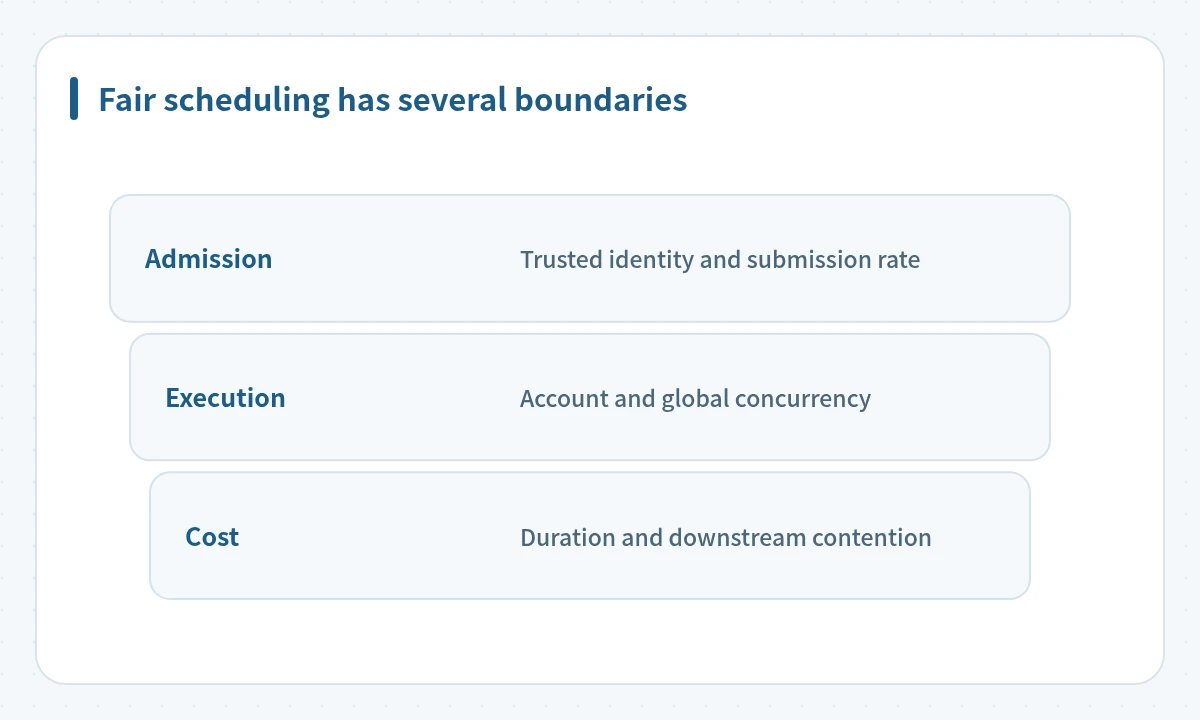
An easy access sms inbox number can belong to an account with very different workload from its neighbours. Separate submission rate, concurrent execution and actual processing cost. Equal task counts do not mean equal resource use when a long export and a short lookup are both represented by one queue entry.
Derive the account or workspace identity from a trusted server-side relationship. An arbitrary client-supplied label must not let one caller appear as many independent tenants. Otherwise, a per-account policy can be bypassed without changing the workload that originally monopolised the system.
Choose a policy that can be explained
Depending on the service design, evaluate account rotation, per-account concurrency limits or controlled queues for different work types. The appropriate policy depends on load and service objectives. Avoid presenting a fixed quota as universally fair without measuring how actual tasks consume the shared resources.
| Measure | Question |
|---|---|
| Waiting time | Are particular accounts persistently delayed? |
| Execution time | What does the work actually cost? |
| Concurrency | What is limited per account and globally? |
| Retries | Can failures repeatedly displace new work? |
Fair scheduling and business priority are related but separate choices. Where priorities exist, define the authorised source and the limits on each class. Letting every client declare its own task urgent eventually removes the distinction and leaves the original contention unresolved.
Put retries inside the same scheduling model
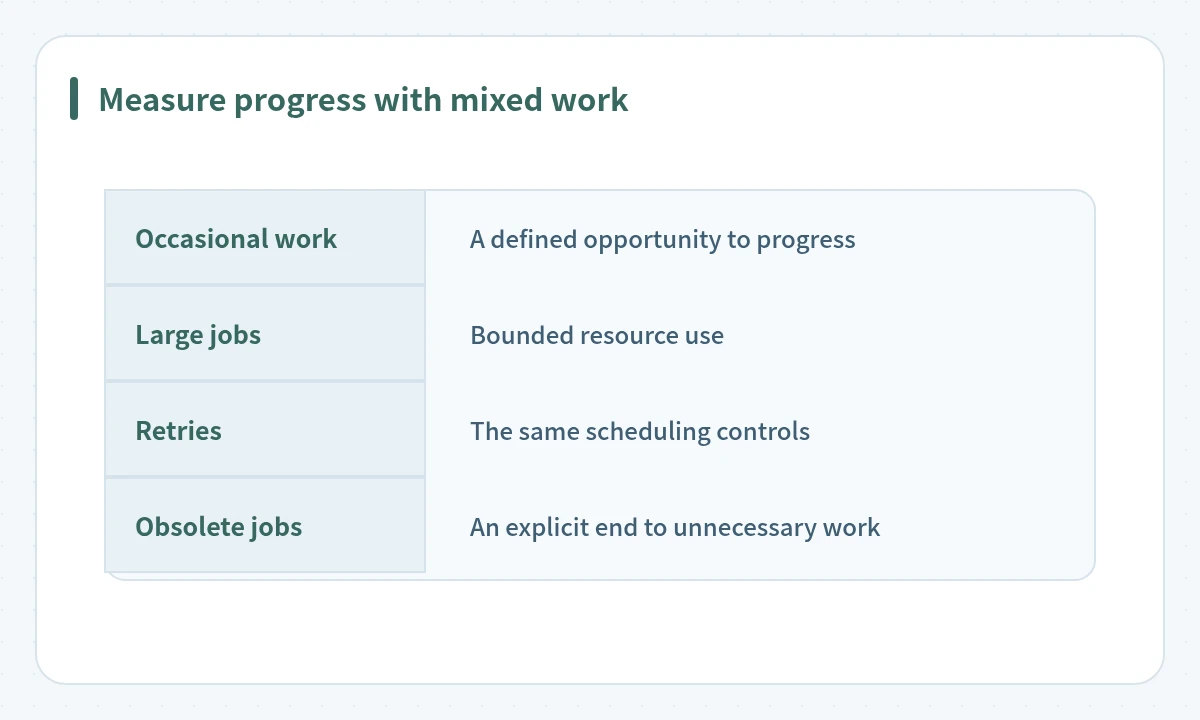
A failed task should follow its defined retry interval and attempt policy without bypassing account controls. Continuous immediate retries can consume the capacity intended to help other work progress. Keep cancelled and obsolete tasks out of active execution through an explicit lifecycle, rather than expecting rotation alone to make wasteful work harmless.
Review long-running operations for supported interruption or bounded units of work under the application's design. A scheduler can rotate queued items fairly while one already-running operation still occupies a scarce downstream connection. Observe the full execution path before attributing every delay to queue order.
A downstream service can impose its own shared limit, so observe where a worker actually waits. Holding scarce worker slots while repeatedly calling a limited dependency can undermine a fair queue at the application boundary. Use the supported retry and scheduling design to release or defer work appropriately. Measure the effect on the occasional-task accounts rather than declaring fairness from the order in which queue items were first selected.
Test a mixed workload
Use an isolated environment with a high-volume account and accounts submitting occasional tasks. Include long and short operations, retrying failures and cancellation. Measure the actual wait and outcome for each group without inventing a throughput claim from an unrecorded test.
Watch for a stable opportunity to progress, not merely a higher global completion count. Preserve task references and scheduling reasons in diagnostics without turning private message bodies into performance logs. The useful operational result is a queue policy that can explain why work waits and that prevents one account's workload from silently becoming everyone else's indefinite delay.
