
Omitting a setting, sending null and sending an empty string need not request the same change. A personal online SMS inbox integration should preserve those distinctions according to its endpoint contract. Filling every missing field with a default can turn a limited update into an unintended reset.
Identify the update format and target
Read the method, media type and field rules for the current endpoint. PATCH does not imply one universal merge behaviour. RFC 7396 defines JSON Merge Patch, where null has a special removal meaning, but that is a particular format rather than a rule for every JSON API.
Confirm the intended account, receiving resource or workspace before constructing the change. A complete object read earlier should not automatically be sent back as the update. It may contain read-only fields or values another process has since changed.
The client should know which fields this user actually edited. A form’s hidden value and an omitted property can express different things, so serialization needs to follow the business contract rather than whatever is easiest to submit.
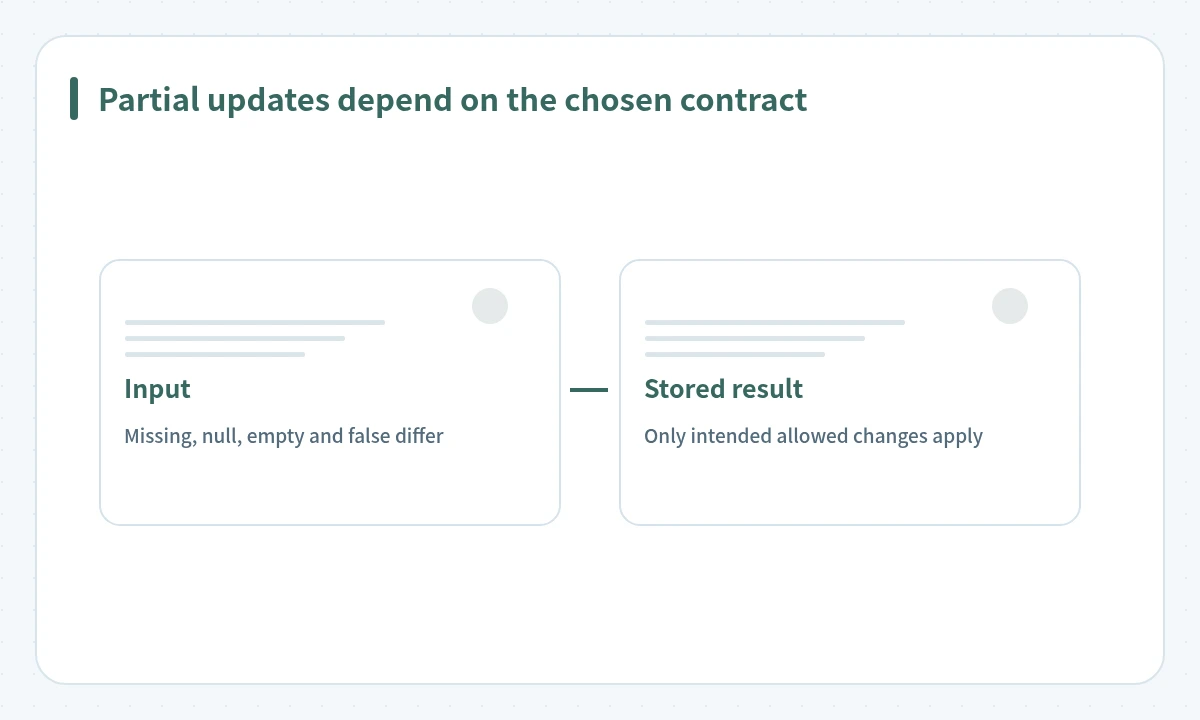
Preserve whether a field was present
After parsing, check presence separately from type and allowed value. Turning an absent boolean into false can disable a setting that was meant to remain unchanged. Treating an empty string as absent can also prevent a supported explicit clearing action.
Use an allowlist of mutable properties under the actual permission rules. An external object should not automatically update internal ownership, roles or lifecycle fields merely because their names match model properties.
If the contract rejects a particular null or empty value, report the error clearly. Do not silently substitute another value and present the save as if the original request succeeded. That conceals the meaning needed to diagnose later state differences.
Handle concurrent updates separately
A partial request can reduce unrelated overwrites without solving conflicting edits to the same field. Where version or conditional-update support exists, follow its documented mechanism. Do not assume that choosing PATCH alone provides concurrency control.
After saving, reopen or obtain the effective value through the normal supported response. The unchanged local form is not independent evidence of the server state. When a save fails, preserve an accurate distinction between unsaved input and the last confirmed setting.
Review an error response alongside the successful update. If a caller cannot tell which properties were accepted, it may repeat the change with a broader payload. Use the endpoint’s supported atomicity and error contract, and inspect stored state after invalid input. Do not invent a partial-success meaning from the HTTP status alone.
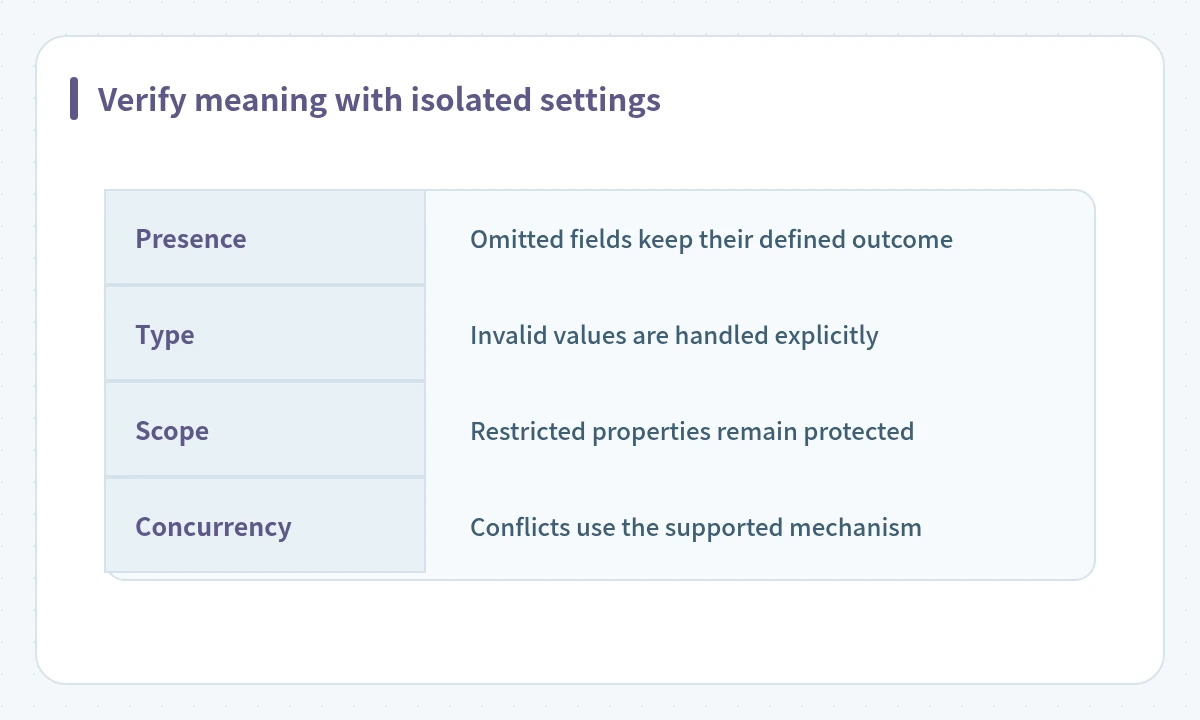
Use a fixture for each intended meaning
In an isolated configuration, test missing, null, empty text, false, zero and an ordinary supported value. Write the expected result for each. Nested objects and arrays need their own cases under the chosen format; a simple object example cannot define them all.
Inspect the stored result, including fields not submitted. Confirm that restricted properties remain protected and validation failures do not create partial unintended changes. Do not use real keys or private message records as sample settings.
Retain the endpoint, format and observed field outcome in the maintenance note. The useful result is a clear mapping from the submitted representation to the intended change, with unrelated state and permission boundaries preserved.
Reference: RFC 7396: JSON Merge Patch.
