A rejected number is not the same as an accepted request whose message is missing. Preserve the exact target-page response and check the submitted value before investigating the inbox.
Preserve the wording of the rejection
An incorrect format, an unsupported region, a number already associated with an account and an explicit number-type requirement are different responses. Record what the target page actually says. Do not rewrite a vague error into a technical diagnosis that the service has not supplied.
Check the submitted value against the resource you are authorised to use and the target's documented input format. A country selector, a stored contact or an automatic fill may affect what was submitted. Correct a genuine input error through the normal interface rather than changing characters to disguise the resource.
A well-formed number is not automatically eligible for every use. Conversely, a rejection at one business does not establish that the receiving provider is unable to receive any ordinary text. Keep the target's acceptance conditions and the provider's actual capability separate.
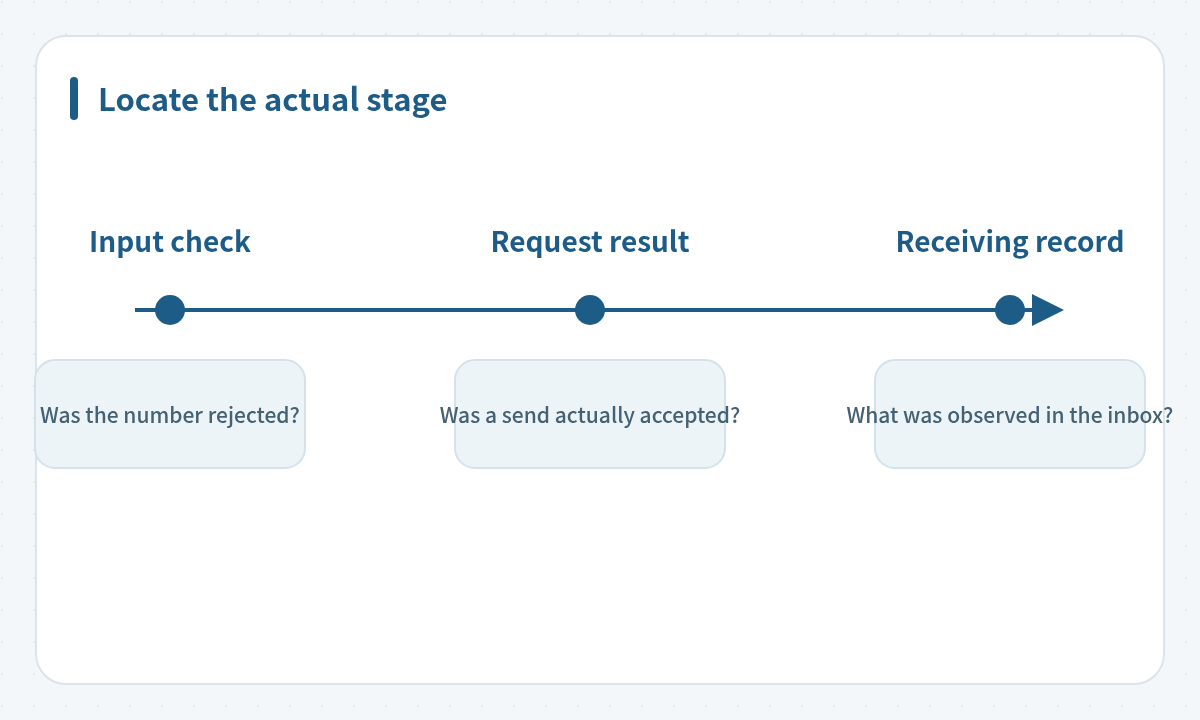
Use the target's current requirements
If the service explicitly requires a particular type of number, read its official help information and supported alternatives. Labels used by different providers do not always explain the same technical or product conditions. Do not rely on an unrelated blog promising universal compatibility.
Ask a precise question through the known support route when the requirement is unclear. Explain the authorised task and the visible error without requesting access to someone else's account or disclosing live authentication material. The receiving provider can describe its own resource, while the target business determines its own accepted process.
Do not repeatedly alter formatting, cycle resources or use another person's credentials to evade an explicit restriction. A supported alternative needs to meet the service's actual conditions. One successful attempt would not establish that a prohibited or unsupported arrangement became appropriate.
Distinguish an accepted form from a confirmed send
A page moving to the next step may still display a pending or failed request. Read the result instead of assuming that acceptance of the input proves transmission. A countdown or a disabled button also needs to be interpreted according to that service's instructions.
Only when the task has reached a legitimate receiving stage should you inspect the correct inbox and time range. If no matching record is found, keep the sending status, receiving observation and browser state as separate facts. An empty list alone cannot identify the earlier rejection or its cause.
For a test, use an authorised, non-sensitive scenario wherever possible. Do not run repeated real account recovery attempts to discover a provider's capabilities. A compatibility question should not become an experiment against an account you are not entitled to handle.
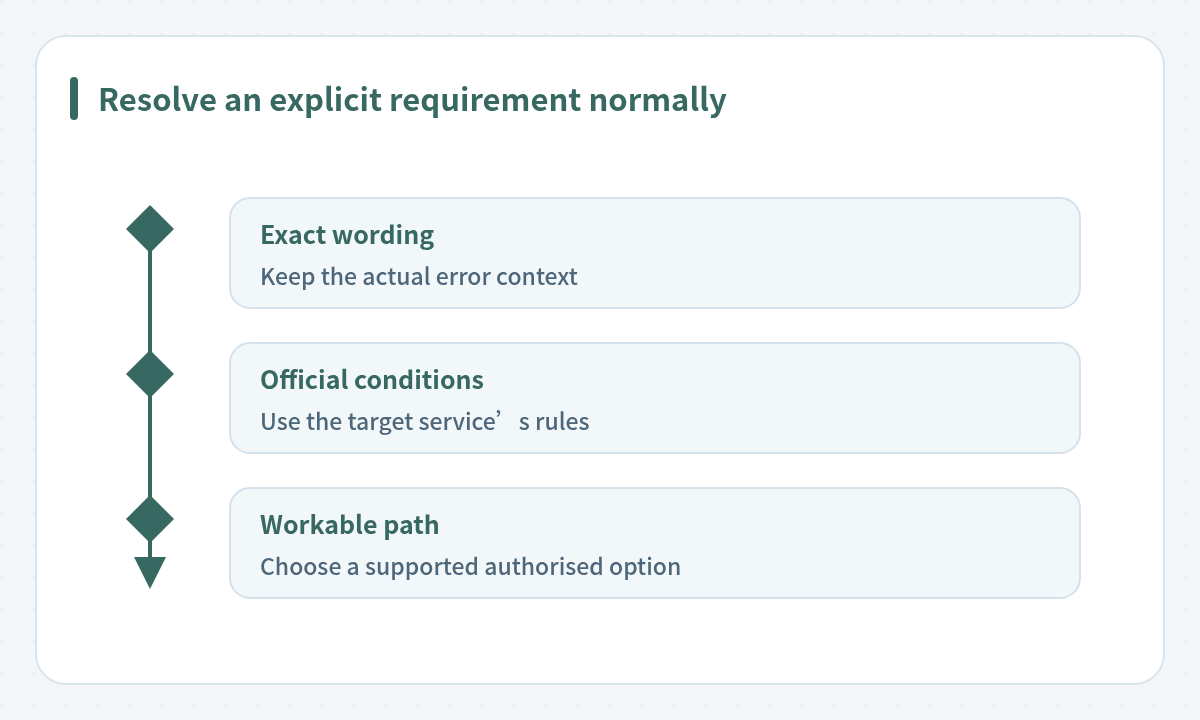
Decide whether the receiving stage was reached
Format errors, unsupported types and an existing-account association need different follow-up. A page advancing or showing a countdown still does not independently prove a text was sent.
Resolve the target’s requirements through its known help route. Only after a legitimate sending step should you examine receiving records; neither repeated resource purchases nor altered formatting clarifies an explicit eligibility rule.
Choose a workable path before creating a dependency
If an appropriate receiving arrangement or supported alternative is unavailable, pause the task. Do not create a long-lived account relationship around a temporary workaround whose future access conditions are unknown. Later sign-in and recovery can impose requirements beyond the first receiving attempt.
Questions about replacing a resource or the treatment of an order belong to the provider's current official terms. A target site's rejection does not automatically establish a refund or replacement condition, and this general guide cannot supply those policies for an unspecified service.