
A monthly reminder on the thirty-first needs an explicit rule for months without that date. Skipping, using the last day and moving forward are different arrangements; a date library should not choose the business meaning silently.
Define the recurrence you intend
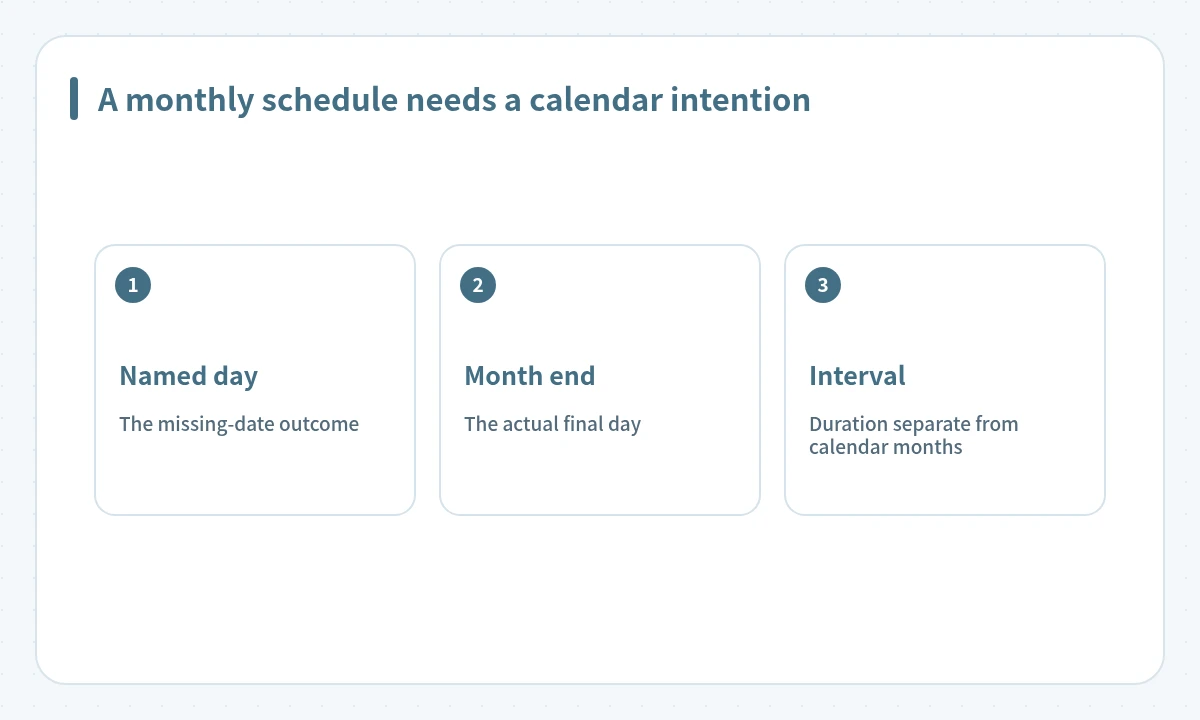
A dedicated sms text receiver workflow can schedule a specific day of each month, the actual month end or a fixed duration. Those are different rules. Repeatedly adding a convenient number of days cannot represent every calendar-month intention correctly.
RFC 5545 defines recurrence behaviour, including invalid-date handling, for its calendar format. If a product uses that standard or a particular library, inspect its actual semantics. Do not infer that every business scheduler applies the same default merely because its interface says monthly.
Preview the boundary months
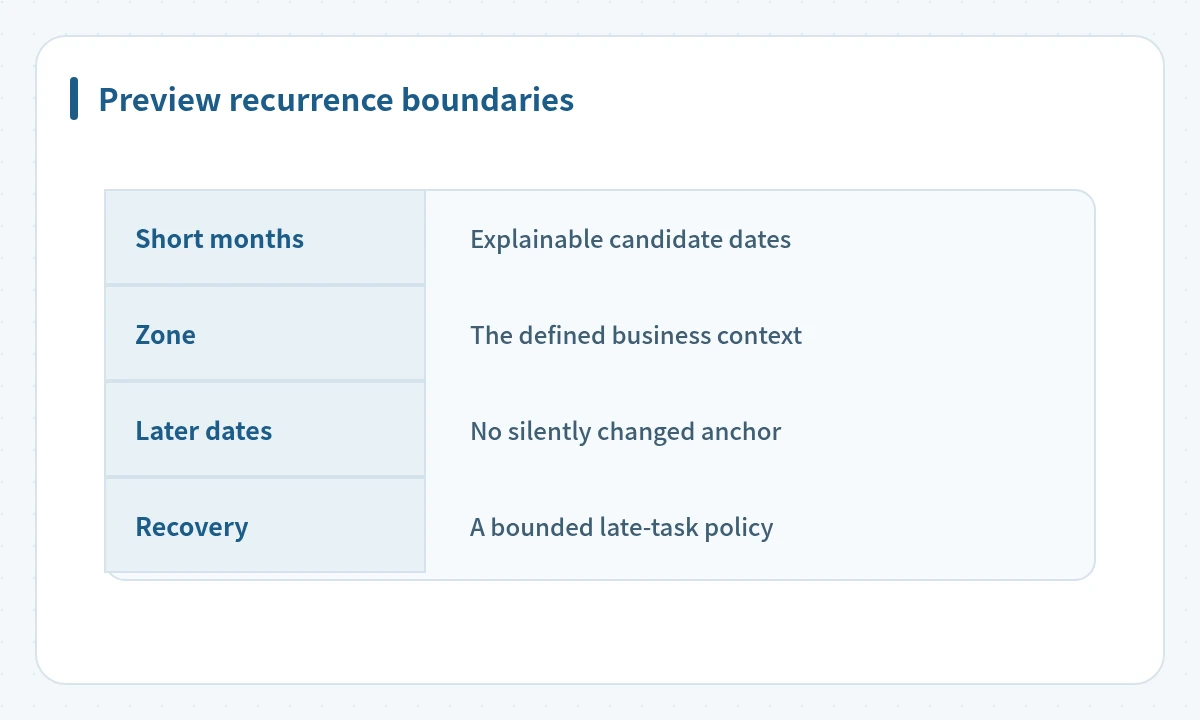
Show explicit upcoming dates covering short months and the relevant special-date conditions. If the business means the last day, use a supported rule expressing that meaning rather than select the thirty-first and hope the software guesses the intended adjustment.
| Intent | Definition needed |
|---|---|
| Named day | The outcome when that date does not exist |
| Month end | The actual last day of each month |
| Fixed interval | Duration rather than calendar-month behaviour |
| Execution time | The applicable business time zone |
Do not infer the task's zone from the receiving number or operator's device. The authorised owner should be able to explain the resulting schedule. A date preview and time-zone definition make that explanation concrete instead of leaving recipients to reconstruct it from reminders.
Change future rules without rewriting past facts
Specify when a revised rule takes effect and how already generated work is handled. Completed historical events should not be shifted to a new month-end pattern simply to make the calendar look consistent after an edit.
Keep the schedule version related to its generated tasks. A delayed worker needs the design's actual rule about current applicability rather than automatically sending every old occurrence whenever service resumes.
Keep the next occurrence as a result of the named recurrence rule, not as a new starting rule inferred from whichever date happened last. Otherwise an adjustment made for a short month can unintentionally shift the pattern for later months. Document whether the original requested day remains part of the schedule’s intent and inspect the following occurrences in the preview. If the system exports a calendar representation, verify that the receiving tool interprets the supported rule as intended. A visually matching first occurrence is insufficient evidence about the continuing series. Use harmless fixtures covering several consecutive months and keep any unsupported conversion explicit rather than silently substituting another recurrence.
Rehearse without changing the server clock
Use a controllable test clock and fictitious tasks to inspect candidate dates, actual enqueueing and late execution. Give missed reminders a defined recovery or abandonment condition. Avoid unbounded catch-up that contacts real recipients repeatedly after an outage.
Record the rule version, time zone and limited task reference without private message content. The useful result is a visible executable schedule whose short-month behaviour is intentional, rather than one monthly label hiding several incompatible interpretations.
Reference
RFC 5545: Calendaring and recurrence
