
Automatic SMS link previews can make a server send requests chosen by message content. A virtual web SMS receiving interface should not treat an incoming link as permission to contact any destination. Previewing needs its own network, data and resource boundaries, separate from ordinary text display.
Decide whether fetching is necessary
Displaying the message does not require the server to open every URL. A text-only presentation can leave the intended user to assess a link in its business context. Automatic fetching adds access attempts, retained observations and possible information disclosure.
If the feature is needed, define the supported address sources and protocols. A familiar sender name cannot replace destination validation. The preview service is acting with its own network position, which can differ substantially from that of the user who eventually reads the text.
Keep the preview requirement specific. Obtaining a limited public title is different from downloading arbitrary documents, signing into sites or following account-management links. A broad fetch anything implementation should not emerge from a small presentation request.
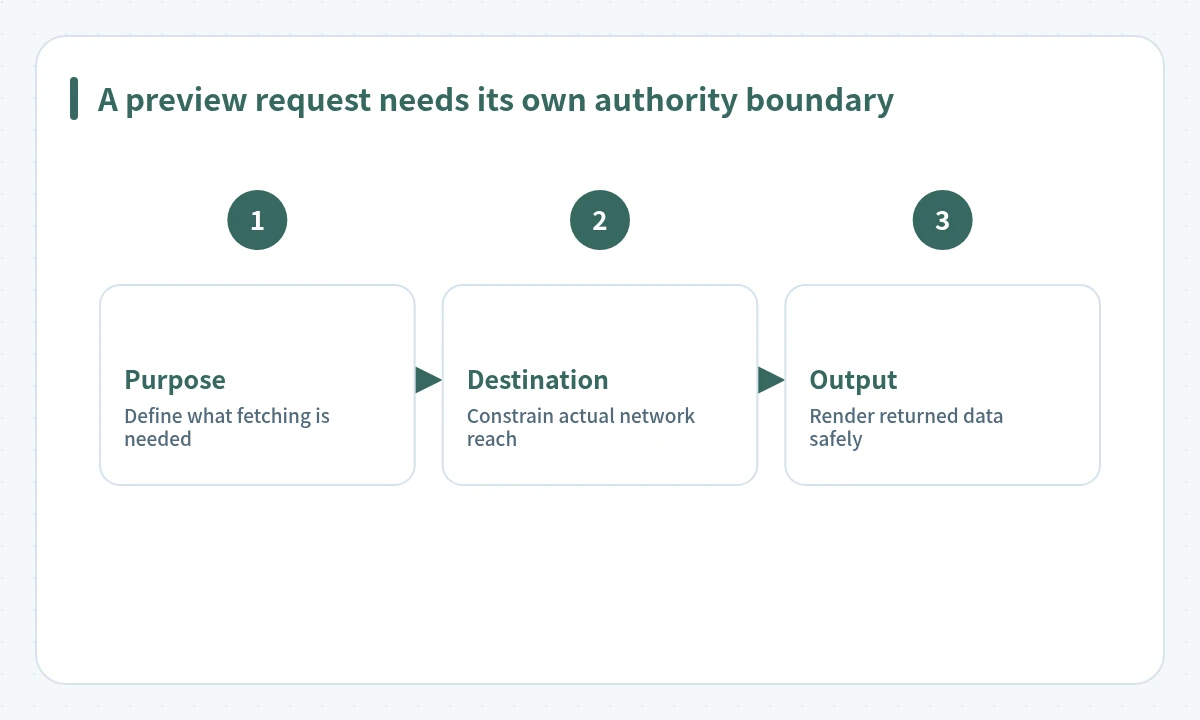
Validate where the connection will actually go
Use a suitable URL parser and a policy appropriate to the permitted destinations. A string containing a trusted brand is not an allowlist. Name resolution and redirects can alter the actual destination, so address and network controls need to follow the chosen design.
OWASP’s SSRF prevention guidance discusses application and network controls for this risk. A preview worker should have only the access it needs, with prohibited internal or local destinations constrained by the actual deployment.
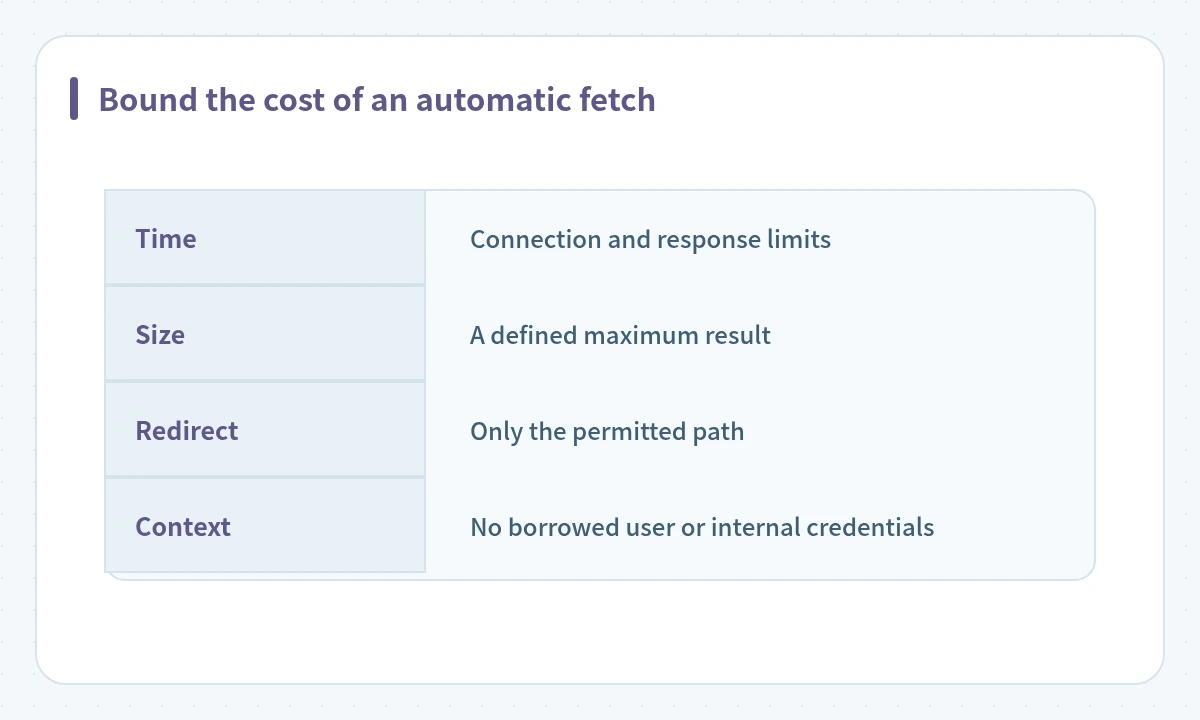
Do not attach a user’s cookies, internal authentication headers or unrelated credentials to a public preview request. The existence of an authenticated inbox session is not a reason to lend its authority to a destination supplied by message text.
Put limits on the cost of a preview
Bound connection and read time, response size, redirects and concurrency. Define what happens when a limit is reached. A title preview should not become an unlimited file download or a permanently occupied worker.
Treat returned titles and excerpts as untrusted output too. Fetching a page successfully does not make its markup safe to execute in the inbox. Images and attachments need their own handling rather than inheriting every permission from the preview process.
Consider whether fetching is appropriate for private, token-bearing links at all. An automatic visit can disclose the address to another system or affect its intended use. The preview policy should exclude such cases where the product cannot establish a safe, authorised purpose.
Test with controlled destinations
Use sites and isolated addresses you operate to check permitted requests, prohibited routes, redirects, slow responses and oversized content. Do not probe real internal systems or unrelated third-party services as an informal test.
Inspect the complete deployed route, including network policy and the final UI. A unit test of URL spelling does not cover a later connection that resolves differently or follows an unintended redirect.
Failure should fall back to an accurate ordinary-text view where appropriate. Do not ask users to resend private verification messages repeatedly to generate another preview. Keep tokens in private URLs out of broad diagnostic logs.
The closing result is a feature with a defined purpose, limited reach and controlled output. It is not a claim that every link can or should be opened by the service, nor that a generated preview authenticates what the message asks the reader to do.
Reference: OWASP: SSRF prevention.
