
An incomplete-looking JSON response needs a transport-boundary check before a format repair. Network chunks are not independent JSON documents, so a client should not require every newly received piece to parse as a complete object.
Identify the document boundary
An easy temporary sms inbox integration can use ordinary JSON or a documented record-streaming protocol. Those require different reading contracts. MDN describes Response.json as reading and parsing the response body; an application consuming a stream itself must define when it has assembled a complete document.
Braces inside strings, escaped content and multibyte characters make simple text counting unreliable. Do not decide completion by looking for a matching closing brace or by assuming that the end of one network callback is also the end of the business document.
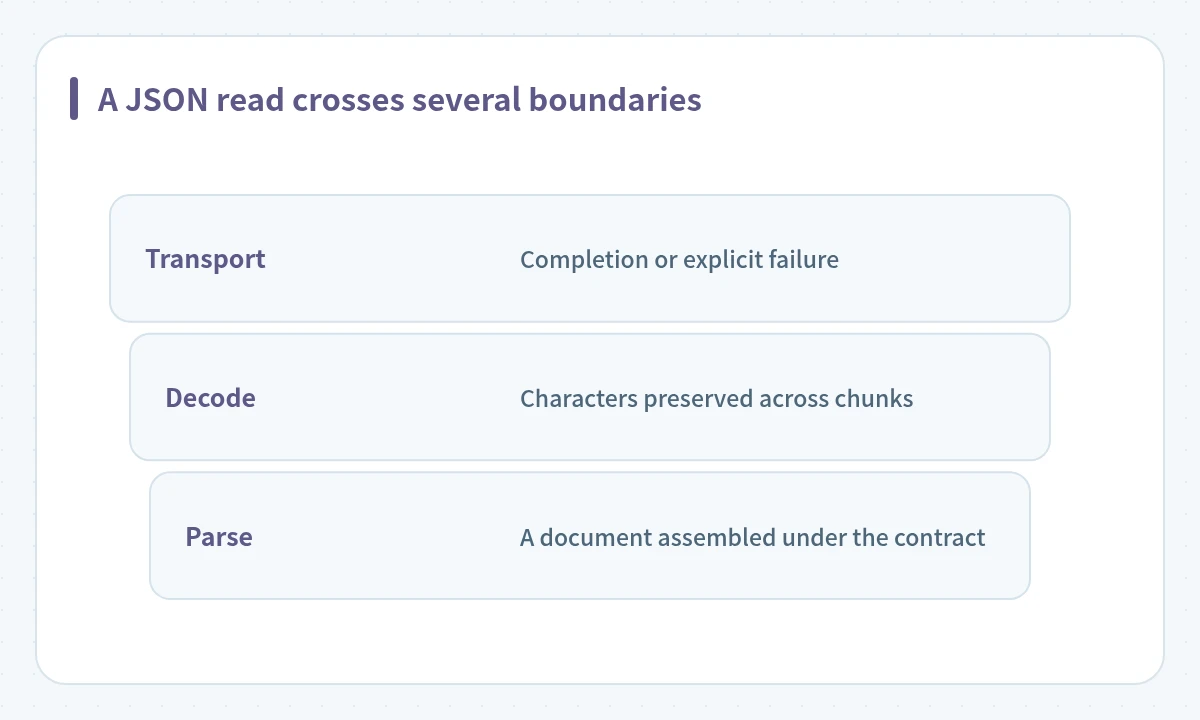
Locate the earliest failed stage
Check the actual status, content type and controlled reading result. An upstream interruption, an intermediary error page and a client that stopped reading early need different fixes. Keep only the request reference and necessary bounded byte observations, not a private message pasted into a public parser.
- Confirm the endpoint's documented body or streaming format.
- Establish transport completion or explicit failure.
- Assemble the document under that contract before parsing.
- Continue with business-field checks after format validation.
A syntactically valid object does not establish the complete business range. Where the contract uses pagination, counts or an end marker, use that mechanism. A prefix that happens to parse should not be presented as proof that every intended record has arrived.
Keep failed input out of successful empty states
A parsing failure needs its defined error or recovery route. Do not save an empty message or clear the list while silently ignoring the error. Before repeating an operation, establish whether the original request could have produced a business effect even though its response was unreadable.
Give the interface an understandable distinction between a failed read and a completed empty query. An operator can then investigate the correct stage instead of interpreting an invented zero count as the provider's actual answer.
A streaming decoder also needs to preserve character boundaries across chunks. A character can span received byte buffers, so decoding each buffer independently under an unsuitable method can introduce replacement text before the JSON parser sees it. Use the supported incremental decoding path where required. Test that path with harmless non-ASCII content divided at different byte positions. This separates a text-decoding defect from a document-structure defect. Keep any parser error associated with the original reading stage so operators do not “repair” valid source content that was damaged only by the client’s handling of the transport buffers.
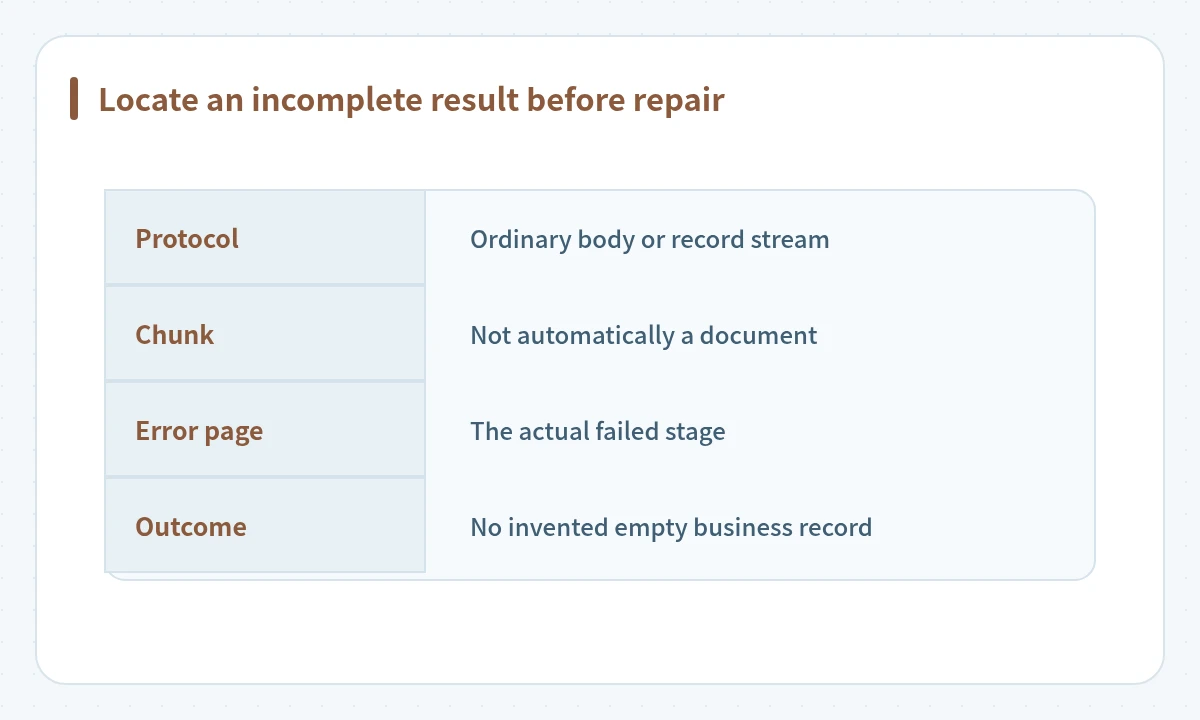
Rehearse across chunks and interruptions
Use harmless samples with characters and structure divided across different chunks. Include a deliberately truncated document, a non-JSON response and a resource-limit failure. Test the final handler rather than only a standalone parser with an ideal complete string.
A useful report identifies the protocol, stage and limited error position. Repair the actual generating or reading boundary. Adding closing brackets, dropping fields or inventing missing values to make a prefix parse would conceal the failure and alter the data the application was supposed to receive.
