
A valid session cookie does not establish that its owner intended a state-changing request. Reusable SMS inbox access through a browser needs appropriate CSRF protection for actions such as modifying settings, changing membership or deleting records. That protection complements account permissions rather than replacing them.
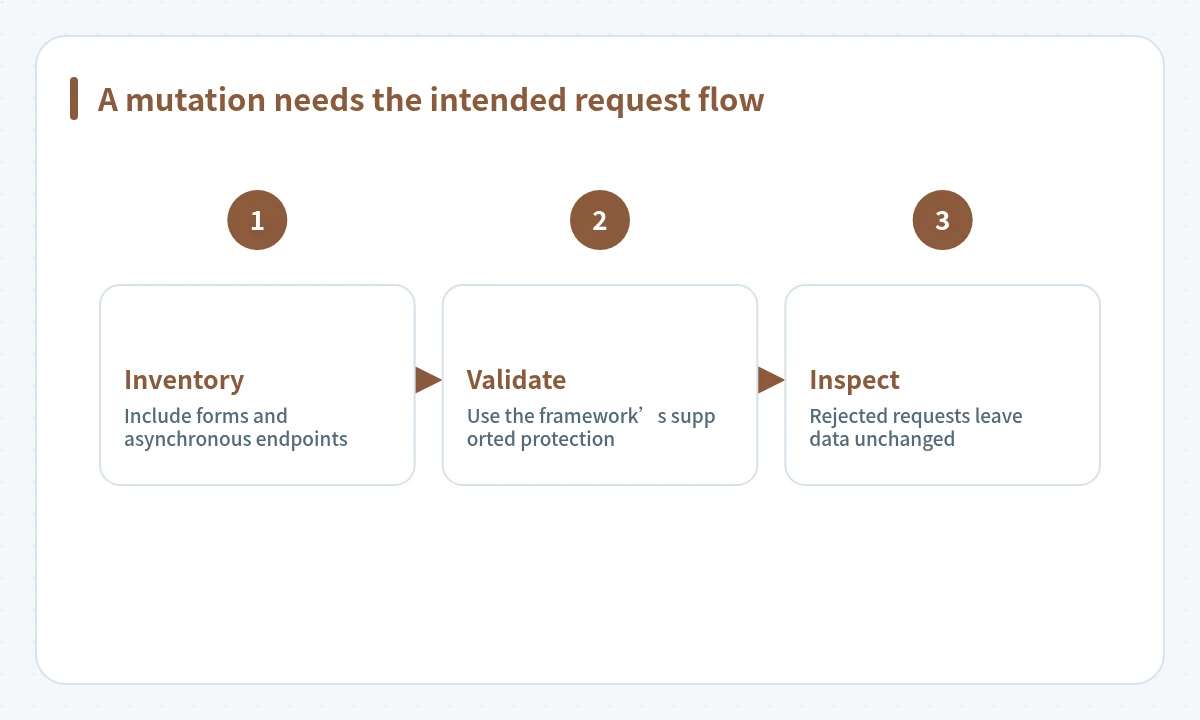
Inventory the actions that change state
Include asynchronous routes and less visible operations, not only the main delete form. A hidden button is not a server-side control. A dangerous action should not be exposed as an ordinary navigation link that a page load can activate.
Use the framework’s supported protection for the actual architecture. Tokens and request context must be generated and checked through the trusted application flow. A fixed public marker is not equivalent to a correctly managed anti-forgery mechanism.
Map the relevant endpoints before implementation. A well-protected page can still call another route that omits the same check. The actual request handler is where the state change needs its required validation.
Give each control a defined role
SameSite cookies, origin checks and anti-forgery tokens can complement one another in suitable designs. Their applicability depends on deployment, supported clients and cross-origin requirements. Do not disable the whole mechanism merely to accommodate an unexplained development failure.
CSRF validation does not decide whether the user may change the target number or workspace. After request-flow checks, enforce current identity, role and object authority. An authenticated but unauthorised request needs a separate rejection.
Other defects, such as unsafe script execution, also need their own handling. A CSRF control is not a broad claim that a page can safely interpret arbitrary message content or trust every script loaded into the account interface.
Make expired flows understandable
Multiple tabs, a changed session and long editing time can create token mismatches. Give a supported refresh or sign-in route with an accurate account of unsaved input. Do not automatically repeat a side-effecting operation simply because the first response was an error.
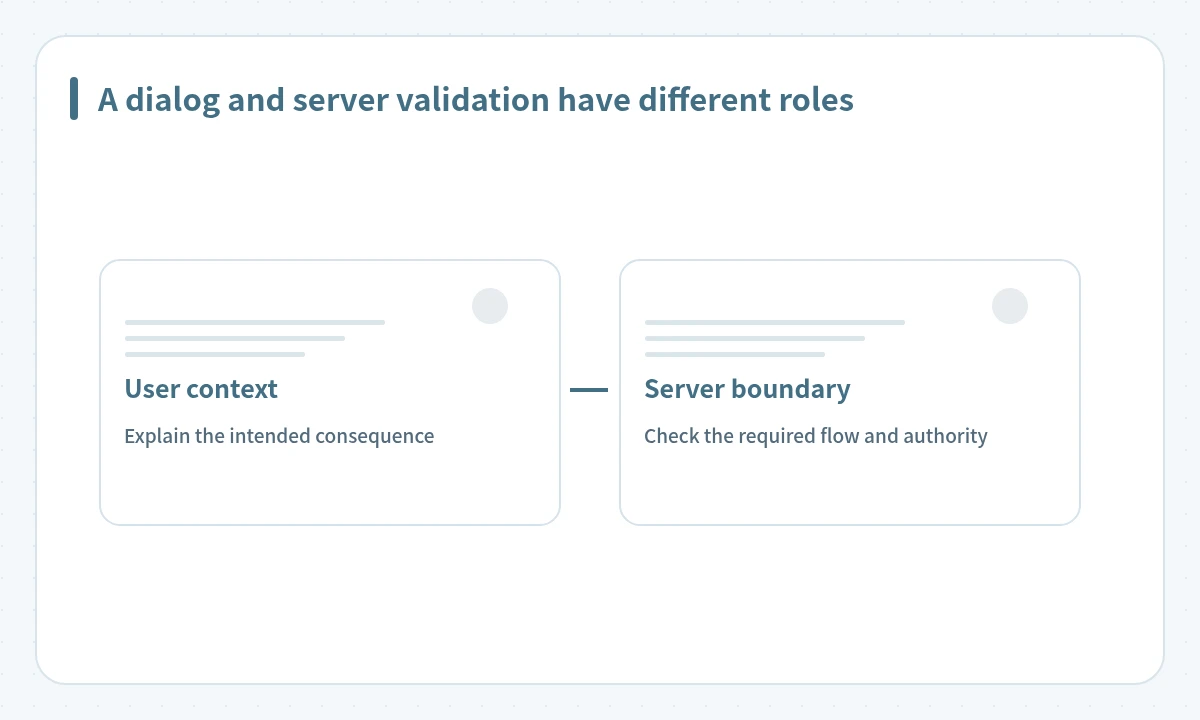
A confirmation dialog can explain consequences to the user, but it does not substitute for server checks. Keep diagnostic records limited to useful failure categories and references, excluding tokens, cookies and private SMS bodies.
Review legitimate non-browser integrations explicitly. They may use a different supported authentication arrangement and should not inherit a browser-session exception by accident. Document the route and required identity so a compatibility change does not become a blanket bypass. Ordinary browser mutations should continue to follow their intended request-flow protection.
Verify rejection against actual stored state
Use controlled accounts and isolated data to test a normal request, missing or incorrect token, session changes and disallowed request context under the design. Confirm that rejected attempts leave the intended records unchanged.
Exercise the ordinary deployed path, including the relevant AJAX route. An administrator seeing a successful action is not evidence that ordinary requests receive the required protection. Likewise, a red error banner does not prove the action was prevented.
Retain the endpoint inventory, architecture assumptions and fixture outcomes so later routes can be reviewed consistently. Testing should stay within systems you are authorised to operate. The closing condition is that the supported user flow works and state changes outside its required checks are reliably refused, with permission checks still intact.
Reference: OWASP: CSRF prevention.
