
HTTP 408 and 504 need a question about which component was waiting for what. A timeout response does not by itself establish that a receiving number failed or that the original business operation had no effect.
Locate the response source
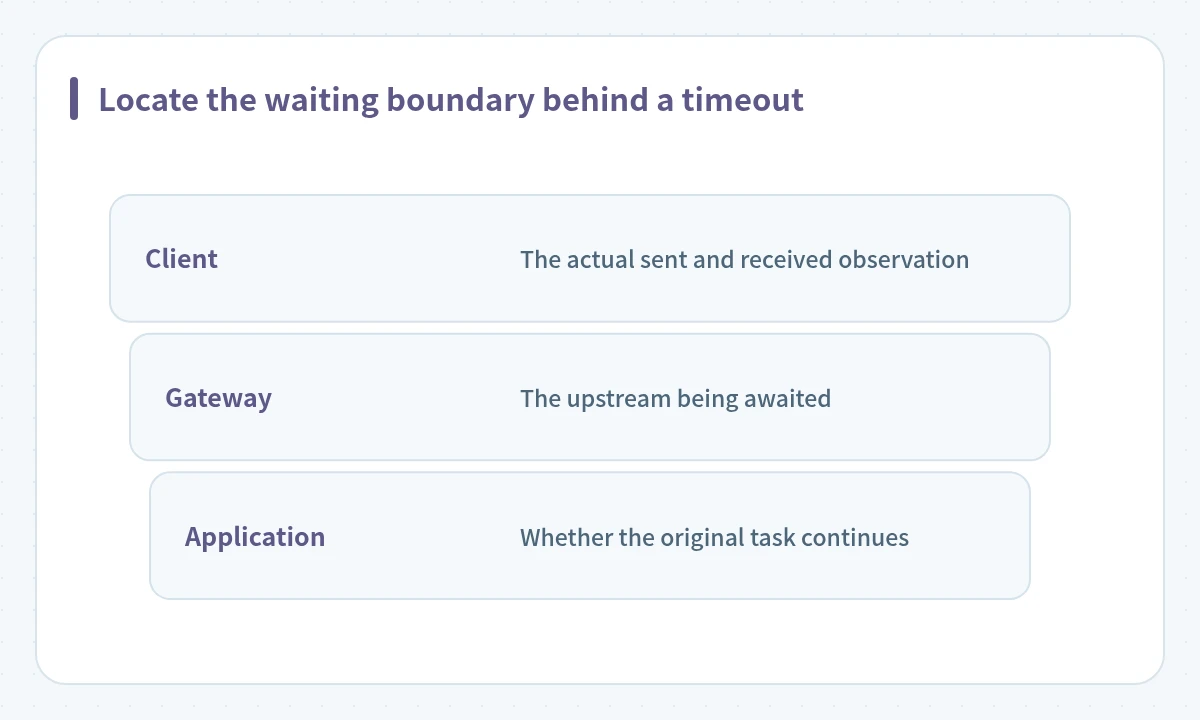
A dedicated online sms inbox integration can involve a client, gateway and application. RFC 9110 gives Request Timeout and Gateway Timeout different meanings. Inspect the actual status, request reference and responding component, including any intermediary or custom error page.
A browser ending its wait, a gateway returning an error and an application continuing work can be different facts. An absent final response is not sufficient evidence that nothing happened. Preserve that uncertainty until the supported task lookup or recovery process can explain the result.
Observe the path in stages
Keep limited client, intermediary and application observations tied to the same operation. Identify the earliest expected step that did not finish. State time units and clock sources so several nodes' timestamps are not casually combined into an unjustifiably precise sequence.
| Layer | Question |
|---|---|
| Client | What was actually sent and received? |
| Intermediary | Which upstream was awaited? |
| Application | Did the original task continue? |
| Result | What does the stable business reference show? |
Increasing every timeout is not a diagnosis. A persistently blocked dependency can occupy more resources when waiting is extended. Locate the actual bottleneck and acceptable business boundary before choosing a supported recovery design.
Keep retries related to the original task
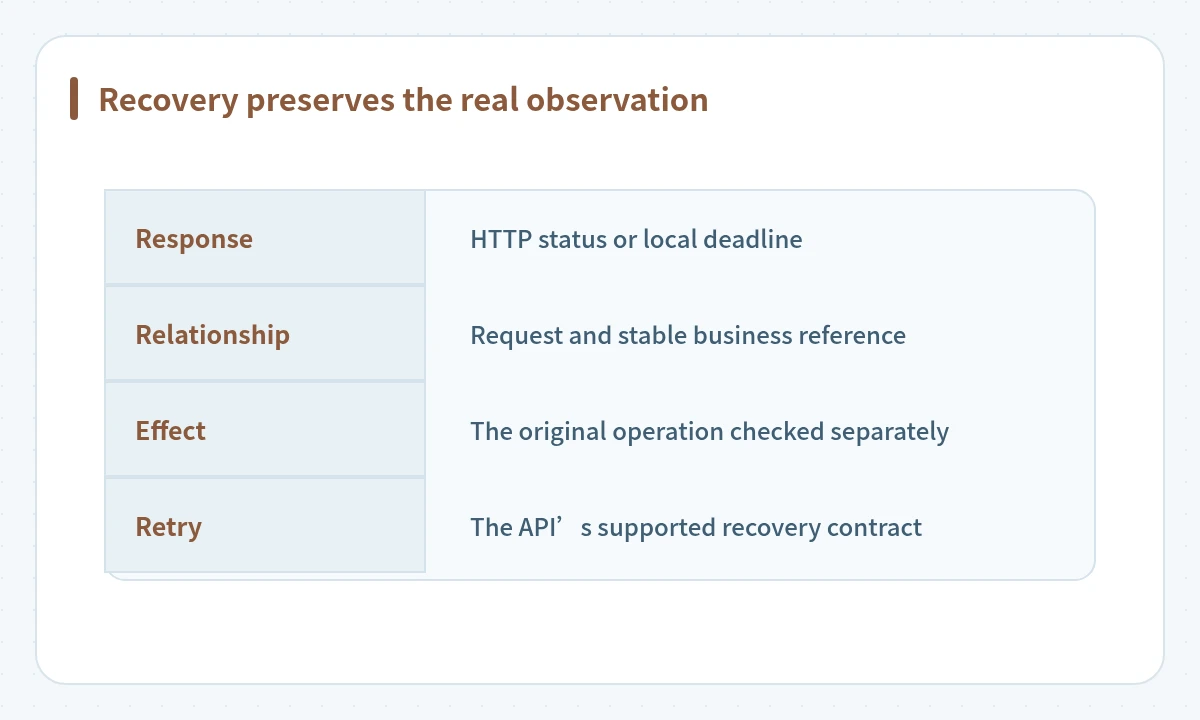
A read and an operation with side effects can need different handling. Use the API's supported object lookup and repeat controls, leaving an unclear result explicit where necessary. A new request identifier is useful tracing information, not proof that the previous operation was absent.
Inspect the user-facing state as well. A message saying try again should reflect the operation's actual recovery conditions. It should not invite uncontrolled repetitions while the backend may still be completing the original work.
A useful trace distinguishes a server-generated timeout response from a local client deadline that produced no HTTP response at all. Preserve the actual observation category before assigning an HTTP explanation. The approved client may expose a network error while an intermediary records a different result for the same task. Relate the observations with the available request or business reference and state any uncertain connection between them. Avoid creating a precise chronology by assuming every clock is identical. This lets the operator identify which boundary needs investigation and choose a supported next step without treating every use of the word timeout as the same transport event.
Rehearse the failing stages in isolation
Use authorised controlled faults for slow request reading, slow upstream response and a late result. Check that the observed status and interface explanation match the stage. Do not repeatedly deliver real messages to investigate a timeout condition.
Record phase, limited reference and necessary error information without exposing keys or private bodies. The useful timeout explanation identifies a verifiable processing boundary. The original task's business outcome remains a separate question until its own evidence is available.
Reference
RFC 9110: HTTP semantics and timeout statuses
