
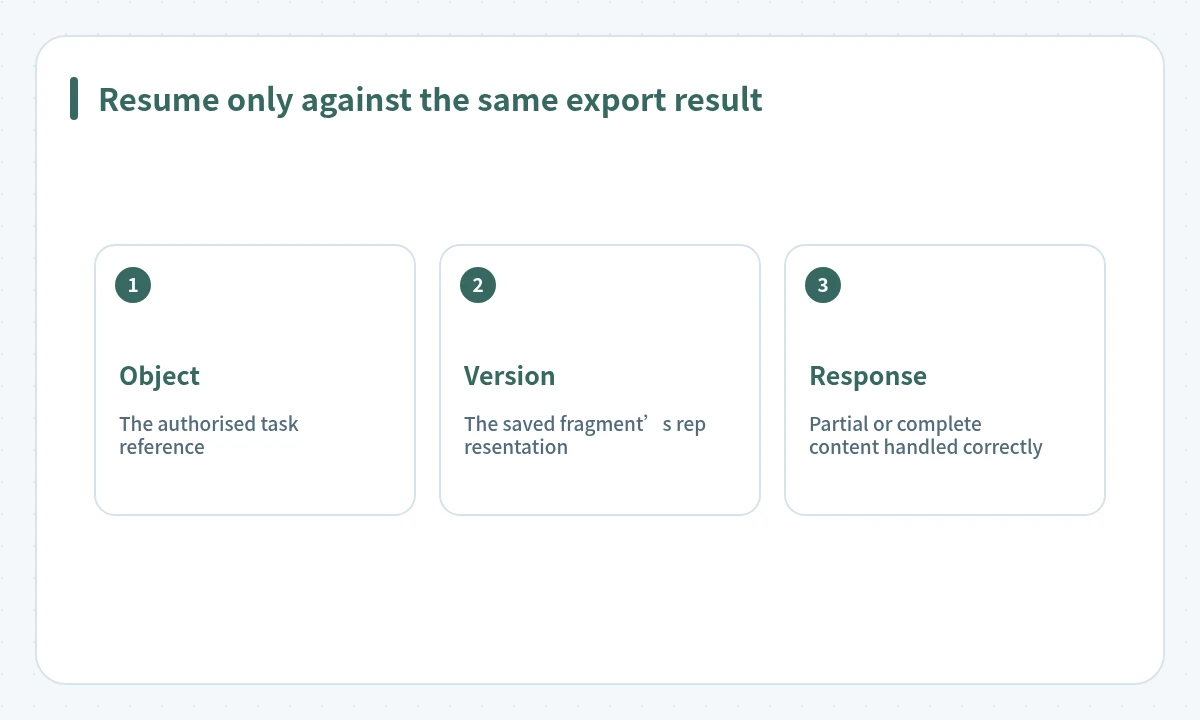
An interrupted export should be resumed only against the same representation. A saved byte count alone is not enough evidence that the next response can safely be appended to the partial file.
Establish the export identity
A sim free web sms receiving workflow may provide an authorised export task and a temporary download address. Check the task reference, format and result version. The same filename can describe a newly generated file, while a replacement address may or may not still identify the original result.
MDN's range-request guide describes partial responses and mechanisms such as If-Range. Confirm what the actual endpoint and client support. A download link should not be assumed to provide safe resumption merely because the browser previously received some bytes.
Let the response determine the next step
Inspect the returned status, range and applicable representation validator. Asking for a range does not prove the server returned that range. If it returns the complete representation instead, use the proper replacement path rather than appending the full response to an existing fragment.
| Evidence | Question |
|---|---|
| Task reference | Which definite export result is being retrieved? |
| Representation | Is this still the same version? |
| Returned range | Does it match the saved portion? |
| Completion | Is the final file actually usable? |
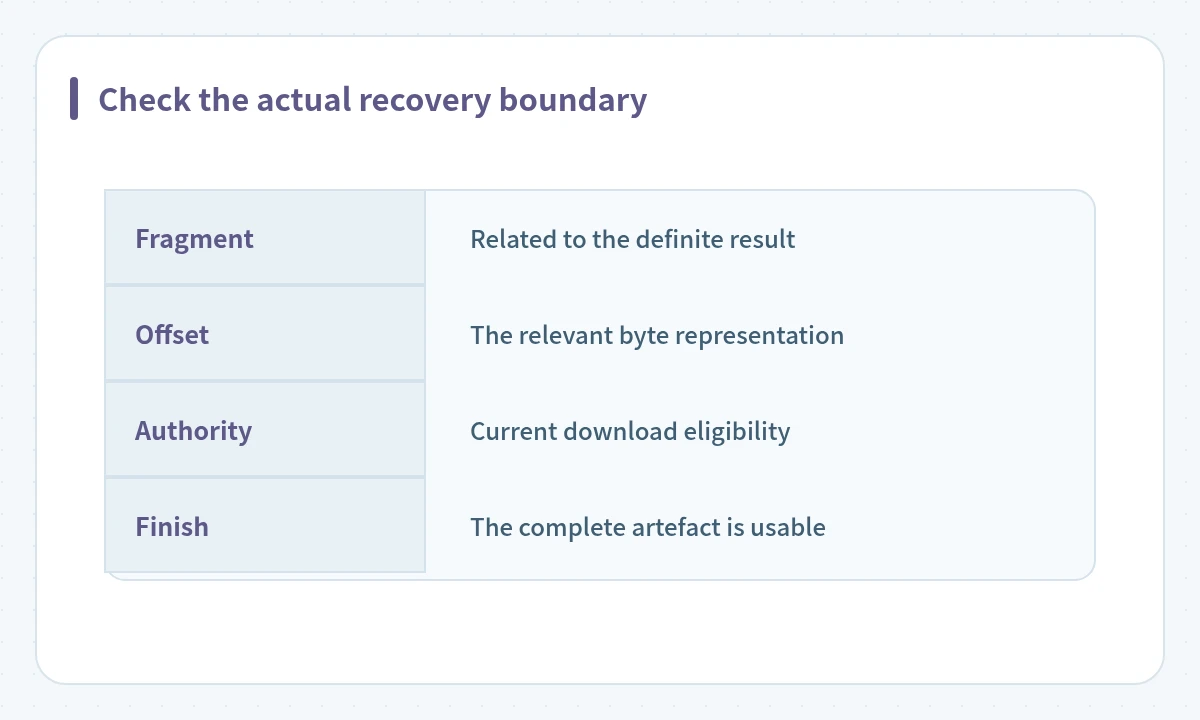
The offset must describe the relevant byte representation. Do not convert a visual progress percentage into an arbitrary range position. Encoding, intermediary handling and client decoding need to follow the supported implementation so the saved fragment and requested range use compatible units.
Preserve the current access boundary
Resumption still needs the current reader's authority and download eligibility. An old URL or validator is not permanent permission. If the route expires, obtain an authorised replacement through the supported process and confirm its relationship to the existing export.
Do not put the complete private address in a public troubleshooting thread. A task reference, relevant status and limited response metadata can usually establish the first diagnostic question without distributing access to the exported data.
Keep partial downloads associated with the exact result in the local client state. A user starting another export with the same default filename should not inherit the earlier fragment automatically. Where the client offers a resume prompt, make its result relationship clear and let an uncertain case restart safely. Also verify the supported treatment of a range that is no longer valid for the result. That error is a diagnostic condition, not permission to assume the local file is complete. A final format or supported integrity check can then confirm the retrieved artefact without claiming that its size alone proves every expected business record is present.
Exercise changed and unsupported results
Use harmless files to test interruption, a changed result, a server that does not provide the requested range and an expired address. Inspect the completed content instead of treating a progress indicator reaching its end as the acceptance condition.
If the existing fragment cannot be related to the new result, restart retrieval explicitly rather than construct an unexplained hybrid. Handle temporary fragments under the supported cleanup process, especially on shared devices. The useful outcome is a complete authorised result whose pieces have a verified relationship, not simply a file that has reached the expected approximate size.
