
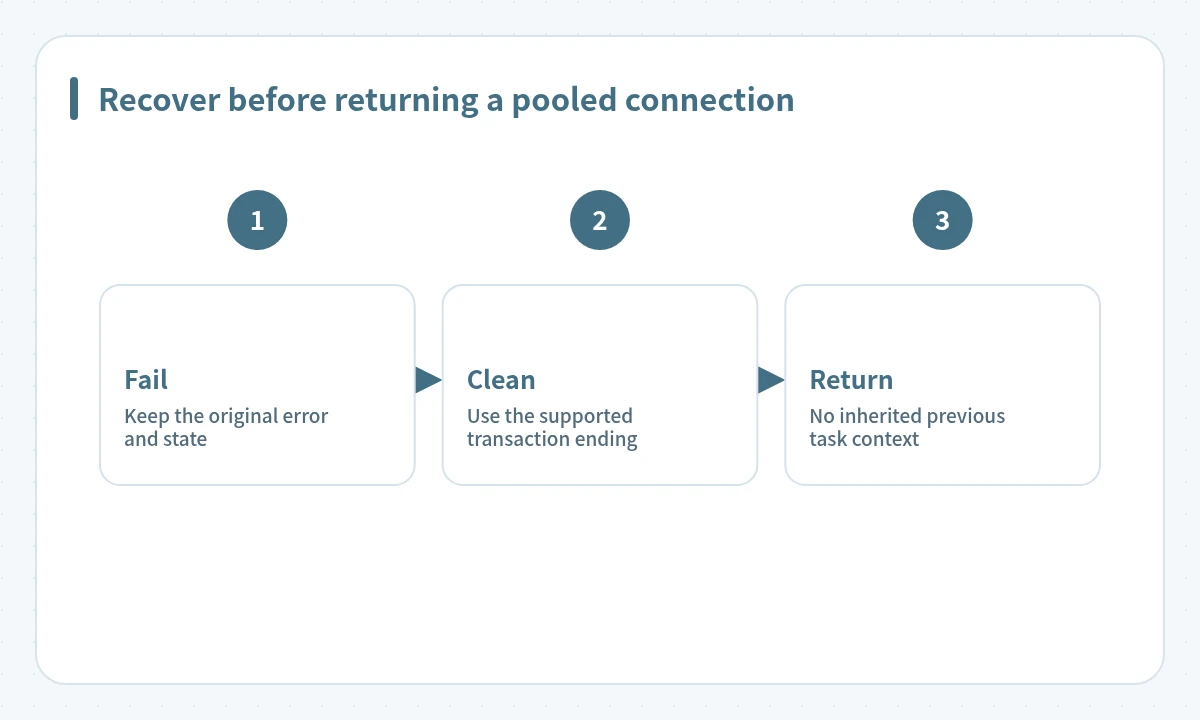
A failed transaction needs an explicit recovery boundary before its connection is reused. Catching an exception and returning the connection to a pool can leave the next task inheriting a failure state or another task's context.
Find the original failure and transaction state
A digital backup phone number inbox may use pooled database connections behind several application tasks. PostgreSQL's transaction documentation explains rollback and savepoints. The precise commands allowed after an error depend on the database and context, so do not impose one product's recovery behaviour on every backend.
Later transaction-error messages can be consequences of an earlier uncleaned failure rather than independent syntax defects. Keep the first error and the observed connection state available to the authorised diagnostic process. That makes investigation more useful than adding a retry around each later query.
Make connection return a controlled lifecycle step
A shared data-access boundary should own commit, rollback or disposal of a connection whose state cannot be confirmed. Cover exceptions, early returns and task cancellation as well as successful completion. Cleanup that runs only on the normal path is incomplete.
| Case | Handling focus |
|---|---|
| Normal completion | The designed transaction ending |
| Known failure | The supported rollback path |
| Unclear state | Result reconciliation and connection usability |
| Pool return | No previous task's transaction context |
Review session-level settings and resource selection too. The next account should not acquire an implicit condition left by the preceding task. Reconnecting can clear a local session without proving that every business effect has been undone elsewhere.
Reconcile effects before retrying
If a connection disappears during an unclear commit outcome, do not automatically conclude that nothing happened. Use the stable business reference and supported lookup to establish the result, then follow the application's duplicate-handling strategy. External sends may need a separate reconciliation path from database changes.
Savepoints can support a deliberate partial-recovery design where the database and application permit it. They should not be added randomly to make an error disappear. Identify which business unit may continue and which outcome must remain atomic before choosing that approach.
Keep connection cleanup owned by one clear layer so nested helpers do not issue conflicting transaction endings. A helper that joins an existing transaction needs to respect that ownership contract. Review its failure behaviour with the caller rather than adding an unconditional commit or rollback locally. This makes the final business outcome easier to explain and prevents a seemingly helpful error handler from ending a larger unit of work unexpectedly.
Test the next borrower of the connection
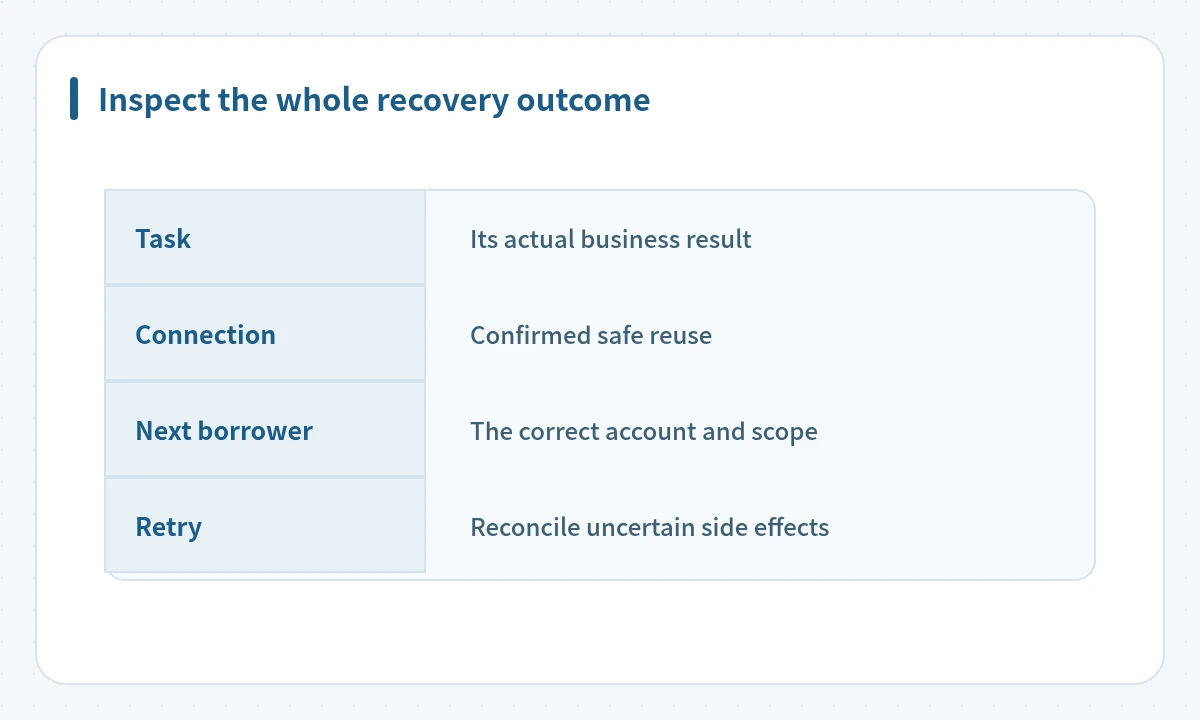
In isolation, let a harmless task fail inside a transaction and then run another authorised task through the relevant connection path. Verify that the second task receives neither the failed state nor the previous resource scope. Inspect the original task's result separately.
Keep limited references, failure categories and cleanup outcomes in diagnostics rather than copying private messages. The useful evidence covers the original task, connection state and next borrower. A quiet exception log is insufficient if the application merely hides failures while returning an uncertain session to the pool.
Reference
PostgreSQL: Transactions and rollback
