
A CORS error describes a browser cross-origin access condition, not a complete account-security decision. A reusable online SMS inbox still needs server-side authentication and resource authorisation. Do not treat a browser refusing to expose a response as proof that no request reached the service or that nobody else can access the endpoint.
Separate sending from reading
Some cross-origin requests involve a preflight; others can be sent while the browser restricts script access to the response. Inspect the actual request and feedback instead of interpreting every console error as server-side rejection.
This matters for state-changing operations. CORS is not a substitute for authorisation, duplicate-action controls or the application’s appropriate cross-site request protection. A frontend error cannot establish that an attempted change did not happen.
A command-line client operates under different constraints from a browser script. Its ability to contact an endpoint does not by itself show that browser origin policy failed. Apply the relevant security question to the relevant execution environment.
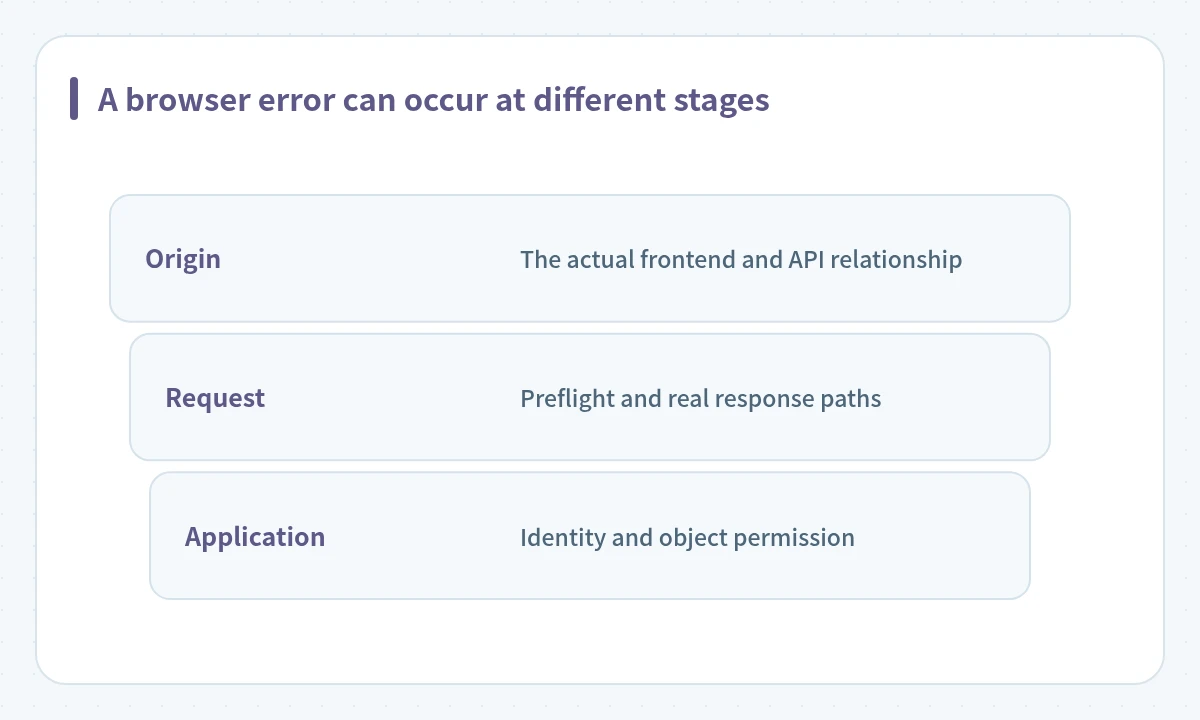
Configure the actual origin relationship
Identify the frontend and API scheme, host and port, alongside whether credentials are needed. The policy should match the supported deployment. Reflecting any supplied Origin value is not the same as checking an allowlist.
Where credentials are used, follow the browser and server rules for that arrangement. Do not broadly open origins merely to remove a development error. Testing also does not justify putting a production management key into the browser.
Keep development and production configuration explicit. A local exception should not silently become a public deployment policy, and a proxy added for testing should not introduce unrestricted forwarding authority.
Locate the failing layer
Review preflight handling, the actual request status, response headers and application error separately. Redirects, proxies and error pages can take different paths from a normal response. Fixing only the successful case can leave the observed failure unexplained.
Use limited request references for diagnostics. Complete cookies and authentication headers should not be copied into ordinary logs to identify a missing origin header. A controlled fixture can reproduce the configuration without exposing a user session.
If the application genuinely rejected an identity or resource permission, fix that access issue through the correct process. Widening CORS cannot grant legitimate account authority. After a policy repair, verify that unauthorised service requests remain rejected.
When origin-dependent responses pass through caching infrastructure, inspect the deployed variation behaviour as well. A header correct at the application can be reused incorrectly by an intermediary under unsuitable rules. Keep this response-policy check separate from the account data check, and use controlled origins rather than private customer content to verify it.
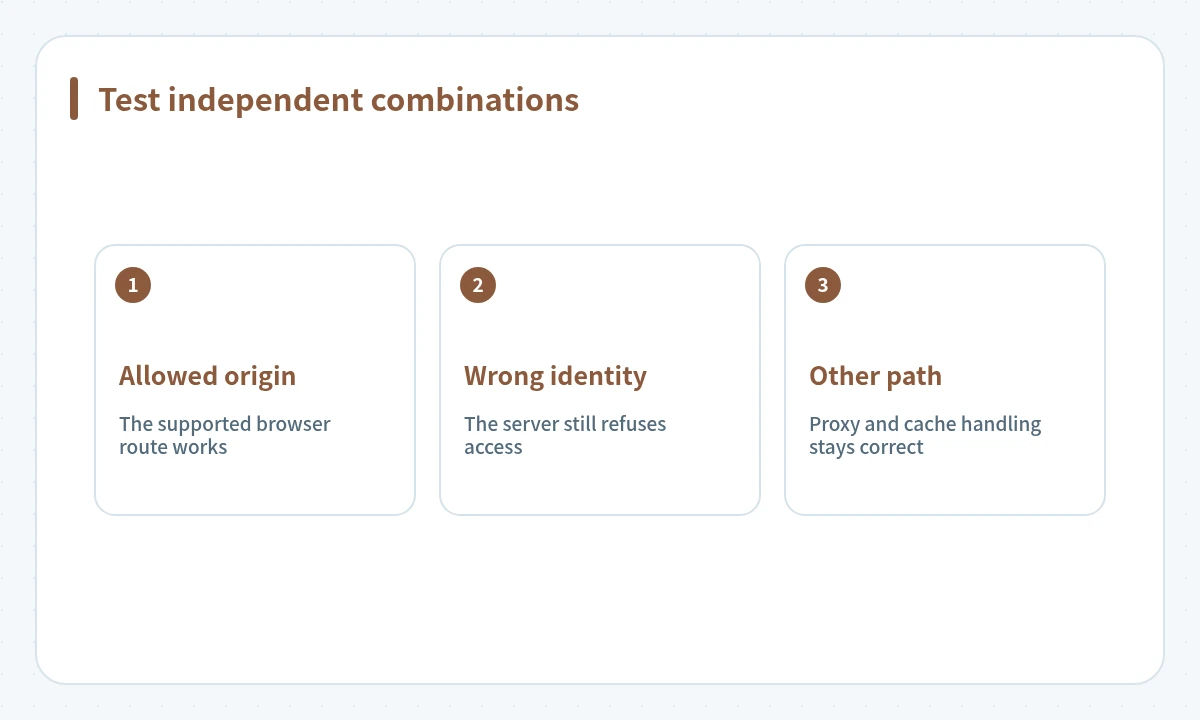
Test combinations rather than one green request
Use controlled pages and fictional records for an allowed origin with proper identity, an unsupported browser origin, and missing or insufficient credentials. Judge each outcome against its own boundary rather than expecting one mechanism to answer all questions.
Include the real deployed proxy route where relevant. Do not test by attempting to read another party’s private records. Retain the permitted origin relationship and the actual account-resource decision as separate results.
MDN’s CORS documentation explains the browser mechanism. The application still decides which authenticated user can perform which operation on which object. A reliable deployment keeps those decisions visible instead of using one browser error or success as the entire security conclusion.
Reference: MDN: cross-origin resource sharing.
