
Restoring an SMS database to an earlier backup does not reverse actions that already happened in another system. A simple virtual SMS number application can recover records while its queue and downstream services remain at different points. Reconcile pending work before allowing old tasks to execute again.
State the actual recovery point
Record which data point was restored and whether message records, job state, files and queues belong to a consistent scope. A database that answers queries is not evidence that every participant returned to the same moment.
A task completed after the backup may look unfinished after restoration. An external action may also have succeeded before the application stored its completion marker. Those cases need evidence from stable business references and the downstream system’s supported lookup route.
Do not reconstruct the result from the last visible log line alone. Keep uncertainty explicit when the authoritative outcome is unavailable. A guessed completion can lose necessary work, while a guessed failure can repeat an action that already occurred.
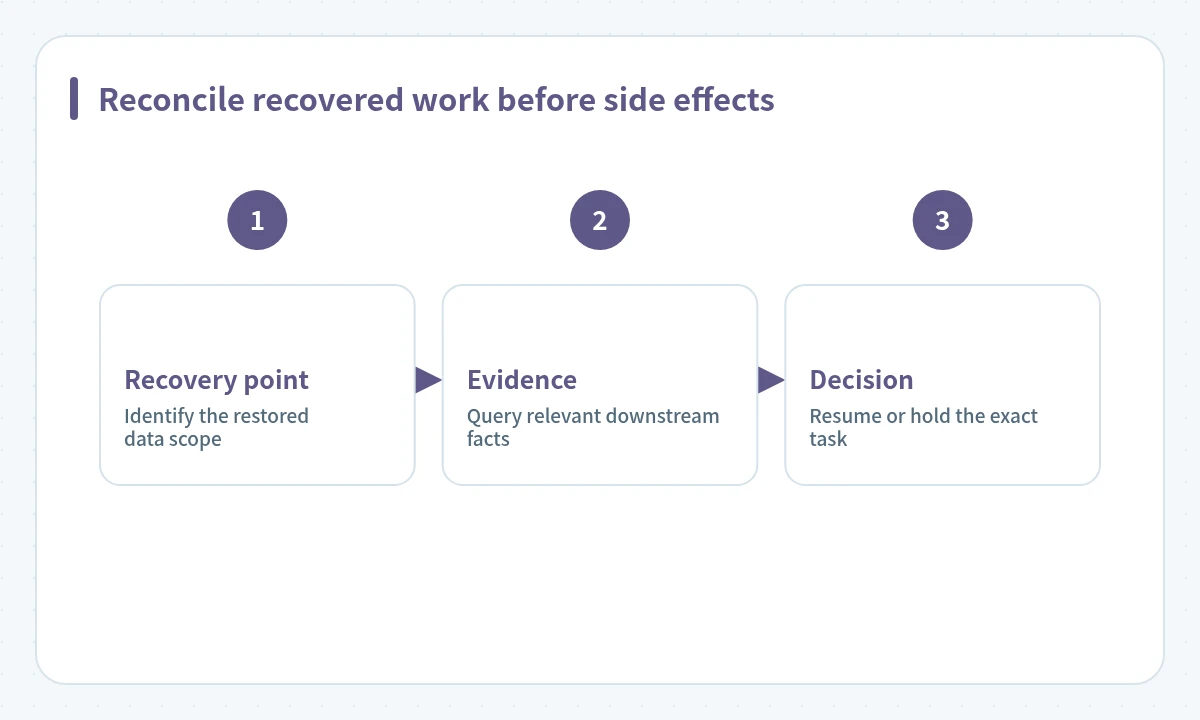
Control side effects during recovery validation
Handle workers and scheduled jobs under the system’s actual maintenance procedure. Avoid starting an ordinary consumer that immediately processes every recovered pending row. Do not clear or republish queues casually without understanding their guarantees and retained relationships.
A recovery test environment should be isolated from real external actions. Review sending credentials, endpoints and independent schedulers as well as the restored database. Copying a data file does not automatically isolate every integration in the deployment.
Use harmless fixtures to confirm those boundaries. A dry-run mode should have defined effects; its name alone cannot establish that no external call or state change will happen.
Classify work from confirmed facts
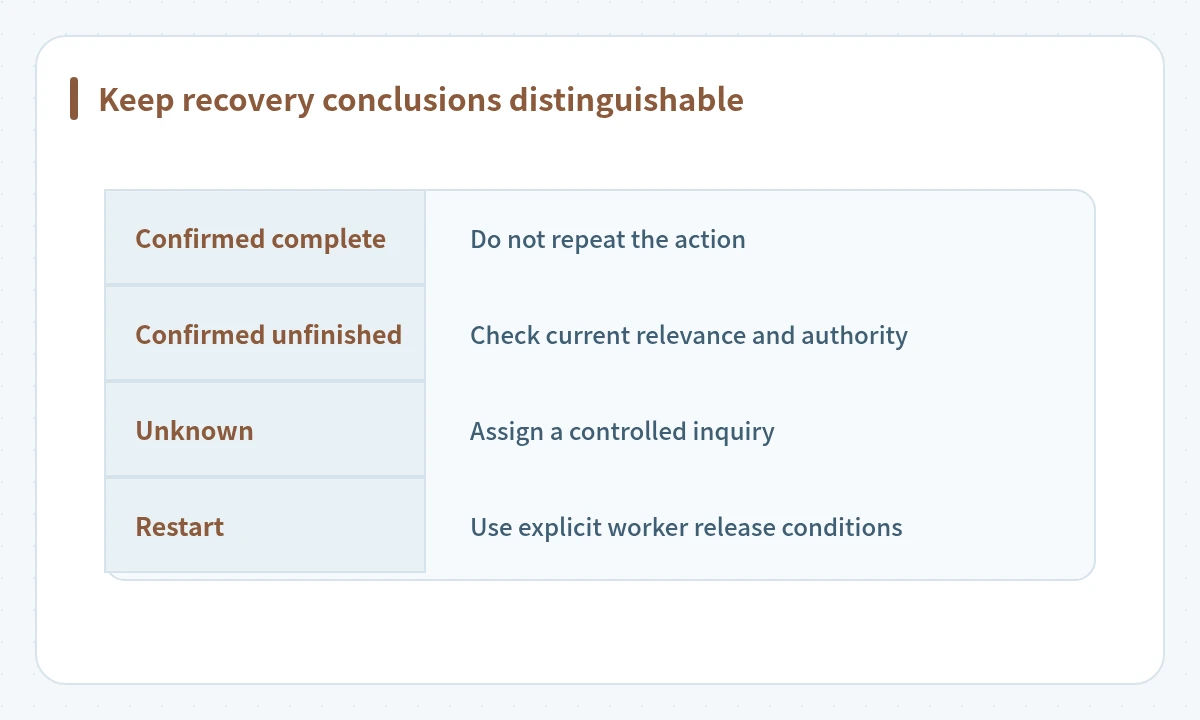
Keep confirmed completed tasks from running again. Resume confirmed unfinished work only where it remains relevant and authorised. Leave uncertain tasks in a controlled state with an owner and next inquiry rather than forcing them all into one success or retry category.
Preserve the logical event identity while tracking a recovery attempt separately. Creating a new identity to bypass duplicate protection removes the association needed for reconciliation. Expired tasks and changed resource ownership also require current decisions.
Retain a recovery decision log with the source of each conclusion. A downstream confirmed object, an unavailable status lookup and an operator assumption are different kinds of evidence. Mark which one supports the task decision so the next person can continue unresolved reconciliation without treating every recovered row as equally trustworthy.
Exercise the business result, not only startup
Create fictional tasks that are unprocessed, partly completed and completed after a selected backup point. Restore the earlier state in isolation and run the intended reconciliation procedure. Check that each case receives the defined treatment without real customer messages or transactions.
Also review file availability, membership and other dependencies separately where they are involved. A restored job table cannot establish that the associated file or current role still exists in the expected form.
Document the recovery point, downstream evidence method, conditions for restarting workers and unresolved items. Retain those operational facts without archiving private codes as test evidence. Database integrity is an important observation, but the recovery closes only when the relevant task relationships and side-effect decisions are understood. That avoids using a technically successful restore as permission to repeat every earlier action.
