
A backup may restore access relationships, credentials or tasks that no longer belong in the live system. Restore in isolation and apply current authorisation before reopening access.
A snapshot describes its own point in time
If the backup predates a member’s removal, it may still contain that person’s former role or sessions. The exact risk depends on what the backup includes. Inspect the scope before assuming it contains only message history or only harmless configuration.
OWASP’s multitenant security guidance says restoration should reapply current access and retention rules and verify tenant isolation. In an inbox system, that means historical data can be recovered without allowing the historical snapshot to decide who is entitled to read it today.
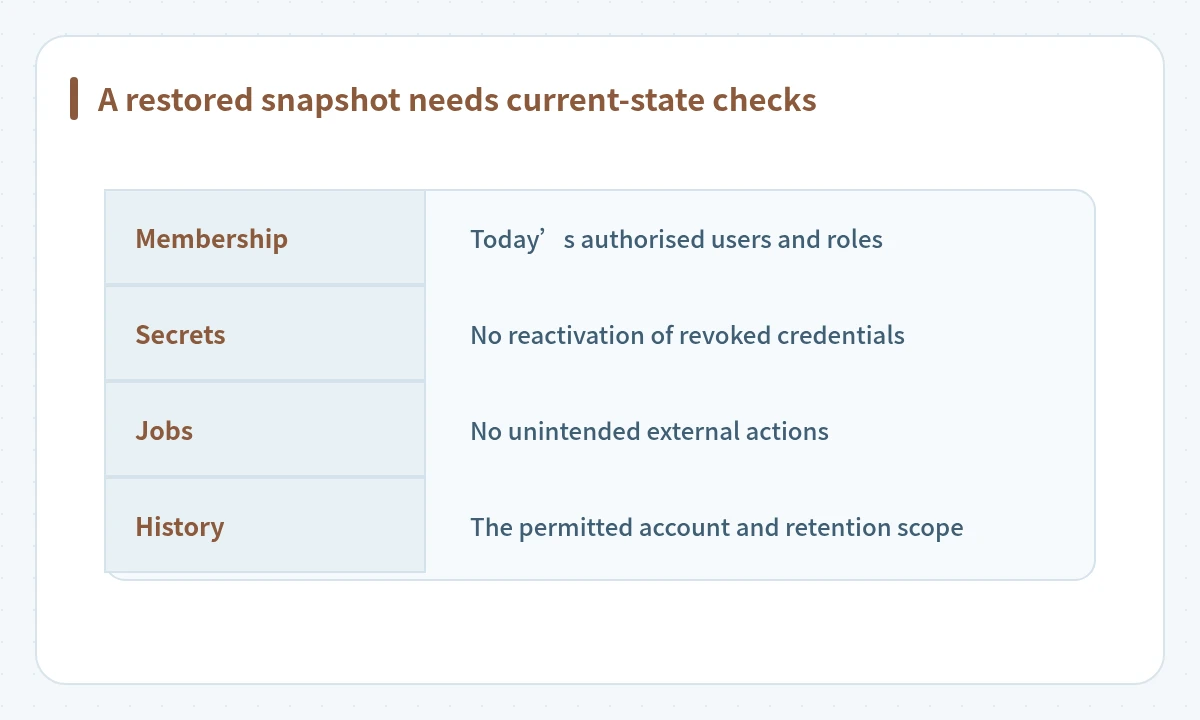
| Restored object | Current-state check |
|---|---|
| Members and roles | Compare with today’s authorised membership |
| Credentials | Do not reactivate revoked or exposed secrets |
| Automated work | Disable unintended external actions during inspection |
| Message history | Restore only the permitted account and retention scope |
The membership reference should itself have a reliable current owner. Do not simply choose whichever of two old lists is more convenient. If the current authority cannot be established, keep ordinary access closed while the responsible administrator resolves that uncertainty.
Prevent the restored system from acting on the outside world
Separate the recovery environment from public traffic and real external jobs. Old schedules or queued events may otherwise send notifications, call retired endpoints or repeat completed work as soon as the process starts. Use controlled test resources instead of live account-verification material.
Review what is needed to inspect the data without enabling those effects. Current secrets and configuration should enter through the approved secure process when appropriate, not be copied back from a historical log. A restore is not a reason to reuse a key that was deliberately revoked.
Check consistency between database records and associated files. A database restored from one cutoff and an unrelated file copy from another can leave references that point to missing or mismatched objects. Use the documented backup set and verify the required file associations without silently substituting another account’s similarly named attachment.
Test denial paths as part of acceptance
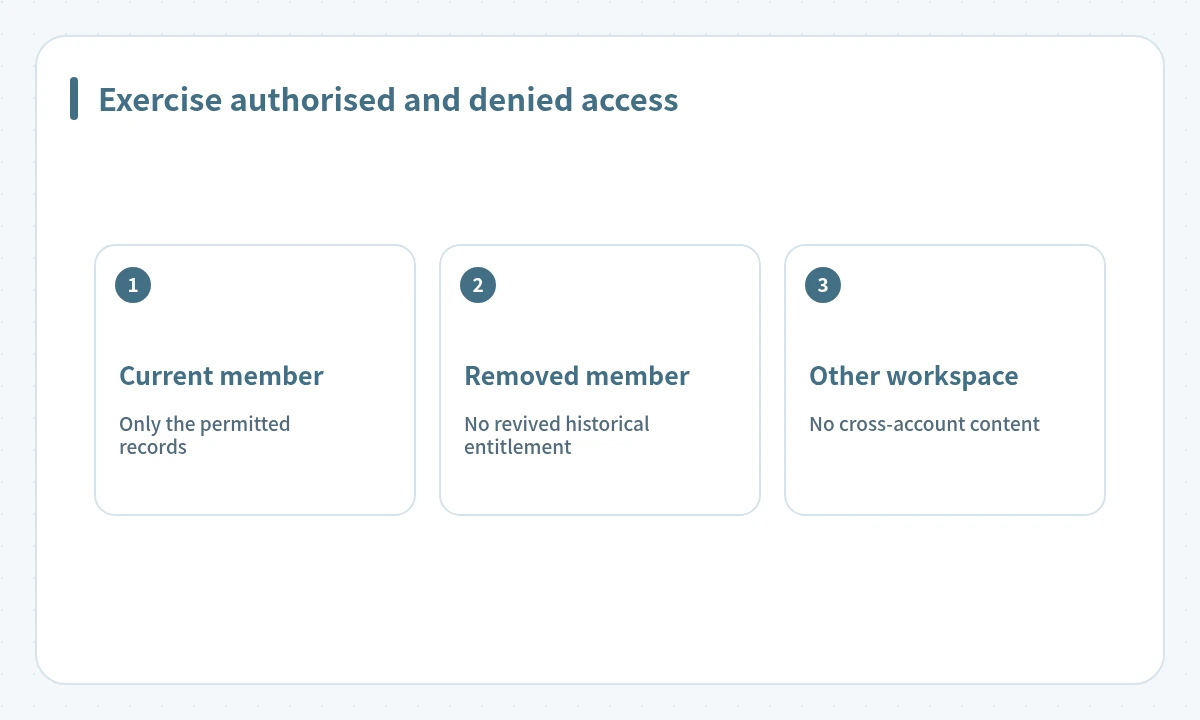
Use controlled identities representing a current member, a removed member and another workspace. Verify that each sees only the authorised data and operations. Opening a few records with the highest-privilege account cannot establish that ordinary user paths enforce the intended boundaries.
Also check previews, downloads and any supported API routes. A correct main inbox does not protect a separate export endpoint that still uses an old permission rule. Keep the fixture data synthetic so the exercise does not itself expose private history.
Record database integrity, readable files, current access rules and required configuration separately. If only part of the history was recoverable, state the missing scope rather than calling a visible list complete. Apply current retention decisions to data recovered from older copies as well.
The recovery note should identify the snapshot time, restored scope, permission comparison and conditions for reopening service, without secrets. A future maintainer can then tell the difference between recovering historical records and re-enabling historical access. Those are distinct outcomes and should be approved and verified as such.
Technical reference: OWASP: multitenant backup restoration and access controls.
