
Access that allowed an SMS export to be requested can change before the file is ready. A private SMS message inbox should check the relevant conditions at creation, execution and download. A completion notification must not turn into permanent authority to retrieve a file after membership or resource ownership changes.
Give the export an explicit owner and scope
Keep the creating identity, tenant, authorised resources and query conditions with the job. A global lookup by export identifier alone cannot establish who may retrieve it. Background processing should carry trusted context rather than accept an arbitrary tenant selector from outside.
Define whether the job uses a fixed requested range or another documented data boundary. Do not let a later UI filter silently replace its scope. An export should not expand beyond the actual authorised request simply because additional records became available.
The job record can describe operational progress without exposing the message content itself. Ordinary status views and notifications need only the information required to find the authorised next step.
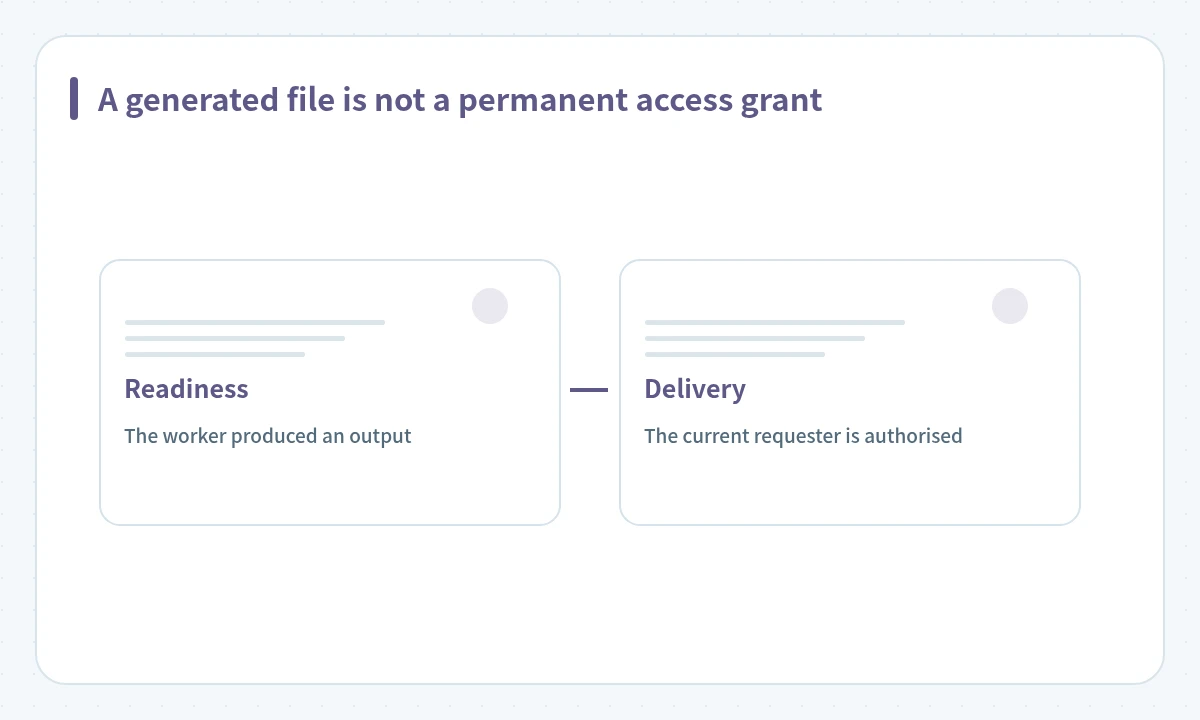
Separate file readiness from permission to deliver
A worker can finish generating the file while the application still needs to decide whether the current requester may download it. The normal delivery route should check identity and the target object relationship. A guessed or copied identifier must not select another user’s file.
If the design uses a time-limited link, inspect its actual authority, lifetime and revocation model. Such a link can be forwarded or stored in logs. Do not assume it remains only with the person who originally saw the notification.
Changing a web permission also does not automatically remove every stored file or already downloaded copy. File retention, cached delivery and backups need their own documented handling. Avoid promising that hiding a download control recalled all existing material.
Define what changes mean while the job waits
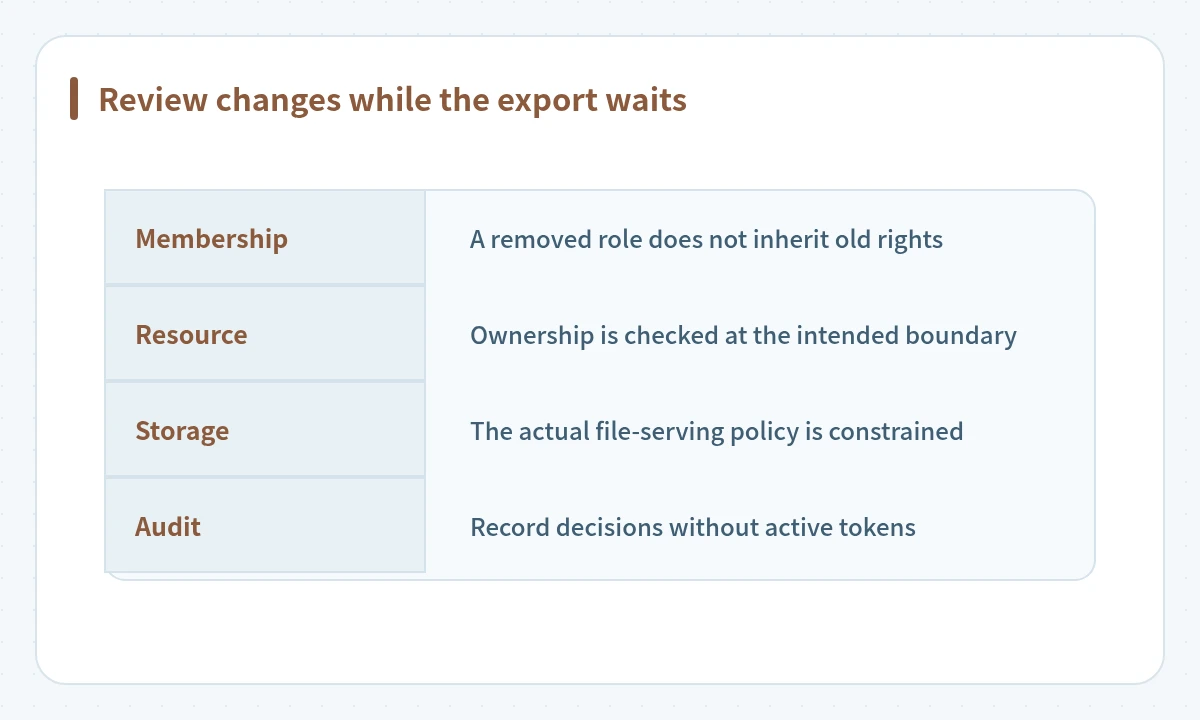
Test removal of a member, reassignment of a number and an account restriction during generation. Decide the supported outcome for each before relying on the workflow. Refusing delivery can be appropriate where current authority is absent, with a recognised support route for unresolved business needs.
Do not make an administrator’s ability to inspect a file the proof that an ordinary requester may obtain it. Test the role and path used by that requester, including authentication failures and another account’s identifier.
The download endpoint may also be a separate storage service. Review its actual credentials, object policy and cache behaviour rather than assuming the application page controls every access route. Any deliberate direct delivery needs to preserve the intended file and audience boundary.
Review the complete download path
Use two controlled accounts with harmless distinct records. Verify ordinary delivery, identifier replacement, signed-out access and the chosen permission-change cases. Include the deployed file-serving route, not only the page that lists completed jobs.
Retain job references, authorisation decisions and outcome states in audit records. Do not log active download tokens or the whole exported file merely to demonstrate that access was checked.
OWASP’s authorisation guidance calls for permission checks on requests. Waiting for asynchronous work does not remove that need. The useful completion evidence is that the file remains correctly associated with its intended scope and permitted audience at delivery, with expiry and retention treated as separate responsibilities.
Reference: OWASP: authorisation guidance.
