
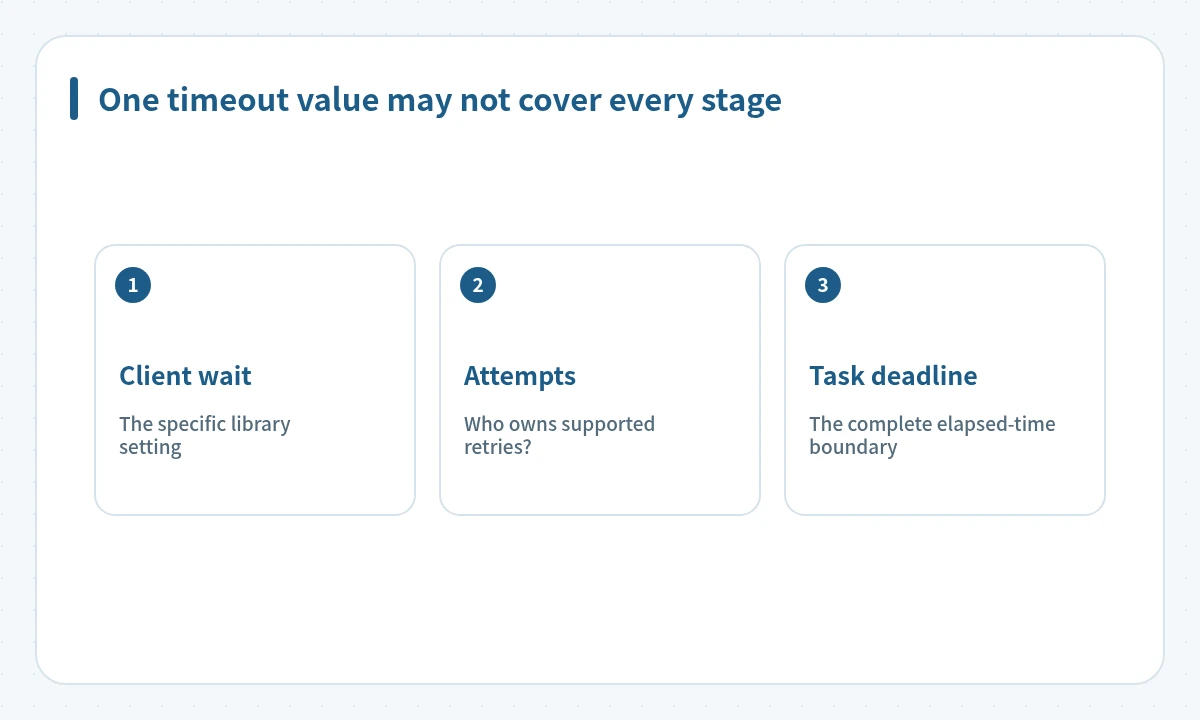
A timeout parameter may describe only one stage of an SMS API call. An easy online text inbox integration should distinguish connection, read, pool and overall task limits according to its actual client. One value named timeout does not necessarily bound the entire operation or all its retries.
Locate where the wait occurred
Retain limited observations such as request start, connection acquisition, response progress and failure category. Avoid logging private message bodies or authentication headers. DNS, proxies, reused connections and server processing can involve different stages.
HTTPX documents connect, read, write and pool timeouts as separate settings. That is a specific client example, not a universal naming scheme. When using another library or version, verify its current documentation rather than copying a parameter and assuming equivalent behaviour.
The relevant stage can differ between a first call and a reused connection. Keep the observed context with the error so a connection-pool wait is not automatically reported as slow SMS receiving at the provider.
Give the logical task a total boundary
A per-stage waiting limit need not be the task’s end-to-end deadline. Define an overall budget where the business requires one, including queueing and retries. When it is exhausted, use an explicit unfinished outcome rather than silently resetting the timer.
Choose values from actual requirements and suitable observations, not arbitrary performance promises. A normal history lookup and confirmation of a state-changing action can need different recovery procedures even when they use the same HTTP library.
If several layers retry, their attempts and delays can multiply. Identify which layer owns recovery, which errors permit it and when the logical task must stop. A user action should not create an unbounded chain hidden behind a single spinner.
Stopping the client is not reversing the server
For an obsolete read, cancel the unnecessary work and keep the view’s state accurate. For an operation that might change something, inspect the original result and duplicate controls. A timeout does not withdraw a remote action that already completed.
Keep the same task reference across supported attempts. A newly created logical operation can obscure whether an earlier attempt succeeded. Where the result remains uncertain, preserve that condition and use the business’s recognised inquiry path.
Inspect how time is measured for an application deadline. Use a suitable elapsed-time mechanism for duration accounting rather than relying on a user-facing clock label. Keep wall-clock timestamps for correlation where appropriate, with the distinction clear in diagnostics. A display-zone change should not silently reset the budget of a running logical task.
Exercise stages with controlled delays
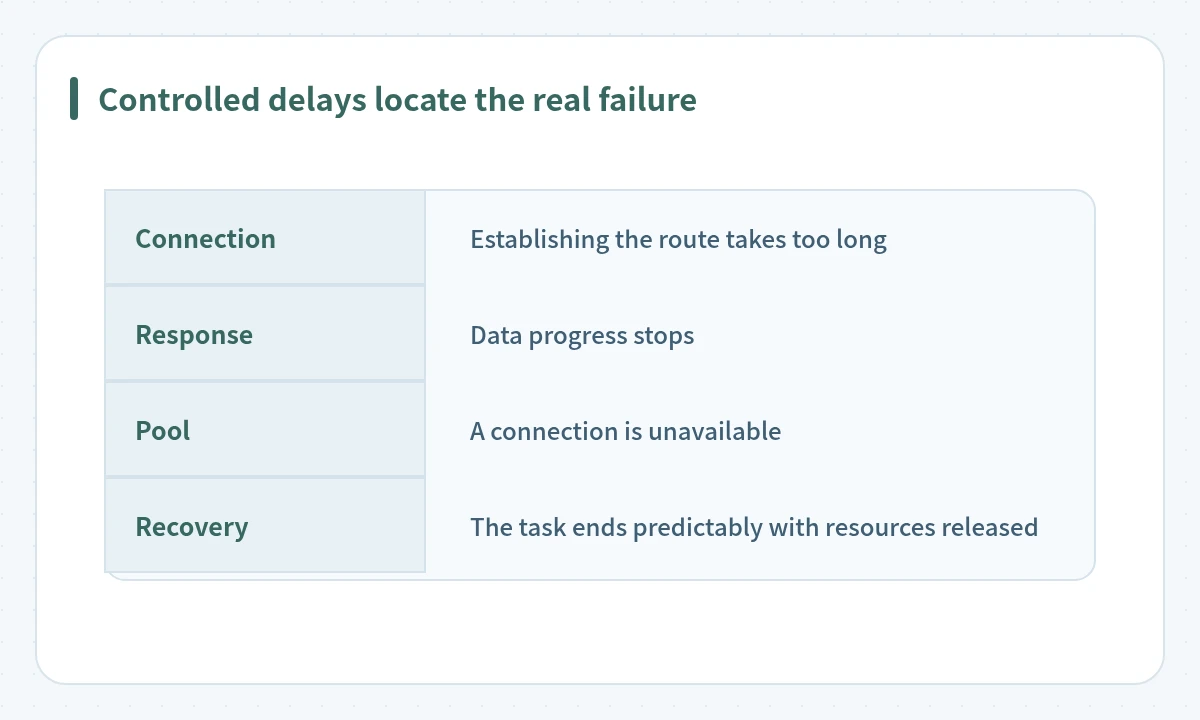
In isolation, simulate a slow connection, a paused response, an occupied connection pool and continuing retry conditions. Inspect failure categories, resource release and the total stopping point. Do not deliberately strain a third-party service to obtain a timeout sample.
Also test a normal response after the configuration change. An excessively tight limit can turn healthy work into repeated failures and additional load. Keep the chosen client, stage and overall budget in the maintenance record rather than an unexplained number of seconds.
The useful outcome is a bounded, interpretable operation: the application knows where waiting happened, what may already have executed and what the supported next step is. A quicker error alone does not establish that recovery or task correctness improved.
Reference: HTTPX: timeout configuration.
