
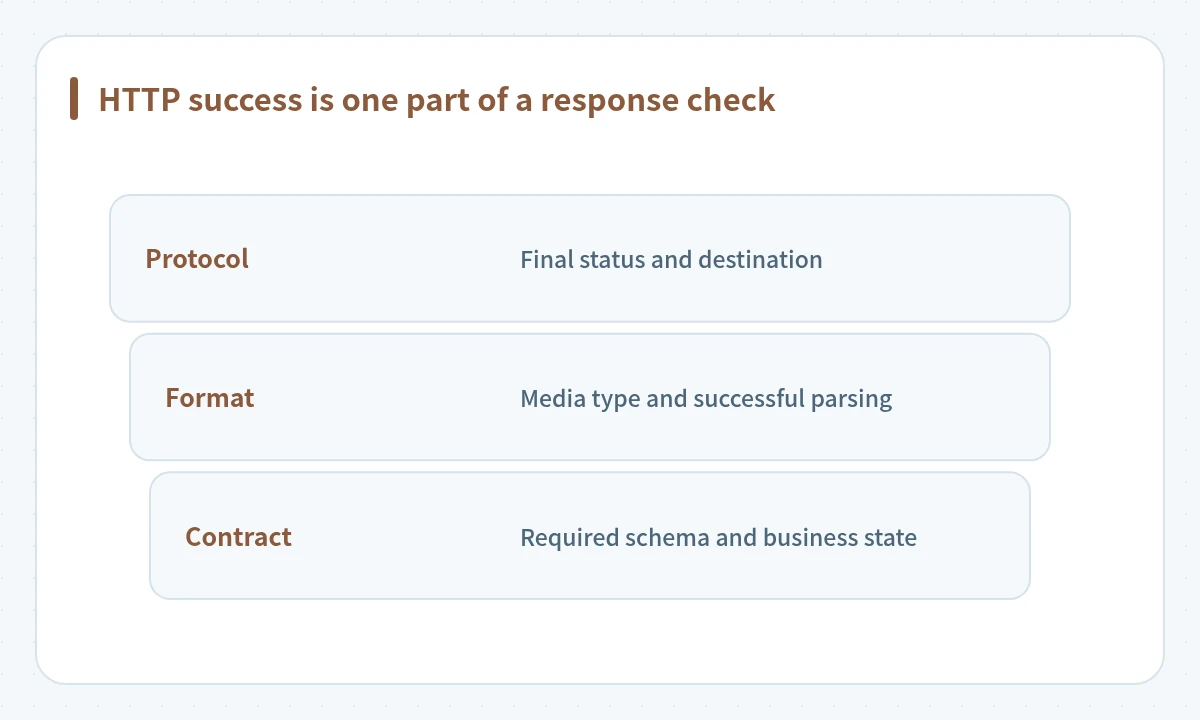
HTTP 200 does not by itself establish that an inbox query returned a valid empty result. Check the expected response format, fields and business result before displaying “no messages.”
Identify what actually answered
Check the final request destination, status, content type and documented response shape. A client that follows redirects can end up at a sign-in page. An intermediary can also return an HTML error document rather than the expected API object. The exact behaviour depends on the deployed path and client configuration.
Do not place the entire response into the user interface just to discover its type. It may contain private message data or internal diagnostics. Retain limited non-sensitive observations, such as the expected endpoint, returned media type and a request reference.
Parsing and validation answer different questions
A body being valid JSON only establishes that it can be parsed as JSON. It could still be the wrong object, an error envelope or a value missing a required identifier. Read the current endpoint schema and verify the fields needed for the intended operation.
| Check | Question answered |
|---|---|
| HTTP result | How did this request complete at the protocol level? |
| Media type and parsing | Can the body be interpreted as the expected format? |
| Schema | Does it contain the required structure and field types? |
| Business state | What outcome does the documented object actually report? |
MDN’s Fetch guidance separates response status checks from reading a JSON body. That separation is useful, but applications still need their own endpoint-specific validation after parsing. A generic successful network helper cannot know whether a missing message identifier is acceptable for your task.
Empty results must remain distinguishable from failures
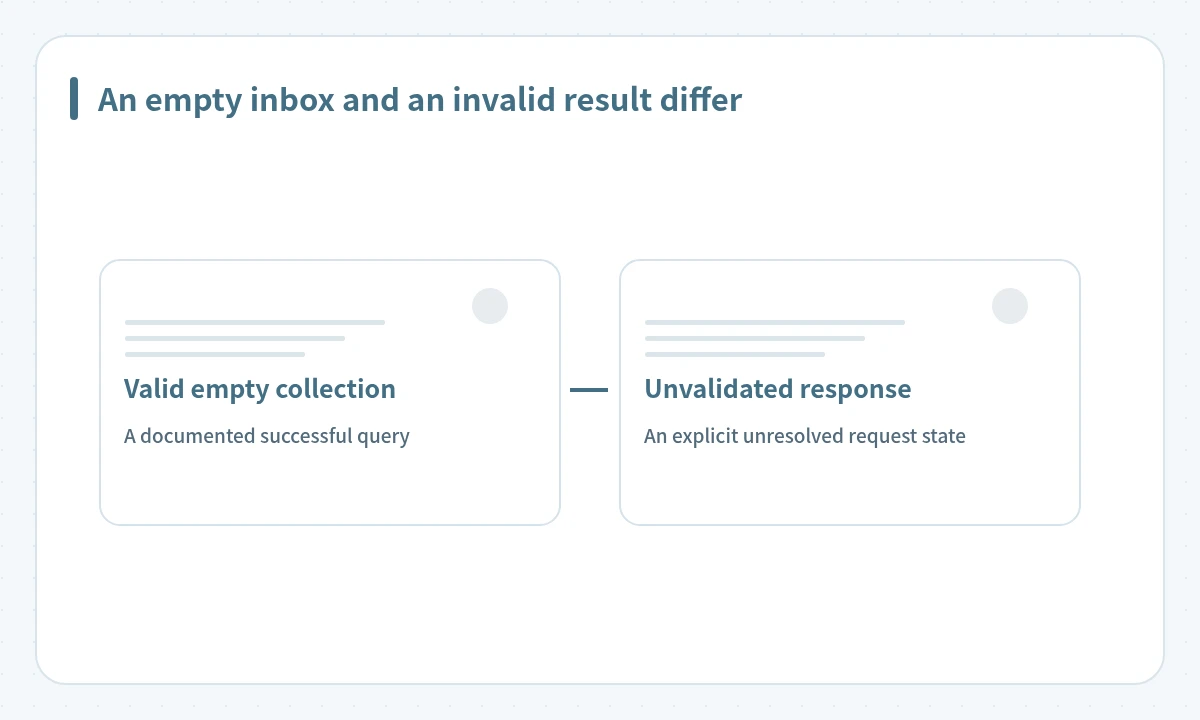
A valid empty message collection may be a normal answer. A response that could not be read or validated is not the same state. Preserve that distinction in the interface and job records; otherwise a transient service defect can look like proof that no messages exist.
Avoid retrying an irreversible operation merely because its response was malformed. The server may have completed the action before the body was lost or changed. Use the provider’s supported operation reference, status query or idempotency mechanism to resolve uncertainty where available.
For an isolated test, provide a valid empty collection, a documented success object, an HTML body, malformed JSON and a JSON object missing the required field. Confirm that each produces the intended state without showing private diagnostics to ordinary users. These are controlled fixtures, not claimed examples of a live provider failure.
A useful incident report states which contract failed and at what boundary. “HTTP 200 with an HTML content type where the API expects a message object” gives a maintainer a concrete starting point. “The request worked but there are no texts” collapses several different possibilities and can send the investigation to the wrong place.
Technical reference: MDN: using Fetch and reading responses.
