
A caller that only queries SMS records should not automatically receive authority to change settings or delete resources. In a private virtual SMS inbox integration, read-only access needs to be enforced by the actual service. Hiding write controls or naming a credential read only does not establish that restriction.
List the operations the caller requires
Identify the endpoints, resources and environment involved. Reading statistics, reading a body and exporting history can be different permissions. Do not treat every GET request as equivalent authority or assume the method name alone proves that an endpoint has no side effects.
Check what scopes the provider really offers. If only broad credentials are available, keep that limitation explicit and assess whether the integration is appropriate. A local nickname cannot narrow the provider’s access model.
Retain a maintenance inventory using credential names or platform references, owners and purposes. It should help locate access without becoming a table of complete secrets. Keep test and production contexts distinguishable.
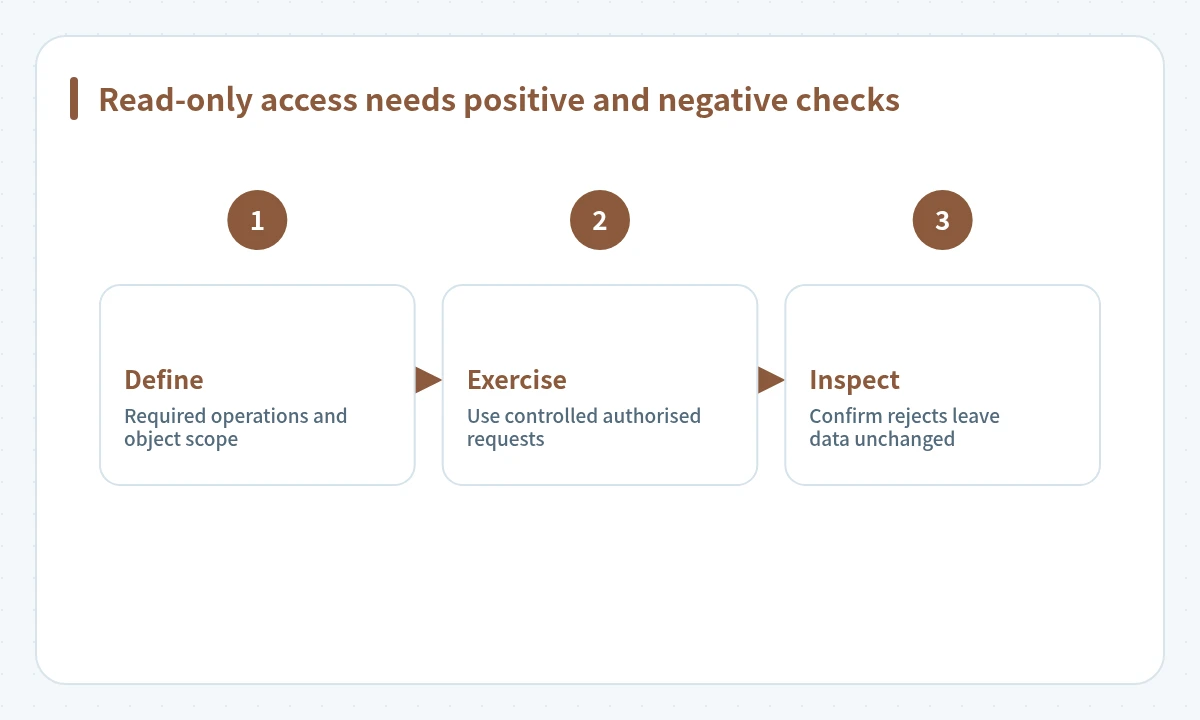
Apply checks at operation and object boundaries
The server should derive identity and authority from trusted authentication, not a role supplied by the client. A valid credential for one receiving resource must not silently become access to every number in an organisation.
Management and ordinary lookup routes may share code while still requiring different checks. Review the actual handler for each necessary operation instead of assuming that a restricted menu corresponds to a restricted API.
Give a third-party process only the supported authority its task needs. Do not place an administrative key in browser code or a public demonstration. A proxy also needs its own fixed scope, rather than forwarding any operation a caller supplies.
Verify prohibited actions safely
In an isolated authorised environment, confirm the allowed non-sensitive reads. Then use controlled fixtures to test that disallowed changes are rejected and the underlying records remain unchanged. An error displayed by the UI is not by itself proof that no write occurred.
Include another resource, another tenant where relevant and a revoked credential. Endpoint restrictions alone may leave object access too broad. Do not use another customer’s real messages to test the boundary.
Keep the allowed resource set reproducible in the test report. A credential can appear read-only while still exposing far more accounts than intended. State which environment and resource were queried so a successful lookup does not hide an overbroad audience.
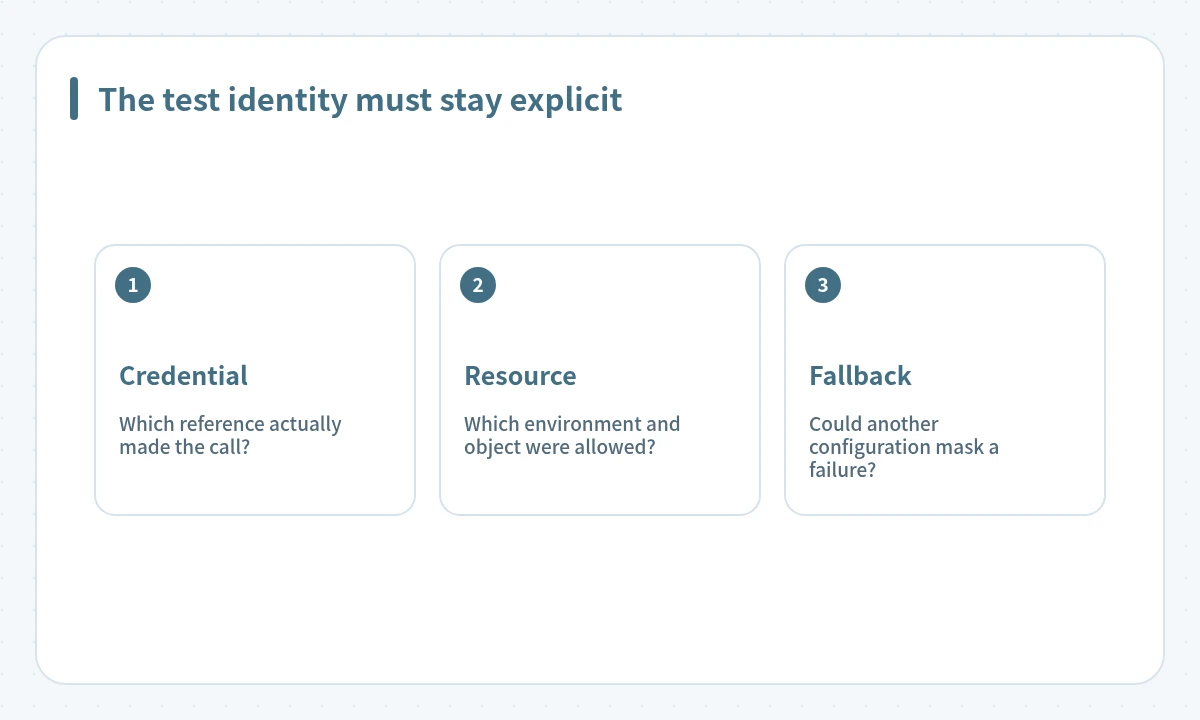
Check what credential actually made the call
If an old or restricted credential appears to succeed unexpectedly, inspect whether the application fell back to another configuration. A cached process or separate worker may use a different value from the one just edited.
Use the program’s supported configuration reload method and retain limited credential references in diagnostic records. Full authentication headers should not be printed merely to compare callers.
After a permission change or handover, revisit the required operations and scope. Read-only access is a specific tested arrangement, not a permanent safety label. It still depends on careful secret handling, account management and the provider’s actual rules. A useful review closes with both permitted operations working and prohibited operations demonstrably constrained under the intended identity.
Reference: OWASP: REST security.
