
An SMS API returning 429 needs a bounded response, not more parallel requests. A no SIM browser text inbox integration should identify the documented limit scope and coordinate waiting, concurrency and task deadlines. Retrying immediately can keep the caller in the same failure pattern.
Read the provider’s waiting signal
Where Retry-After is supplied, its value can be a delay in seconds or an HTTP date. Parse the documented form correctly rather than treating a date string as a numeric interval. The provider’s actual quota and retry guidance still define the surrounding policy.
If no explicit interval is available, use an appropriate bounded backoff strategy and observe its result. Missing or invalid data should not create either a tight retry loop or an unlimited wait that occupies the task indefinitely.
The documented quota can attach to an account, credential, endpoint or resource. Record that scope alongside the waiting signal and the relevant interval. A resource-specific limit belongs with that resource’s task rather than an unexplained global unavailable flag.
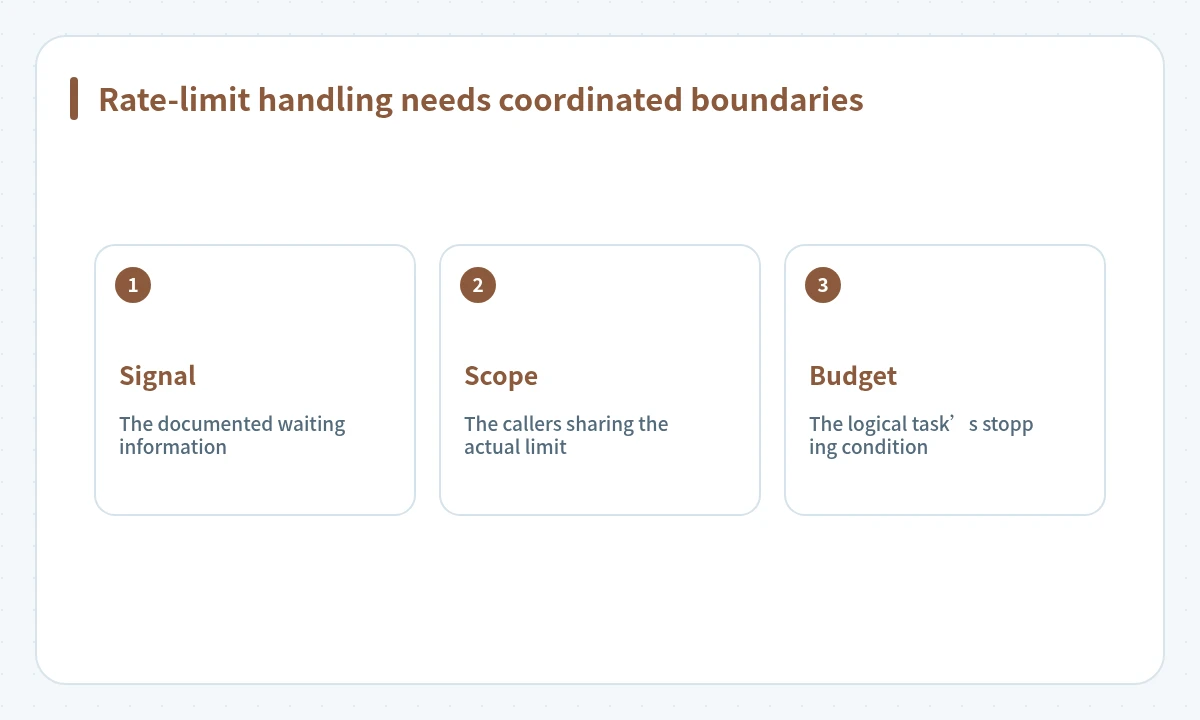
Coordinate callers sharing the same limit
Several workers using one credential can each pause and then resume together, producing another peak. Control concurrency and scheduling at the relevant scope. A large history task should not silently consume every opportunity needed by other supported work.
Do not rotate accounts, credentials or network sources to evade the provider’s restriction. Keep the integration within the actual service arrangement. A harder-to-trace call path does not establish legitimate capacity.
Where randomised delay is appropriate to the chosen design, it can reduce synchronised retries, but it does not replace an overall bound or documented waiting requirement. Record which part of the behaviour comes from the provider and which part is the application’s own policy.
Recheck whether the task should continue
A user may leave the view or change the query while work waits. An old read may no longer be useful. A state-changing request has another concern: its result and duplicate controls need their own treatment rather than being handled as an ordinary lookup.
Keep one logical task with its attempts, wait reason and next allowed action. Recreating a new task on each attempt can hide total effort and make cancellation ineffective. Monitoring should distinguish waiting, limited and completed states.
If the response supplies quota metadata, preserve its documented units and scope. A remaining value for one interval should not be treated as an unrestricted global allowance. Compare the caller’s shared state with the provider’s actual definitions, and avoid making admission decisions from an unlabeled number that another endpoint counts differently.
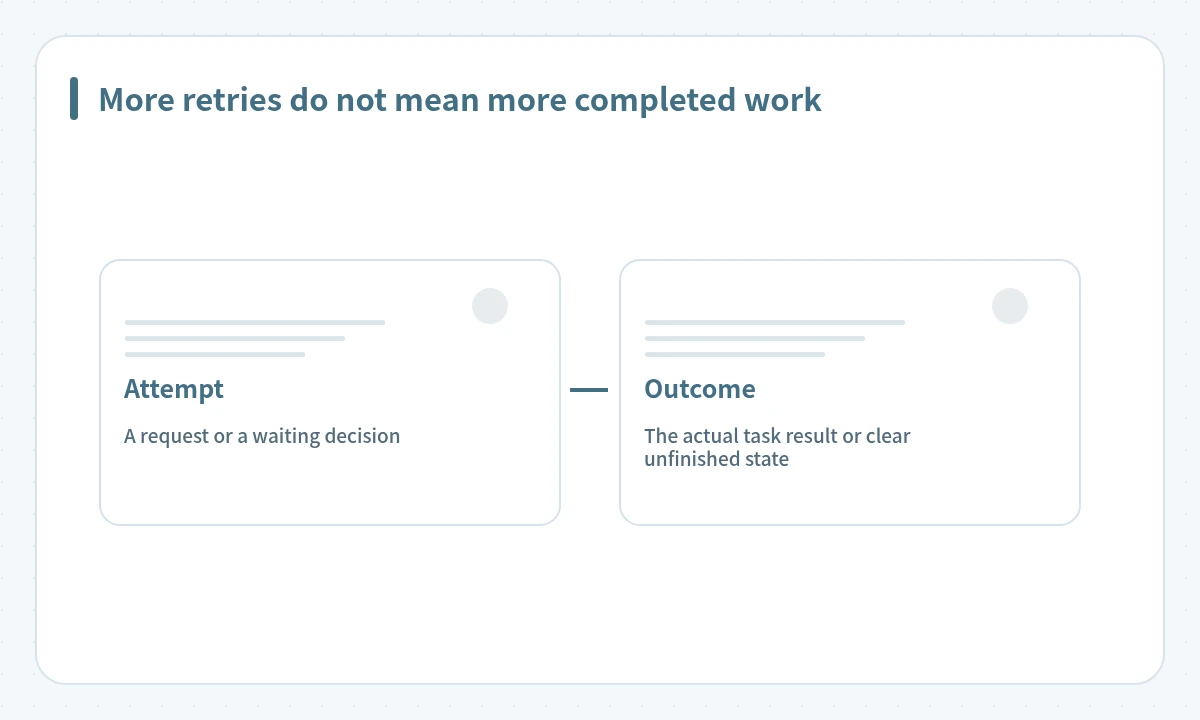
Verify the policy with controlled responses
Use a test receiver to return delay seconds, a date, no waiting header and persistent limits. Include task cancellation and several callers under one defined limit. Inspect the actual waiting and concurrency, not only the error shown in the browser.
Do not intentionally flood the real provider to manufacture an example. Harmless fixtures can establish the client policy without consuming another service’s capacity or collecting live SMS data.
Check the normal success path too, including whether waiting tasks release resources appropriately. The closing record should explain when a retry may occur, why attempts stop and what remains unfinished. Making the error disappear briefly is less useful than maintaining a predictable request pattern under the documented contract.
Reference: MDN: Retry-After.
