
New messages can change an inbox dataset between page requests. Define the collection window and the API’s pagination rules before treating a completed loop as a complete export.
A moving list is not automatically a snapshot
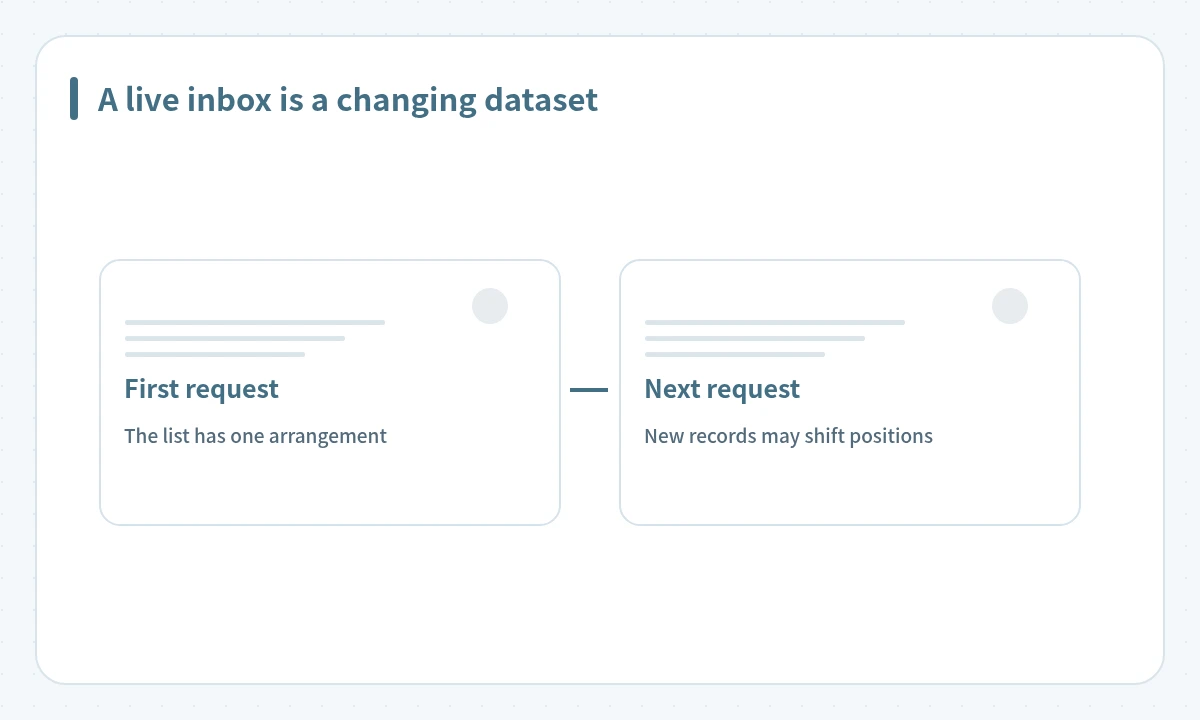
Suppose an endpoint returns the newest records first. With offset-based pages, a new record at the beginning can shift older rows between page requests. The same row may then appear twice. Deletions or changes can create other gaps. This is an illustration of changing-list behaviour, not a claim about a particular provider’s implementation.
Read the API’s pagination contract. Does it supply a next-page link or cursor? Is the ordering documented? Are date filters inclusive, and can more than one record share the same timestamp? A cursor should be treated as the provider defines it, not assumed to guarantee snapshot consistency.
Set a collection boundary you can explain
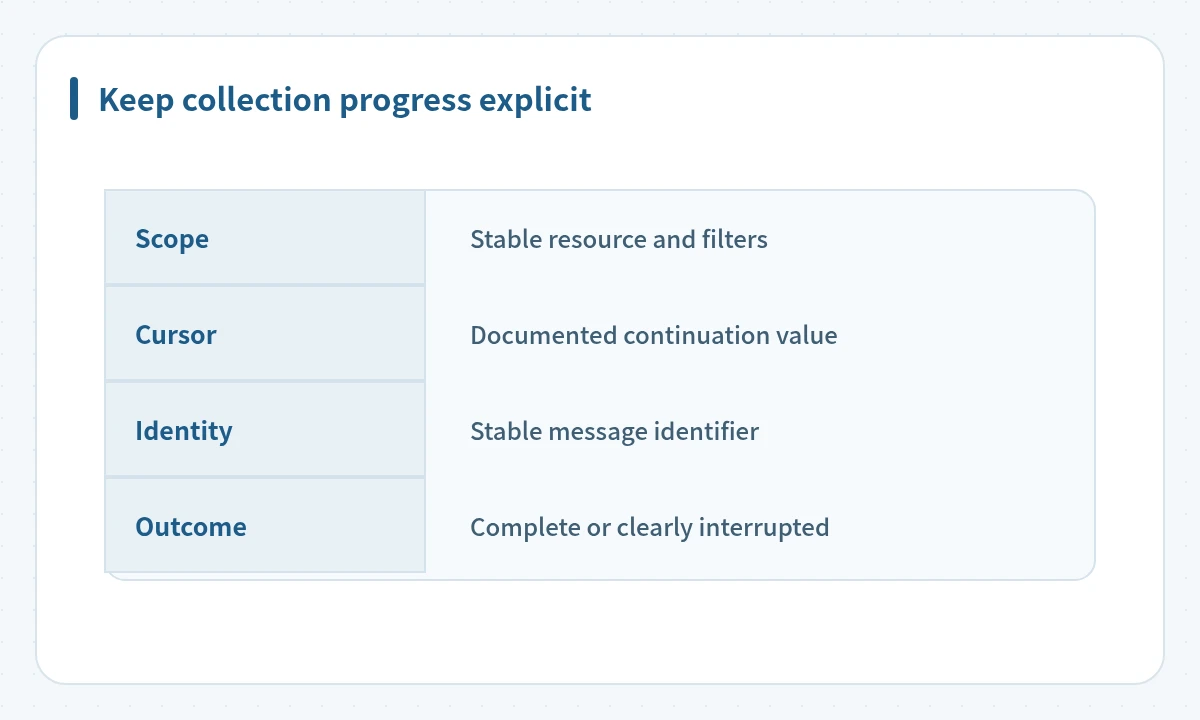
For a historical report, use documented start and end conditions where available. As an illustrative collection plan, a run beginning at 14:00 UTC can retain that chosen cutoff throughout the run, if the endpoint supports the required filter. Keep the resource, direction, filters and ordering constant while following its continuation mechanism.
A timestamp alone may not identify a record uniquely. Use the provider’s stable message identifier for duplicate detection, and preserve the original timestamps with their defined meaning. If the API lacks sufficient guarantees for exact historical completeness, state that limitation instead of manufacturing a total from the number of pages fetched.
| Collection property | What to keep |
|---|---|
| Scope | Resource and unchanging filters |
| Progress | Documented continuation reference |
| Identity | Stable message identifier |
| Outcome | Completed, interrupted or incomplete |
Resume without silently changing the request
Save progress only after successfully storing the corresponding page. If a transfer stops, resume according to the provider’s documented continuation lifetime and ordering rules. A saved cursor may expire; restarting with a clearly recorded overlap can be appropriate where supported, provided stable identifiers prevent double counting.
Distinguish a failed page request from an empty successful page. A timeout, rate limit or authentication error should not be converted into “no more messages.” That shortcut makes an interrupted extraction look complete. Use bounded retries and preserve a clear failure state when the job cannot safely continue.
For a harmless test, create authorised records with distinguishable identifiers, introduce new records between page requests, and verify which ones the collector stores. Also test interruption after storage but before the next checkpoint. The purpose is to evaluate your collector’s assumptions, not to claim the provider has a defect because a live list changed.
A browser’s displayed total is not an independent completeness certificate for an API job. Compare like-for-like scope and query times. Twilio’s Message resource is one example of an API documenting pagination fields; the exact strategy must follow whichever endpoint your integration actually uses.
API reference: Twilio: Message resource and list response.
