
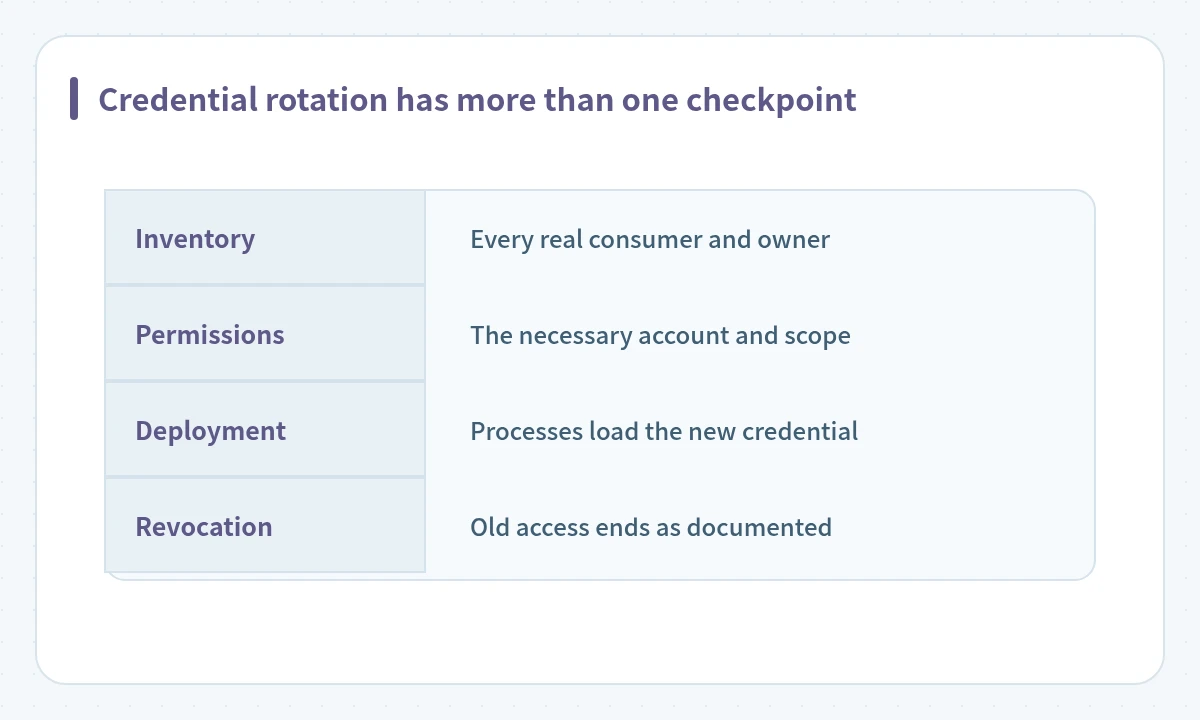
Key rotation should establish that the new key performs necessary tasks and the old key is revoked. Inventory consumers such as scheduled tasks and queue workers rather than checking one configuration file alone.
Inventory consumers without copying secrets
List the actual applications and tools: receiving integrations, history readers, media retrieval, scheduled jobs and maintenance scripts where they exist. Record their owners, environments, account scopes and credential identifiers. Keep the secret itself in controlled storage, not in the inventory or a support ticket.
Check how each consumer loads configuration. A long-running process may need a supported reload or redeployment, while a scheduled job may read its setting only when it starts. A file containing the new value is evidence about that file, not about every running process.
Use the provider’s supported transition model
Some services permit multiple active keys and a short controlled overlap; others require a different rotation procedure. Establish the actual model before planning a zero-interruption change. Twilio’s API-key documentation discusses separate credentials and their lifecycle, but another provider can have different permission, region and revocation rules.
Verify the new credential against the correct account and environment with the permissions the task requires. Prefer an authorised low-impact operation rather than provisioning a paid resource or sending a real business message just to prove authentication works. A failed read does not automatically justify assigning unrestricted administration rights.
Record the actual deployment or load time, credential identifier and verification outcome for each consumer. Keep an unsuccessful consumer visible instead of marking the whole application switched. Before revocation, review unresolved dependencies against the change plan. If a planned transition cannot finish, give it an explicit owner and decision rather than silently extending the old credential’s lifetime.
Inventory credentials by purpose too. An API access key, a webhook-verification secret and a browser session may have separate lifecycles. Rotating one should not be recorded as rotating the others unless the provider explicitly couples them. Keep the relevant checks attached to the credential that actually changed.
Include the low-frequency jobs
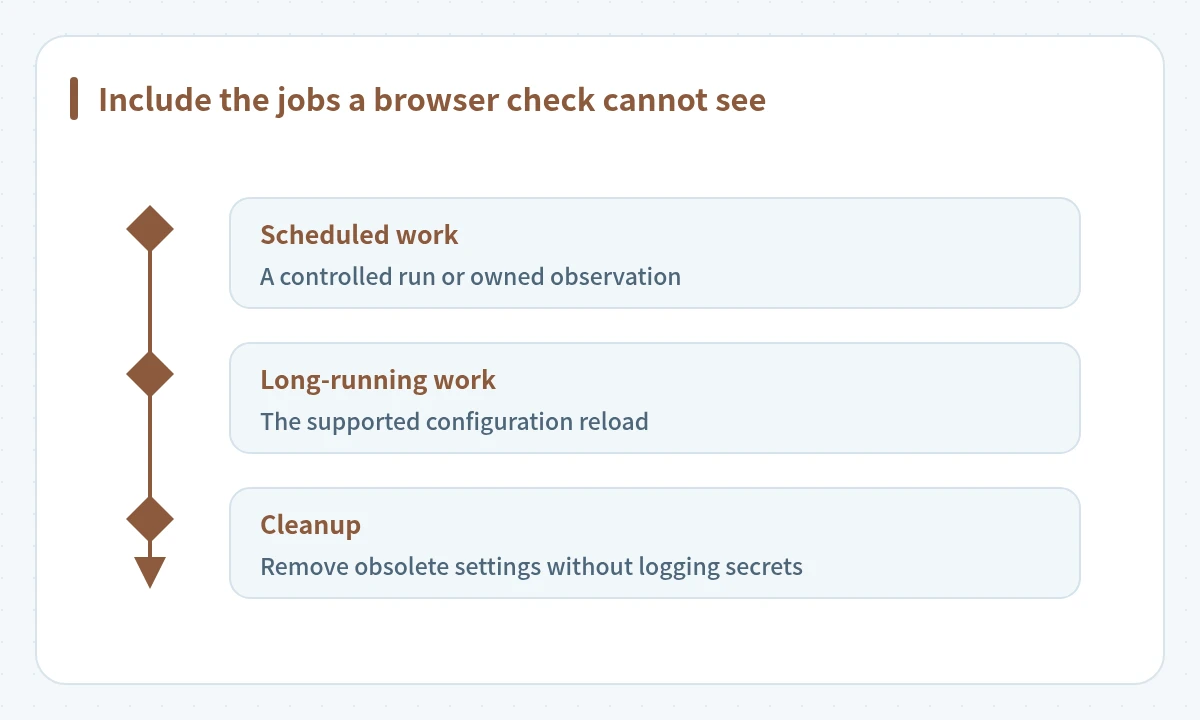
A job that runs tonight may expose a missed dependency that the current browser session cannot. Arrange a permitted controlled check or a clearly owned observation window. Do not close the change merely because the interactive query path looks healthy.
Confirm revocation within your authorised scope. An old-key request failing for an unrelated network problem does not establish that the key was revoked. Use the provider’s supported management state and an appropriately bounded check of the resulting access behaviour.
Treat an exposed key as an incident
If the old secret was exposed, follow the incident response requirements rather than extending overlap indefinitely for convenience. The replacement must not be distributed through public chat, front-end JavaScript or an indexable page. A careful rotation should not recreate the exposure that prompted it.
Finish by updating the inventory, removing obsolete configuration and handling temporary copies. Retain a change record that contains identifiers and outcomes without secrets. That gives the next operator a way to locate a forgotten consumer reporting old-credential errors without circulating the credential again.
Reference: Twilio: API-key scope and lifecycle.
