
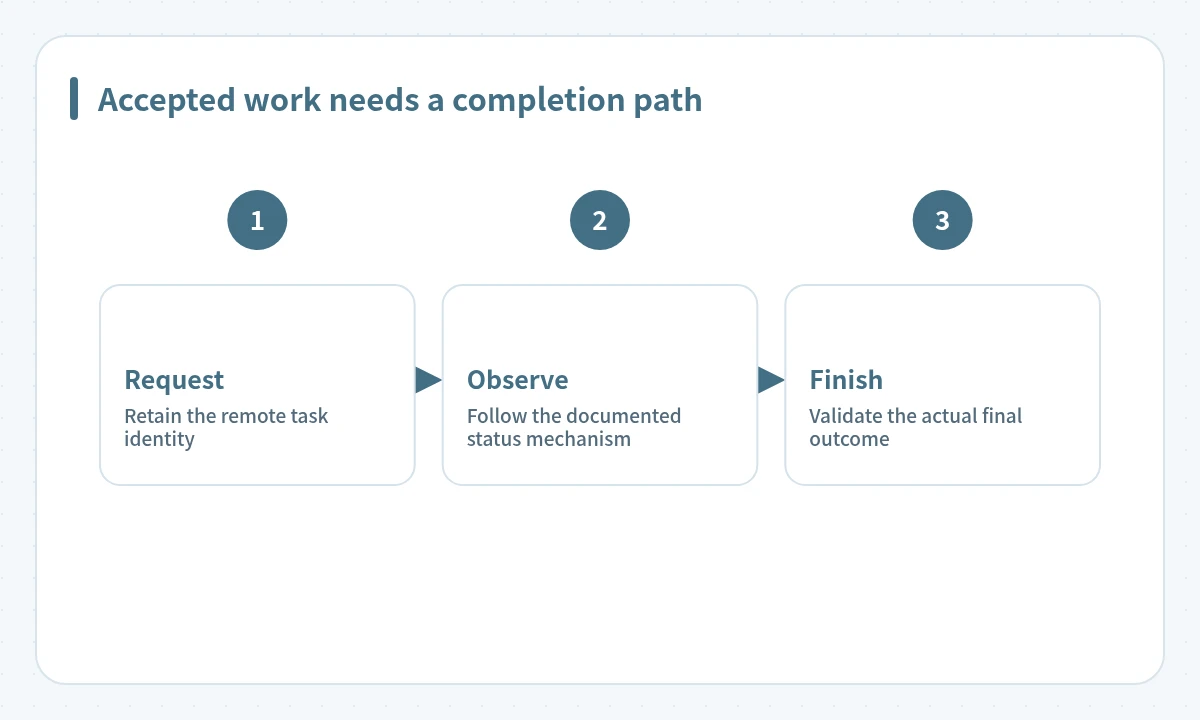
HTTP 202 means a request was accepted for processing. Follow the documented task identifier, status endpoint or completion notification before presenting the business action as complete.
Save the task before leaving the request screen
Look for the task identifier, status resource, callback arrangement or other documented way to observe completion. A 202 response does not itself provide a later final response, and processing can still fail. If the API describes no follow-up mechanism, ask the provider how completion is established rather than inventing a status URL.
Associate the remote task with the local business request. The interface can say that processing is pending and provide a way to resume checking it. Closing or reloading the page should not lose that association or silently submit the same operation again. Number provisioning and export generation, for example, need their own actual state definitions; neither should borrow a message-delivery label by convenience.
A waiting limit is not a remote cancellation
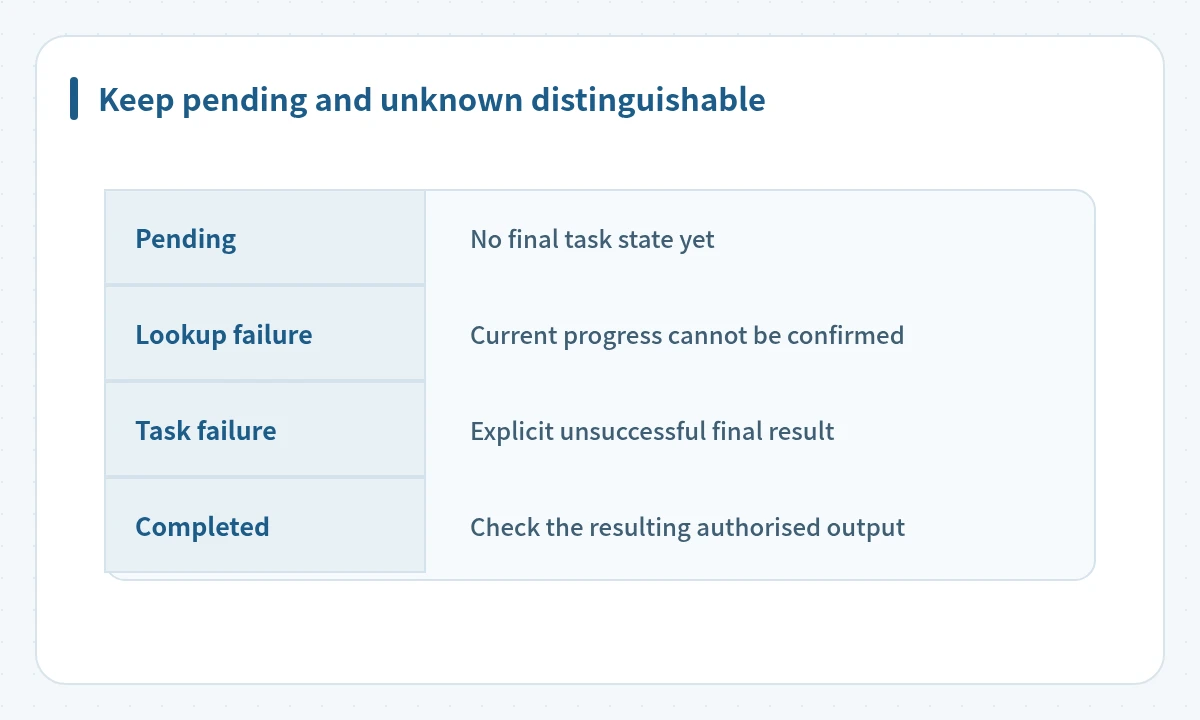
| Known state | Appropriate handling |
|---|---|
| Accepted, no final state | Keep the task pending |
| Status lookup temporarily failed | Retain the task and explain the uncertainty |
| Explicit task failure | Show the documented reason and permitted next step |
| Explicit completion | Validate the resulting resource or output |
Your application stopping its wait after ten seconds does not establish that the remote service stopped work. Before repeating creation, check for supported idempotency, status lookup and cancellation. Do not assume that a new request identifier prevents duplicates; it may instead identify another chargeable or consequential operation.
Cancellation needs its own state check. A user pressing Cancel may only submit a cancellation request while remote processing continues. Read the documented cancellation outcome and handle a task that completed before cancellation took effect. Keep this result attached to the original task instead of treating a dismissed progress dialog as proof that no action occurred.
A task identifier is a correlation value, not a substitute for authorisation. If the API returns a status URL, use it through the documented authenticated route and keep any credential-bearing URL out of ordinary logs. A support operator should only be able to inspect tasks within the account scope they are permitted to manage.
Give unresolved tasks an owner
For polling, follow the service’s interval and rate guidance. For callbacks, apply its authentication requirements and handle duplicates or out-of-order updates. If both mechanisms exist, use a shared transition policy so a late pending update cannot overwrite a previously established final result.
Define when a task needs manual attention, who can investigate it and how long the supporting records remain available. An operator should be able to resume from the task identifier without asking the user for an entire message history. Unknown and failed are different conditions and should remain distinguishable in the support interface.
Acceptance fixtures should include completion, explicit failure, a temporary lookup outage and a task that outlives the local waiting window. Check the displayed state and the actual output in each case. A completion notice should lead to the authorised result when one exists, rather than repeat the initial API acknowledgement as though it were fresh evidence of success.
Reference: MDN: 202 Accepted.
