Read state helps locate messages; assignment tells people who owns the work. Keep the source record, responsible person and next action distinct, especially at a shift change.
Separate three questions
Has anybody noticed the message? Who is dealing with it? What happened next? These questions often collapse into a single read or unread marker, even though they describe different events. A colleague can read a request and realise it belongs elsewhere without being able to resolve it.
The opposite also happens: a message can remain unread in one interface after work has been completed in the business system. Before interpreting a marker, find out whether it is personal to a user, shared across the workspace, or merely a filter maintained by the current page. If the documentation does not say, treat it as an interface aid rather than an authoritative team record.
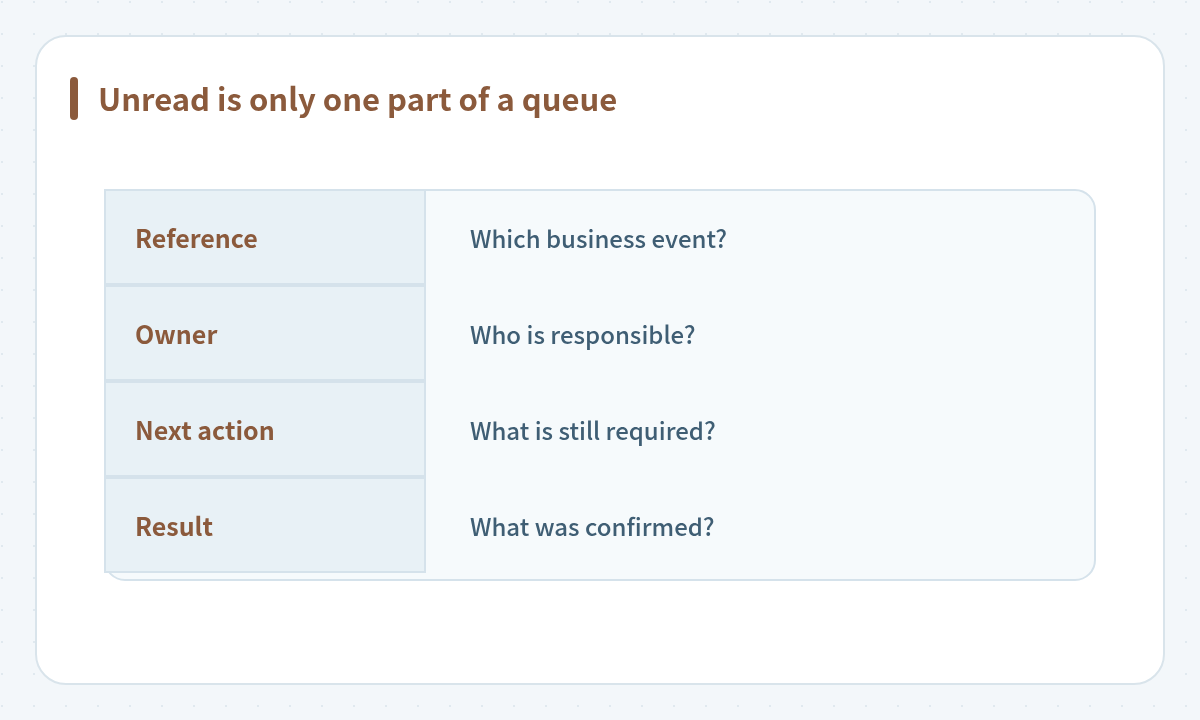
Agree on the smallest useful work record
A workable queue needs a reference to the message or business event, a responsible person, a current state and a next action where one is necessary. Those fields do not have to live inside the receiving product. Use an existing task system if the inbox does not provide assignment, rather than implying that a feature exists because it would be convenient.
Avoid copying complete text histories into a second tool just to establish ownership. A minimal reference and a short description of the required work may be enough. The person assigned still needs the appropriate access to the original record; putting their name in a spreadsheet does not grant it.
For a simple example, a message reports that a pickup window has changed. One person can confirm the relevant booking, another can contact the customer if that is their responsibility, and the task record can show what remains. There is no need to mark every incoming text as urgent, or to create an action for a message that is purely informational.
Make handover a deliberate event
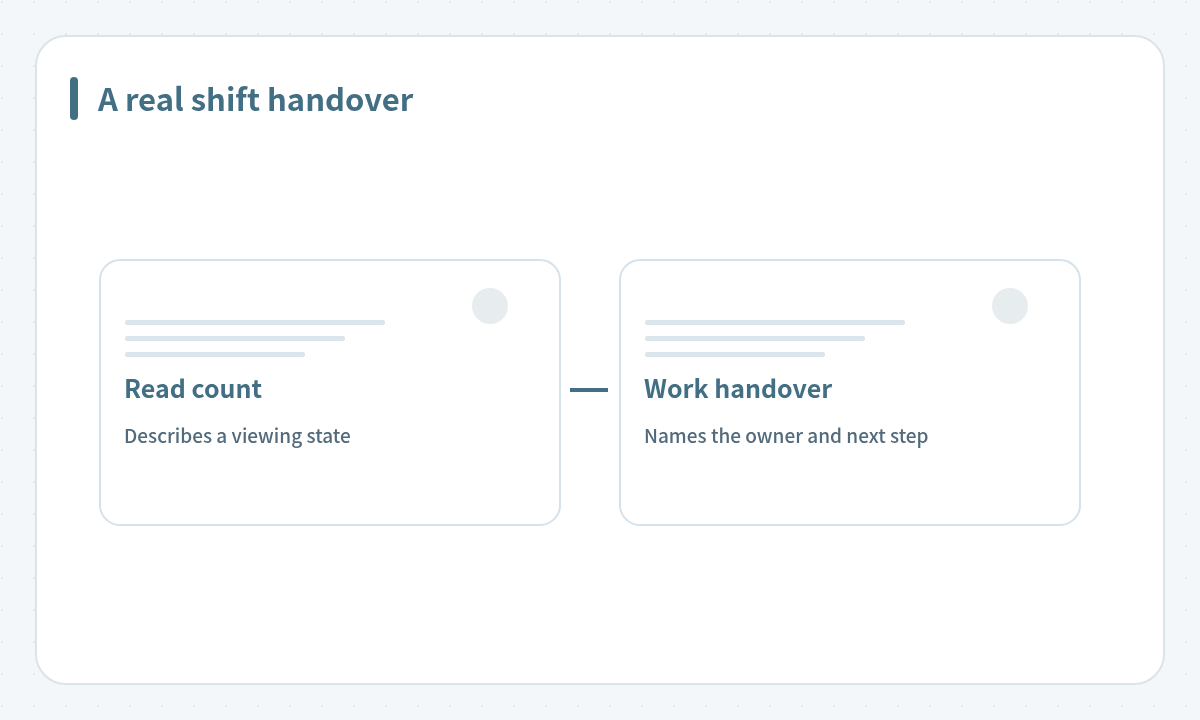
At the end of a shift, identify unresolved items and say who should pick them up. “Everything has been read” is not a handover. Mention the next required action, any business deadline and whether the latest state has been checked in the original service.
The incoming colleague should be able to distinguish a new request from a reminder about an already open issue. Use the business reference and context, not just an identical sender name. A conversation may contain several separate tasks, while several messages may describe one task. The queue should follow the work rather than count every row as a new obligation.
If the usual person is absent, there should be an agreed way to reassign the work. Do not solve this by sharing private credentials or asking colleagues to approve each other's login requests. The role responsible for a task and the identity authorised to enter an account remain separate matters.
Do not use deletion as a queue state
Removing a record simply to make the list look clear can erase the reference needed by the next person. Whether deletion is reversible, personal or shared depends on the product; none of those behaviours should be assumed. Handle retention according to the actual work requirements, separately from assignment.
If the inbox has no suitable task status, leave the source record alone and track progress in the existing authorised work system. Agree how a colleague follows the reference without receiving an unnecessary copy of private message content.
An acknowledgement can leave work unfinished
A colleague may acknowledge a pickup change but lack authority to contact the customer. The work record should name the next authorised handler and show that confirmation is still pending, rather than closing the item because it was opened.
Use assignment controls only if the tool provides them; otherwise keep a minimal reference in the existing restricted task system. Do not delete source messages simply to create an empty queue.
Close the loop without manufacturing certainty
A completed task should have a result that another authorised person can understand: the booking was checked, a reply was sent through the correct channel, or no further action was required after verification. Do not record “customer informed” merely because an outbound request was submitted or because a message appeared as read.