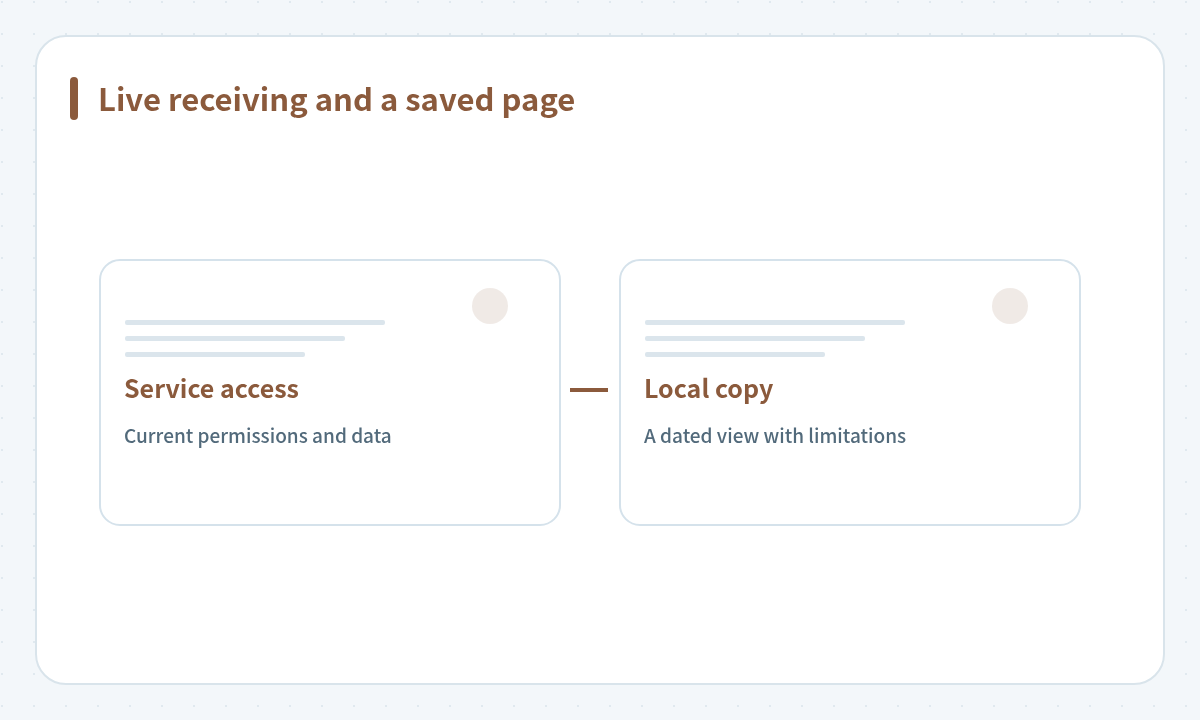
A saved webpage is a copy of material available at capture time. It does not preserve receiving rights, a live session or future messages, and it may omit dynamically loaded details.
Begin with the purpose of the copy
If you need one message for a legitimate work record, look for the service's supported export or record-saving method. Saving an entire interactive page may include surrounding controls while omitting the data you actually need. A file opening successfully is not enough to establish that the relevant message and context were preserved.
Choose the necessary scope. A record may need a recipient identifier, timestamp meaning and business reference, but it rarely needs unrelated message histories. Do not collect more just because the browser's save command operates on a whole page.
Keep the original service and time of capture identifiable. A local file's name or modification time is not necessarily the message's receiving time. If you add a note explaining when it was saved, distinguish that note from fields originally supplied by the service.
A saved page may depend on more than one file
Depending on the saving method, a page may refer to images, styles, scripts or other resources. Some content may have been loaded dynamically rather than preserved in the file you see. The result can look complete in the original session but fail to show the same information later.
Use an appropriate, controlled environment to check the saved material. Do not upload private files to an unfamiliar online preview or conversion tool merely because the browser display is inconvenient. Opening a saved page can also involve external resource requests depending on its content; do not assume every saved web file is a self-contained, inert document.
A supported export and a saved page serve different purposes. Neither should be described as reproducing the service's full search, access controls or history unless the actual format and documentation establish that. If the file is incomplete, retain that limitation rather than manually inventing missing fields.
It cannot extend a temporary arrangement
A local copy cannot assign the number again, deliver future messages or restore an expired account session. A saved sign-in button or visible resource label is not authority to continue using an arrangement after its conditions have ended.
If future access is required, resolve that with the actual provider while normal access is available. Do not plan to recover a time-limited task by reopening an old HTML file. The target business's current request and the receiving service's current permissions still need confirmation through their normal interfaces.
A screenshot has similarly limited scope. It may preserve one visible view, not all rows or hidden details. The choice between a screenshot, supported export and another record method should follow the work you need to do, rather than the assumption that any downloadable object is a complete backup.
Check the copy against its intended purpose
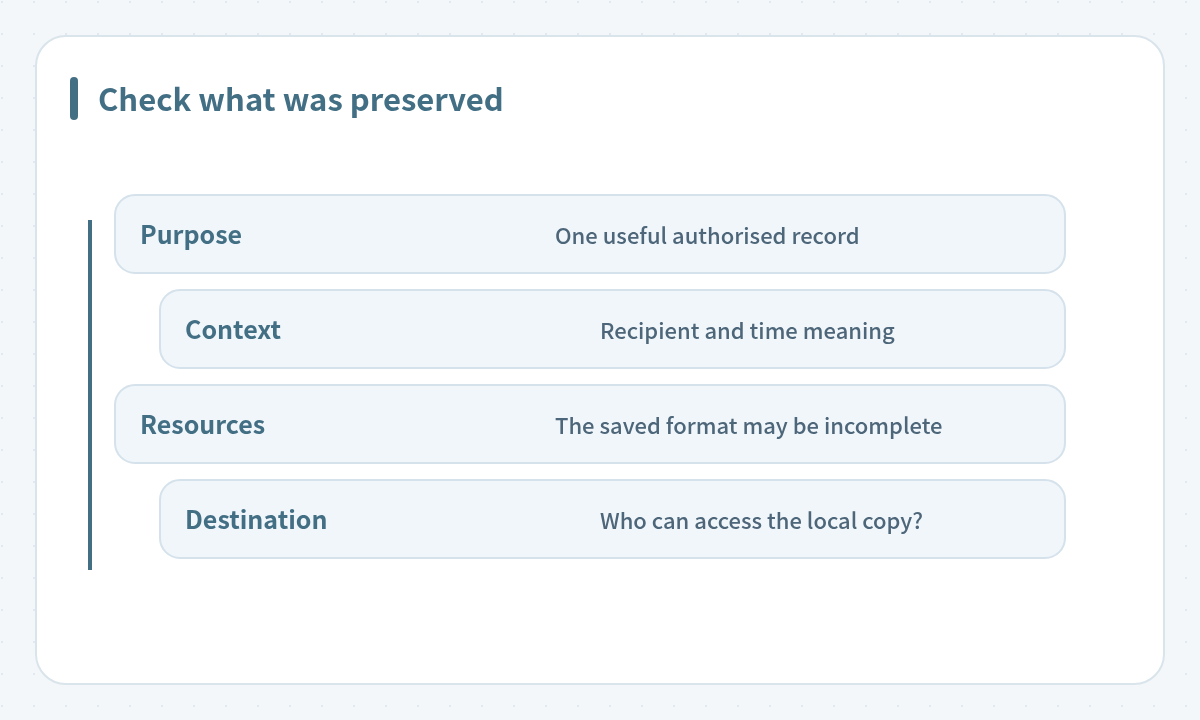
If you need one work record, confirm the required text, recipient and time context actually appear in the saved material. A file opening without error does not prove completeness or reproduce the service’s search and permissions.
Prefer a supported record method where available, and inspect its controlled storage destination. Do not upload a private page bundle to an unfamiliar preview tool simply because it is difficult to open.
Review the local destination too
Check whether the file was saved to a personal download folder, a shared work location or a synchronized directory. Its access scope can differ from the inbox that originally protected the message. Copying material out of a private account creates a new place that needs its own handling.
If other people need the record, give authorised recipients the minimum useful material through an appropriate channel. Do not send a bundle of active session links, private message bodies and browser resources simply to help someone open one relevant item. Ask for a supported alternative when the saved result is difficult to interpret.