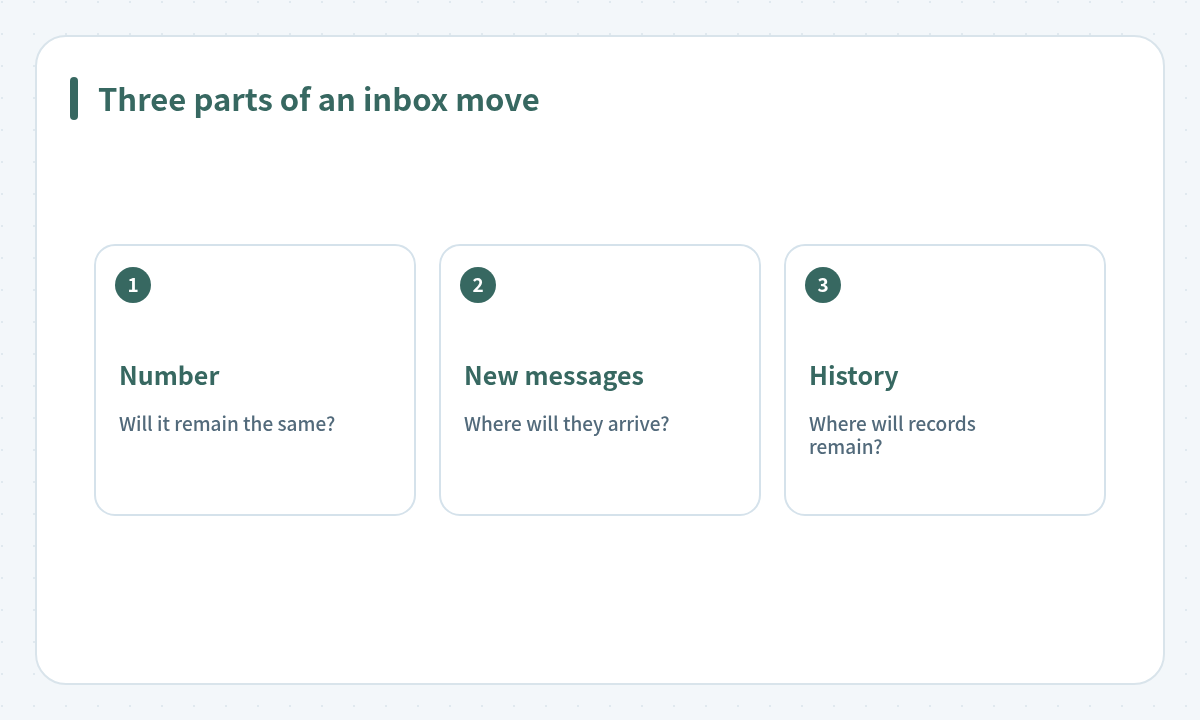
An inbox change can alter the receiving number, the route for new messages or access to old records. Confirm which project the providers actually support before choosing a transition date.
Is the number staying the same?
You may be changing only the authorised interface for an existing service, transferring an eligible number through a documented process, or replacing it with a different number. These are different projects. A label such as “fixed” describes neither a universal transfer right nor a guarantee that every destination will accept the resource.
Ask the actual providers about the specific number, account authority, receiving capability and required process. Do not begin by assuming that a number format, country code or previous successful text establishes eligibility. If the answer is unavailable, keep it as an unresolved condition rather than setting a switch-over date around a guess.
List the things that depend on the old arrangement
Identify authorised senders, business records that display the number, and accounts that use it for notifications or recovery. Keep these separate from the inbox login itself. Being able to sign into the new service does not show that a third-party account has updated its recipient information.
If the number will change, update those dependencies through each service's official process while you still have normal access. Some changes may require verification or an alternate recovery method. Do not cancel the old arrangement first and then discover that confirmation is still being sent there.
If the number is expected to stay the same, verify the exact receiving scope after the change. Avoid substituting a random test for the intended message type. A successful ordinary text does not establish acceptance of every verification sender, nor does it confirm support for pictures, replies or other messaging products.
Historical messages need a separate decision
New receiving access may have no relationship to old records. Ask what happens to the existing inbox history, whether a supported export exists, and how long access remains available. Do not promise colleagues that every message will appear in the new interface unless the actual process confirms it.
Where records need preserving, select only what the business purpose requires and keep their original context. Record the source, recipient number, timestamps and any relevant reference. Store the material in an appropriate controlled location rather than importing private text histories into an arbitrary conversion website.
An exported file is a copy, not continued access to the old service. It may be useful for reference without reproducing search behaviour, attachments or account permissions. Check that the retained material is actually readable before relying on it as the only available record.
Name a clear point for new work
The team needs to know which arrangement is responsible for newly expected messages. Write down the agreed transition point using the actual provider's process, and keep the old and new record locations distinguishable. Do not merge histories merely because they show the same number.
During verification, identify whether a sample was sent before or after that point and which receiving interface recorded it. This does not establish a universal interruption period; it simply prevents a historical message from being mistaken for evidence that the new path works.
When communicating the change to colleagues, state what remains uncertain. “New inbox access is confirmed; historical records remain in the previous system” is a useful distinction if it reflects the verified arrangement. Saying that everything has moved when only the login has changed creates work that will later be difficult to trace.
Make acceptance specific to the change
If only the interface changes, check the intended authorised reading path. If the number changes, confirm external contact updates separately. If history remains behind, identify its approved location and access deadline.
Use a sample clearly sent after the agreed transition point to test new receiving. Keep any overlap or rollback dependent on the actual provider process; neither transfer eligibility nor instant reversibility follows from the label “fixed number.”
Write a go-or-stop decision before the switch
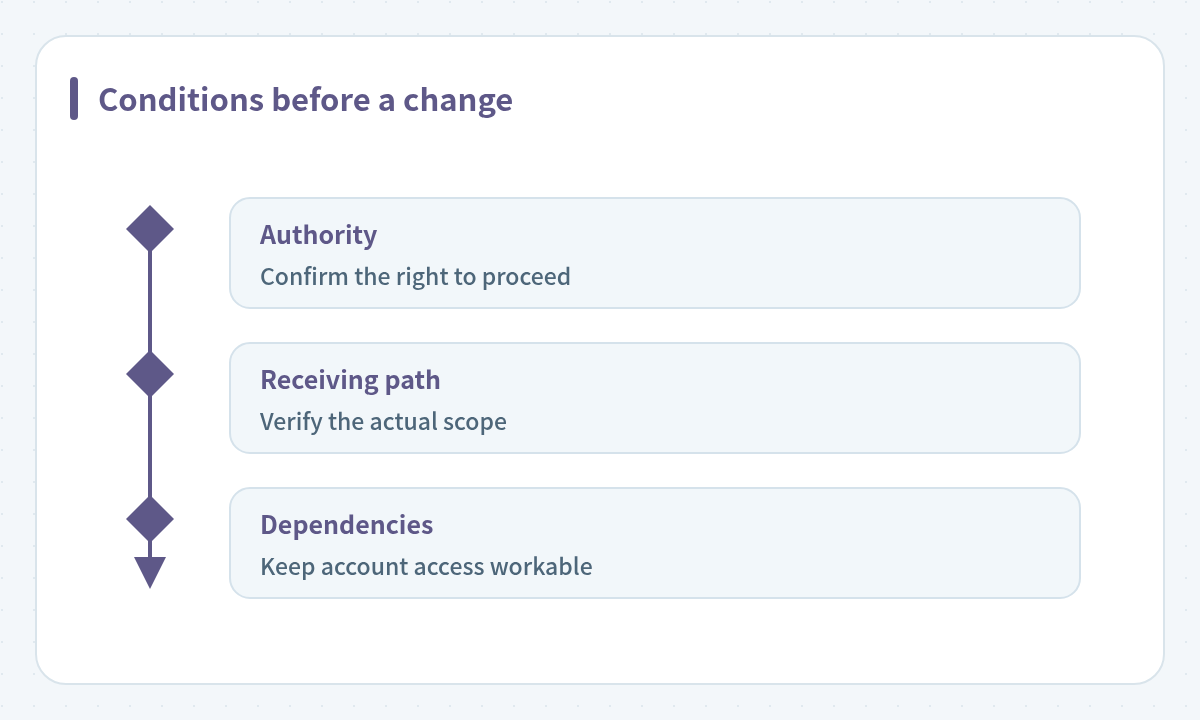
Define what must be true for the move to proceed: authorised control is confirmed, the receiving arrangement is understood, necessary dependent accounts have a workable path, and required records have been handled. Name who will check the new receiving path and who can decide to pause.
If a test fails, investigate which condition failed instead of repeatedly changing settings at both ends. Keep the previous working arrangement available where the agreed process permits it; do not assume that every transfer or cancellation is instantly reversible. Any overlap, interruption or rollback arrangement must come from the real providers.